Hundreds of billions of dollars are being poured into AI infrastructure right now — data centers, chips, power deals — on the bet that AI revenue eventually catches up to the spending. Some of the smartest analysts on Wall Street think that bet is sound. Others think it’s the most obvious bubble since the dot-com crash. Both sides have real evidence.
We ranked the five clearest warning signs by how seriously the market itself is taking them — from “worth watching” to “already causing real damage.” We also included the strongest counter-argument at the end, because a fair read on this requires both sides.
5. Customer concentration risk
The mildest signal on this list, but a real one: a huge share of AI infrastructure demand is coming from a small handful of hyperscale customers. CoreWeave, one of the largest AI cloud providers, got 67% of its FY2025 revenue from a single customer — Microsoft — up from 62% the year before, even after adding OpenAI, Meta, and Anthropic as clients. If one major buyer slows its spending, the shockwave hits everyone downstream who built capacity assuming that demand was permanent.
Why it’s ranked lowest: concentration risk is a known, manageable category of business risk — it doesn’t by itself prove a bubble, just that the industry’s foundation currently rests on fewer pillars than it looks like from the outside.
4. The debt is enormous, and profits haven’t caught up yet
Morgan Stanley projects $250–300 billion in debt issuance in 2026 from hyperscale tech giants alone, funding infrastructure builds that don’t yet have matching revenue. CoreWeave, the most-watched case study, illustrates the pattern directly: Microsoft accounted for 67% of its FY2025 revenue (up from 62% the year before), the company carried roughly $35 billion in debt on its balance sheet as of its Q2 2026 earnings, and net interest expense alone hit $640 million in that single quarter — more than double what it was a year earlier. Net losses widened to $626 million in the same quarter, even as revenue more than doubled year-over-year.
Why it’s ranked here: heavy debt funding fast growth that still isn’t profitable is exactly the shape of the dot-com telecom buildout, where companies laid 80.2 million miles of fiber optic cable, 76% of all U.S. digital wiring at the time, only to leave 85% of it unused for years. The comparison is direct enough that even bubble skeptics acknowledge the historical echo — though it’s worth noting CoreWeave’s revenue backlog has also grown to over $100 billion, which bulls point to as evidence the debt is buying real, contracted future revenue, not speculation.
3. Hardware ages faster than the buildings holding it
GPUs can lose most of their economic value within a few years, while the buildings, power connections, and fiber routes around them can stay useful for decades. That mismatch means a data center can be a genuinely sound long-term asset while still representing billions in prematurely obsolete hardware sitting inside it — a risk investors don’t price the same way as physical depreciation.
Why it’s ranked mid-list: this is a real structural risk unique to this AI boom (the dot-com era didn’t have an equivalent “hardware ages in 3 years” problem at this scale), but the underlying real estate often survives the correction, unlike the AI chips inside it.
2. Microsoft already pulled back — and the wider industry is missing its own targets
Analysts at TD Cowen reported in 2025 that Microsoft had canceled or deferred data center lease agreements totaling more than 2 gigawatts across the U.S. and Europe, tied to a cooling in its relationship with OpenAI — and that signal has kept getting cited through 2026 as an early warning that proved out. It has: industry trackers now estimate that of the roughly 12 gigawatts of new U.S. data center capacity that operators committed to deliver in 2026, only about a third has actually broken ground, leaving a shortfall equivalent to 30-70 mid-size AI facilities that were promised but aren’t materializing on schedule.
Why it’s ranked this high: unlike theoretical debt-load arguments, this is confirmed, repeated evidence that announced capacity and delivered capacity are diverging — first at one company, now industry-wide. That moves it from “hypothetical warning sign” to “already happening, and getting worse.”
1. Local opposition is now blocking billions of dollars in projects outright
This is the strongest, most concrete signal on the list, and it’s not financial — it’s political. Data Center Watch counted at least 75 U.S. data center projects worth roughly $130 billion blocked or delayed by local opposition in just the first quarter of 2026, driven by concerns over water use, electricity prices, noise, and pollution. Polling shows 71% public disapproval of data centers sited in their own area.
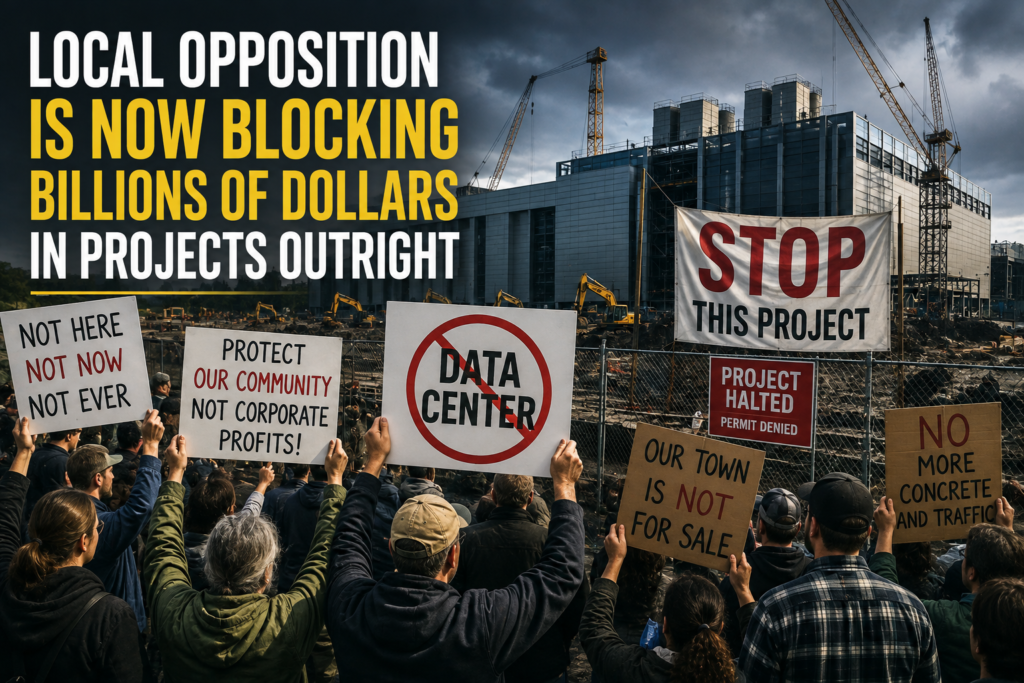
Why it’s ranked highest: every other signal on this list is a financial bet that might or might not pay off later. This one is happening right now, is already measured in tens of billions of dollars, and adds an entirely new constraint — “permission to operate” — that the industry didn’t have to plan around five years ago. Capital and chips can be raised faster than local trust can be rebuilt.
The strongest counter-argument
It’s not one-sided. UBS’s own analysts dismissed bubble concerns outright in mid-2026, pointing to record-low vacancy rates across North America (1.8%), Europe (3.6%), and Asia-Pacific (5.8%), alongside $17 billion in early-stage generative AI annual recurring revenue already on the books. CBRE data shows data center inventory in the largest North American markets still grew 33% year-over-year in early 2026 — and demand kept outpacing it. The counter-case isn’t “there’s no risk” — it’s that the actual usage numbers, not just the spending numbers, still support the buildout for now.
The bottom line
The financial argument for a bubble (debt, hardware depreciation, customer concentration) is real but not yet conclusive — vacancy rates and revenue growth are still backing up the spending, for now. The argument that should worry you more is the non-financial one: local communities are already blocking tens of billions of dollars in projects today, not hypothetically. Whatever happens to the financial bubble question, the “consent” bottleneck is reshaping how and where this industry can build, right now, regardless of which side of the debate turns out to be right.
Figures compiled from Morgan Stanley, CoreWeave’s Q2 2026 earnings and SEC filings, TD Cowen analyst notes, Sightline Climate, Data Center Watch, UBS Evidence Lab, and CBRE market data, current as of August 2026. This is market analysis, not financial advice — if you’re making investment decisions based on this trend, talk to a licensed financial advisor who can look at your specific situation.
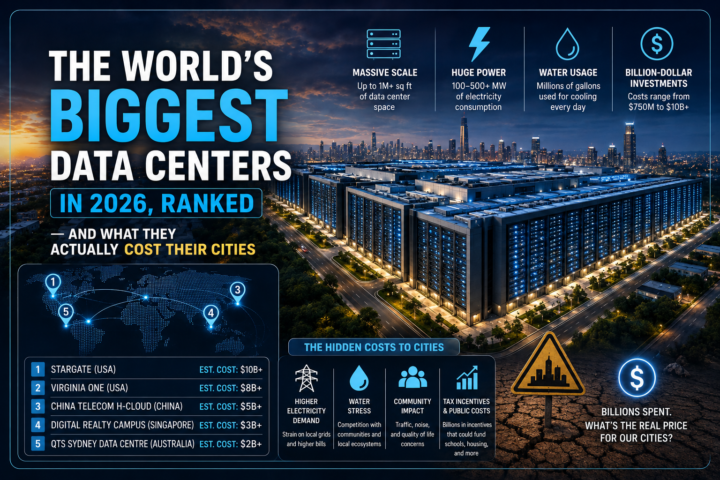
Read: The World’s Biggest Data Centers in 2026, Ranked — And What They Actually Cost Their Cities