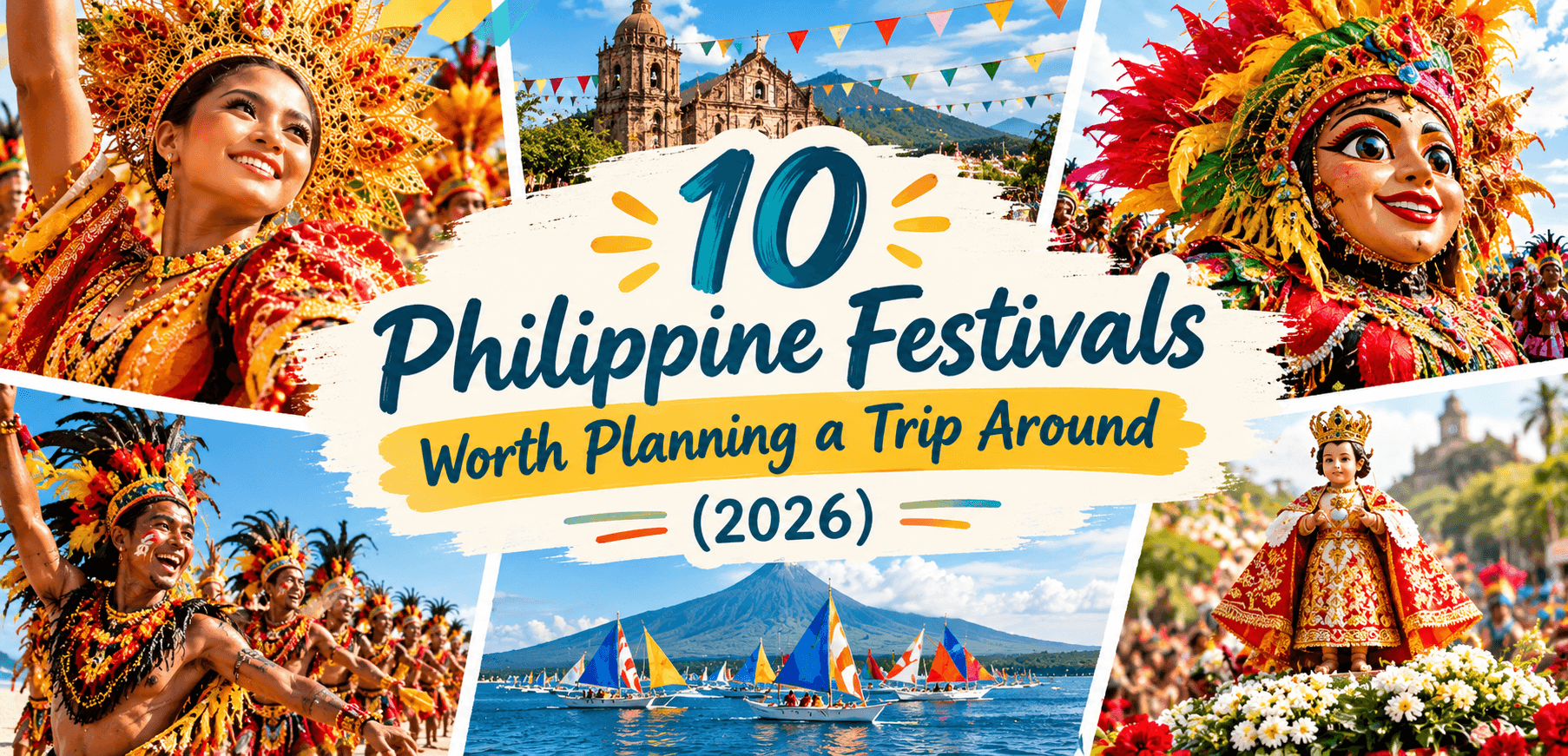
The Philippines holds thousands of festivals a year — more than almost any other country on earth, by most tourism-board estimates. Most tourists stumble into one by accident. The smarter move is picking your trip dates around one on purpose, since these events transform a city for days: streets close, hotels fill months in advance, and the entire place runs on festival energy instead of its usual rhythm.
We ranked ten of the most worth traveling for, in calendar order, with the real history behind each one, the specific 2026 schedule, and what actually catches first-timers off guard — so you can build a trip around whichever one fits, not just admire a list of festivals you’ll never time right.
January: Sinulog, Cebu City (Grand Parade: January 18, 2026)
The biggest single-day crowd of any festival in the country — organizers are bracing for 4 to 5 million visitors in Cebu City alone for 2026. Sinulog traces back to 1521, when Ferdinand Magellan presented a Santo Niño statue to Cebu’s Queen Juana; the dance itself — a distinctive two-steps-forward, one-step-back shuffle mimicking the flow of a river current — evolved from that moment and was formally organized as an annual festival in 1980.
The full season actually runs December 27, 2025 through January 23, 2026, built around nine consecutive days of Novena Masses at the Basilica Minore del Santo Niño, but nearly everyone means the Grand Parade — Sunday, January 18, 2026 — when they say “Sinulog.” For 2026, organizers moved the main competition hub back to the Cebu City Sports Center (Abellana) and the classic Osmeña Boulevard street loop, after using a more spread-out venue in prior years — which means denser crowds in the city center than recent editions.
The insider move most guides miss: the Sinulog sa Kabataan (Youth Festival) happens a full week earlier, on January 10, at the same venue. You get the same dances, the same costumes, without the multi-million-person crowd — genuinely the smartest option if you’re traveling with family or want usable photos.
Book ahead: hotels fill months out; expect prices to double or triple during festival week. Major roads (Osmeña Blvd, D. Jakosalem, Magallanes St.) close January 5–18. A liquor ban runs 6 a.m. to 8 p.m. on both January 17 and 18. If Cebu City itself is full, Mandaue, Lapu-Lapu, and Talisay are workable nearby alternatives with easier access.
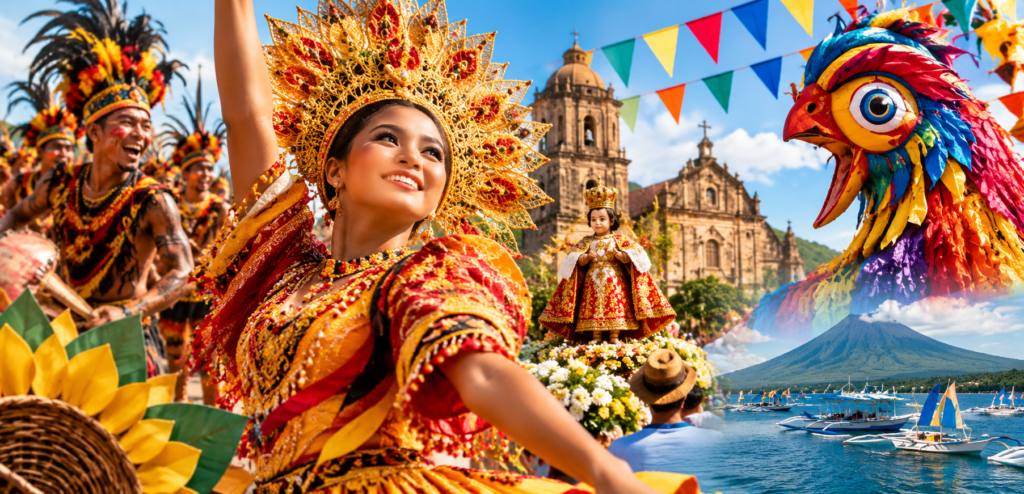
January: Ati-Atihan, Kalibo, Aklan (Third Sunday of January)
Widely called the “Mother of All Philippine Festivals” and considered the oldest of the country’s Santo Niño street festivals — locals trace its roots back centuries, well before Spanish colonization blended in the current Catholic framework. What sets it apart from Sinulog and Dinagyang: Ati-Atihan is genuinely participatory. Face paint and tribal-inspired costumes aren’t just for performers — visitors are actively invited to join the dancing in the streets, chanting “Viva Santo Niño!” and “Hala Bira!” alongside everyone else, rather than watching from behind a barrier.
If you’re already routing through Boracay in January (a short ferry-and-drive connection away), staying a few extra days in nearby Kalibo for this is genuinely worth the detour — and far less crowded than Sinulog the same week.
February–March: Panagbenga, Baguio City (February 1 – March 8, 2026)
The most forgiving festival on this list for scheduling — it runs over five weeks, so you don’t need to hit one exact date. Panagbenga (Kankanaey for “season of blossoming”) was born directly out of tragedy: the 1990 Luzon earthquake devastated Baguio, and the festival began in 1996 as a deliberate act of civic recovery, choosing flowers and celebration as the response. 2026 marks its 30th anniversary, themed “Blooming Without End.”
The actual 2026 calendar: Opening Parade February 1, Grand Street Dance Parade February 28, Grand Floral Float Parade March 1, and a closing ceremony with fireworks on March 8. Baguio’s naturally cool mountain climate — a genuine relief if you’re visiting from anywhere else in the tropics — makes this one of the most physically comfortable festivals on the list to actually spend hours walking around in.
What catches people off guard: Kennon Road, the fastest route up from Manila, has remained closed to tourist traffic in recent years, forcing a detour via Marcos Highway that can stretch the usual 4-hour drive to 7-9 hours during peak festival traffic. Organizers are projecting roughly 2 million visitors into a city built for a permanent population of about 350,000 — book accommodations as early as you can, since major hotels routinely hit 95% occupancy by December for a February festival.
Local tip: try the strawberry taho — a festival-season specialty you won’t find the rest of the year.
March/April: Moriones, Marinduque (Holy Week 2026: March 29 – April 5)
The odd one out on this list, in the best way — genuinely quiet and reflective rather than loud and crowded, if that’s more your pace. The tradition began in the Spanish colonial period, when a local priest in Mogpog envisioned a way to make Holy Week’s Passion narrative come alive through public performance. Locals wearing elaborate, hand-carved wooden Roman centurion masks reenact the biblical story of Longinus — the soldier said to have pierced Christ’s side and was later healed and converted — across all six municipalities of Marinduque, with the largest gatherings in Boac, Mogpog, and Gasan.
The week builds gradually: a Senakulo (passion play) on Holy Wednesday, an intense Via Crucis reenactment at noon on Good Friday, and the climactic Pugutan — the ritual “beheading” of Longinus — on Easter Sunday itself, where performers remove their masks in a moment of thanksgiving.
Getting there: from Manila, take a bus to Lucena Port (₱400–500), then a RORO ferry to Balanacan or Cawit Port — total travel time runs 6-8 hours door to door. The festival has been recognized as a National Cultural Treasure and is a candidate for UNESCO Intangible Cultural Heritage status. There’s no entrance fee, though supporting local stalls is the expected courtesy. Since dates move with Easter’s calendar every year, always confirm the current year’s exact schedule before booking rather than assuming last year’s dates apply.
May: Pahiyas, Lucban, Quezon (May 15, 2026)
A harvest festival honoring San Isidro Labrador, the patron saint of farmers, built entirely around food in the most literal way possible: entire house façades along the parade route get decorated with kiping — colorful, leaf-shaped wafers made from rice paste, dyed and sun-dried until they turn translucent — alongside real fruits, vegetables, and woven local crafts, turning the whole town into an edible art installation for one day. Homeowners compete for the most striking display, and it’s genuinely one of the most Instagram-able festivals in the country precisely because none of it is staged for cameras — it’s a real, centuries-old harvest tradition that photographs beautifully as a side effect.
Pair the visit with Lucban’s own longganisa (the town’s distinctive garlicky sausage) and pancit habhab (noodles traditionally eaten off a banana leaf, no utensils) — this is genuinely one of the best food-focused festival stops on the entire list.
August: Kadayawan, Davao City (August 7–31, 2026, grand parade on August 16)
A month-long thanksgiving celebration for Mindanao’s harvest and cultural diversity, officially opened with a ceremonial gong strike led by Davao’s 11 deputy mayors, each representing one of the city’s indigenous ethnolinguistic tribes. The 2026 edition carries a ₱68 million city budget — the largest in the festival’s history — and organizers are targeting roughly 250,000 tourist arrivals. (If Kadayawan has you thinking about more than just a visit, see our full cost-of-living breakdown for Davao — it topped our ranking as the most affordable major city on the list.)
The main event — the Pamulak floral float parade and Indak-Indak street dancing competition — falls on August 16, 2026, with August 14 declared a special non-working holiday in Davao City specifically so residents can fully participate without missing work. The festival celebrates Davao’s icons — Mount Apo, the durian fruit, the waling-waling orchid, and the Philippine Eagle — through performances drawn directly from the traditions of the city’s indigenous peoples, alongside a month-long Agri-Trade Fair (running August 7–23) showcasing the region’s produce.
Food: stalls lean hard into local specialties — durian, marang, and fresh seafood, if you’re brave enough for the durian, which Davao takes seriously enough to have named a whole festival icon after it.
September: Peñafrancia, Naga City (fluvial procession September 19, feast day September 20, 2026)
The largest Marian devotion in Asia, and one of the most genuinely moving religious events to witness in person even without a personal connection to the faith. The devotion traces back to 1434 in Spain, when a hidden image of the Virgin Mary was discovered on a mountainside; it reached the Philippines in the early 18th century after a seriously ill Spanish seminarian, Miguel Robles de Covarrubias, credited a holy card of the image with his recovery.
The modern procession tradition began in 1864: nine days before the feast, the sacred image is carried from its shrine to Naga Metropolitan Cathedral in the Traslación (September 11, 2026), followed by nine days of novena masses, culminating in the Fluvial Procession on September 19 — where devotees, traditionally exclusively men (the magdadaragat), wade into the Bicol River or crowd onto small boats to pull the image’s barge by rope, competing simply to be near it as thousands more watch from the riverbanks by candlelight.
Practical note for 2026: the Philippine Bar Examinations fall on September 6, 9, and 13, and a major teachers’ licensure exam lands on September 20 — the exact same day as the feast. Testing centers within Naga City will generate their own localized traffic and noise restrictions, worth factoring into any tight itinerary.
October: MassKara, Bacolod City (throughout October)
Known as the “Festival of Smiles” — and unlike almost every other festival on this list, it has no religious origin at all. Bacolod created it in 1980 during a genuine crisis: the global collapse of sugar prices (Negros Occidental’s core industry) coincided with the sinking of the passenger vessel MV Don Juan, which killed hundreds, many from the province. The city’s response was deliberate — artists and local officials organized a festival built around smiling masks specifically to declare that Bacolod would survive and recover, no matter how bad things looked. The name itself is a portmanteau: “mass” (a multitude of people) plus the Spanish “cara” (face).
Modern MassKara draws over 3 million visitors across roughly 20 days of programming, and now includes an “Electric MassKara” night parade with illuminated floats alongside the traditional daytime mask parade. Pair it with Bacolod’s famous chicken inasal — this city takes its food as seriously as its festival, and inasal is the specific dish locals will point you toward first.
December: Giant Lantern Festival, San Fernando, Pampanga (weekend before Christmas Eve)
The single best night to time a Philippine Christmas trip around, in a country that already runs the longest Christmas season in the world, starting as early as September. The tradition traces back to 1904 in nearby Bacolor, as a modest, two-foot lantern procession called “Ligligan Parul,” carried barrio to barrio during the nine-day Simbang Gabi novena leading up to Christmas Eve. It moved to San Fernando alongside the provincial capital that same year, and the decisive turning point came in 1931, when electricity was introduced — transforming a simple religious procession into the elaborate, technically complex lantern showcase it is today.
Modern giant lanterns can stretch over 15 feet in diameter, built by dedicated local teams who operate thousands of synchronized, computer-choreographed lights in a genuinely spectacular nighttime competition — the achievement has earned San Fernando the nickname “Christmas Capital of the Philippines.”
How to actually plan around one
Book accommodations 3-6 months out for the major ones (Sinulog, Panagbenga, MassKara, Kadayawan) — rooms in the host city sell out completely, not just get pricier, and this is confirmed by organizers themselves for 2026’s editions.
Pack for standing in crowds for hours: comfortable shoes, a power bank, light clothing, sunscreen, and a reusable water bottle cover almost every festival on this list.
Bring cash. Festival-week vendors and smaller transactions frequently don’t take cards, especially in smaller host towns like Lucban or Marinduque.
If you want the parade but not the crush, staying near the route but not directly in the main square usually gets you a good view with an actual ability to move — or, where available (Sinulog’s youth festival is the clearest example), attend the smaller preview event a week earlier instead of the main day.
Dates verified against official sources where available — Davao City’s Tourism Operations Office and Malacañang’s proclamation for Kadayawan, the Naga City Investment and Tourism Promotions Office for Peñafrancia, the official Panagbenga 2026 calendar via the Philippine Information Agency, official Sinulog Foundation schedules, and the confirmed 2026 liturgical calendar for Holy Week/Moriones — plus established travel guides and historical sources for the remaining festivals. Several dates (particularly Moriones, tied to Holy Week) shift yearly; always confirm the current year’s exact schedule before booking, especially for festivals more than a year out.