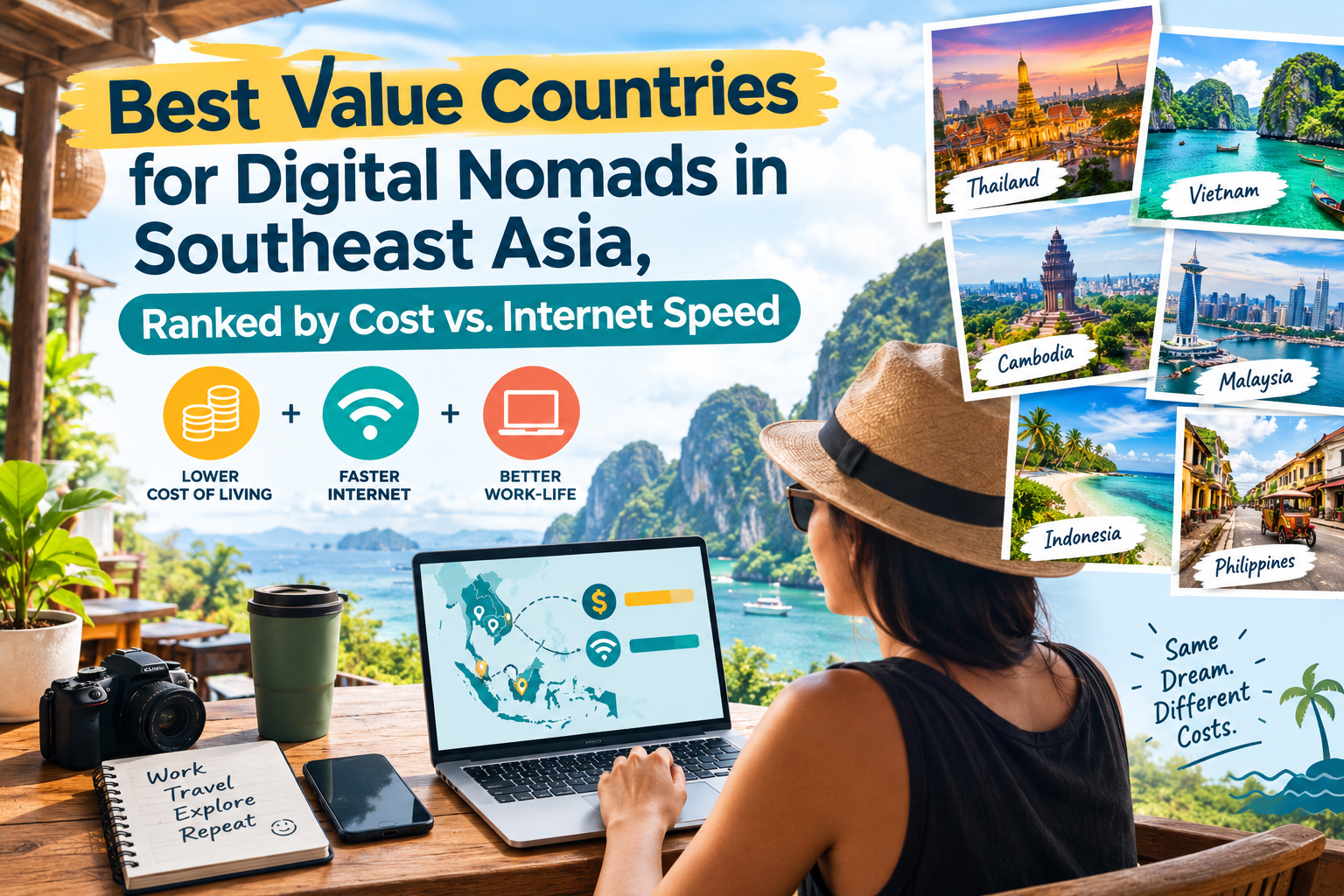
Ask Reddit where to base yourself as a digital nomad and you’ll get the same five answers every time: Bali, Chiang Mai, Da Nang, Bangkok, Kuala Lumpur. They’re cheap, the coffee shops have wifi, and for a three-month stint they work fine. But if you’re picking a base for a year or more — where a dropped connection costs you a client, not just an afternoon — cheap alone isn’t the metric that matters.
We ranked five Southeast Asian countries by the actual trade-off that decides whether a move works long-term: what you’ll spend against what your internet will actually do when it counts.
1. Thailand — $1,200–2,200/month, fast but reported speeds vary widely by source
The best overall balance on this list, and it’s not close — though it’s worth flagging that published broadband figures for Thailand genuinely conflict depending on where you look: some trackers cite 250+ Mbps national averages, others report closer to 100 Mbps with real variance between cities and islands. What’s consistent across every source is that Chiang Mai and Bangkok both deliver reliably fast, video-call-grade connections in practice — Chiang Mai’s Punspace coworking space is regularly cited as one of the most dependable options in Southeast Asia, and a comfortable solo budget runs closer to $1,200/month there, rising toward $2,200 in Bangkok. The Destination Thailand Visa (DTV), launched in 2024, grants up to 180 days per entry over a 5-year validity — the longest formal nomad visa duration in the region — with a lump-sum bank balance requirement of roughly THB 500,000 (about $14,000) rather than a monthly income threshold.
The trade-off: Thailand isn’t the cheapest option on this list — that’s Vietnam — but the combination of visa length and consistently workable connectivity in its major nomad hubs is hard to match elsewhere in the region.
2. Malaysia — $1,750/month, fast infrastructure, but the “visa” is more limited than it sounds
The country that wins when you stop optimizing for cheapness alone. One 2026 data-driven ranking system — built from institutional public datasets rather than travel-blog opinion — placed Malaysia #1 globally for digital nomads specifically because it’s the rare combination of fast internet, high safety, and strong healthcare, even though it isn’t the cheapest country on the list. Reported broadband speeds for Kuala Lumpur vary by source (from roughly 115 Mbps to 248 Mbps depending on the tracker), but every source agrees KL is among the fastest, most consistent connections in Southeast Asia. English is widely spoken, and the cost of living sits roughly 40% below Western Europe.
One detail worth knowing before you plan around it: the DE Rantau Nomad Pass is officially classified as a Professional Visit Pass, not a residency visa — it grants 3 to 12 months, renewable, but time spent on it doesn’t count toward any permanent residency pathway (that’s a separate, much higher-bar program called Malaysia My Second Home). It requires $24,000/year in documented income for tech-sector workers, or $60,000/year for everyone else.
The trade-off: at $1,750/month, it’s meaningfully pricier than Vietnam or the Philippines, and the visa — while genuinely useful for banking and lease purposes — is more of a renewable visit status than a long-term settlement path.
3. Vietnam — $1,100/month, ~46 Mbps national average (up to 200 Mbps in coworking spaces)
The cheapest country on this list by a real margin — a full, comfortable solo life in Da Nang runs around $1,100/month, covering a private room with air conditioning, food, and a coworking desk. The catch is connectivity variance: Vietnam’s national average download speed sits around 46 Mbps, noticeably behind Thailand and Malaysia, though dedicated coworking spaces in Da Nang and Hanoi report fiber connections up to 200 Mbps — meaning your actual experience depends heavily on where you choose to work, not just which country you picked.
The trade-off: the lowest cost of anywhere on this list, but you need to actively seek out a coworking space or verified fiber connection rather than assuming your apartment’s wifi will hold up for client calls.
4. Philippines — $1,300–1,800/month, 47–109 Mbps depending on measurement
Worth being transparent about a real discrepancy in the data here: official Speedtest.ph figures show the Philippines averaging 109 Mbps on fixed broadband, while independent “real-world” browser-based testing puts the median closer to 47 Mbps — a meaningful gap that likely reflects the difference between optimized speed-test conditions and everyday browsing performance. Either way, the Philippines ranks solidly in the middle of the pack regionally, with monthly living costs comparable to Vietnam and Malaysia depending on the city.
If you’re specifically weighing the Philippines, our ranked cost-of-living breakdown and highest-paying remote jobs guide cover the country in more depth than this regional overview can.
The trade-off: no dedicated digital nomad visa exists yet — most nomads work around this through tourist-visa extensions or the retiree-oriented SRRV — which is a real disadvantage against Thailand’s five-year DTV or Malaysia’s DE Rantau program.
5. Indonesia (Bali) — variable cost, weakest on infrastructure metrics
The most culturally iconic entry on this list, and the one where the data pushes back hardest against the popular narrative. That same institutional data-driven ranking placed Bali at #58 globally — far behind its reputation — once safety, healthcare, and connectivity outside the main tourist hubs are weighted alongside cost. Canggu and Ubud both have genuinely good coworking spaces, but connectivity across the wider island is markedly less consistent than in Thailand’s or Malaysia’s major cities. Indonesia’s E33G digital nomad visa, requiring roughly $60,000+ in annual income, grants up to five years for those who qualify — a real option, just a narrower one than Thailand’s or Malaysia’s.
The trade-off: Bali’s culture, surf access, and wellness scene are real and don’t show up in a spreadsheet — but if your work depends on a connection that never drops, this is the entry on the list most likely to let you down at the worst moment.
The bottom line
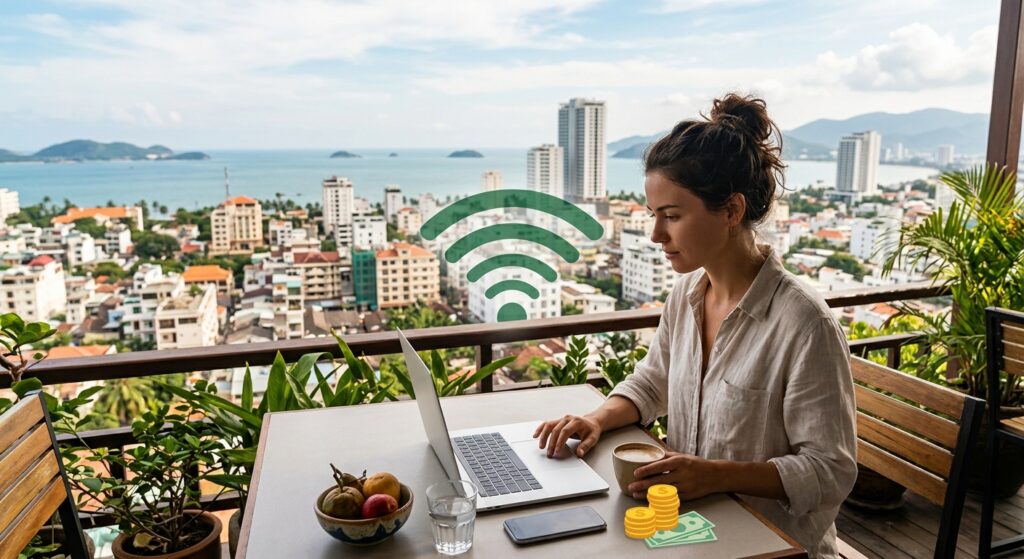
If reliability during client calls is your top priority, Thailand’s combination of speed, cost, and visa length is hard to beat. If you’re optimizing for the strongest all-around package — safety, healthcare, infrastructure — and can absorb a higher budget, Malaysia is the data-backed choice, even though it won’t top anyone’s “cheapest” list. If you’re minimizing cost above everything else, Vietnam wins, provided you build your work life around a verified coworking space rather than assuming home wifi will hold. The Philippines and Bali both offer something the spreadsheet can’t fully capture — but know going in that you’re trading some infrastructure certainty for it.
Compiled from Speedtest Global Index data, Ookla, speedtest.ph, SpeedOf.Me’s H1 2026 real-world testing, and cost-of-living and visa data aggregated across multiple 2026 nomad-focused trackers, current as of August 2026. One honest note: published internet speed figures for Thailand and Malaysia vary substantially even across different pages from the same publishers, likely reflecting differences in testing methodology (optimized speed-test conditions versus real-world browsing performance) rather than a single settled number — we’ve presented ranges rather than a single figure wherever sources meaningfully disagreed. Visa terms for all five countries change periodically — verify current requirements directly with each country’s official immigration portal before applying.