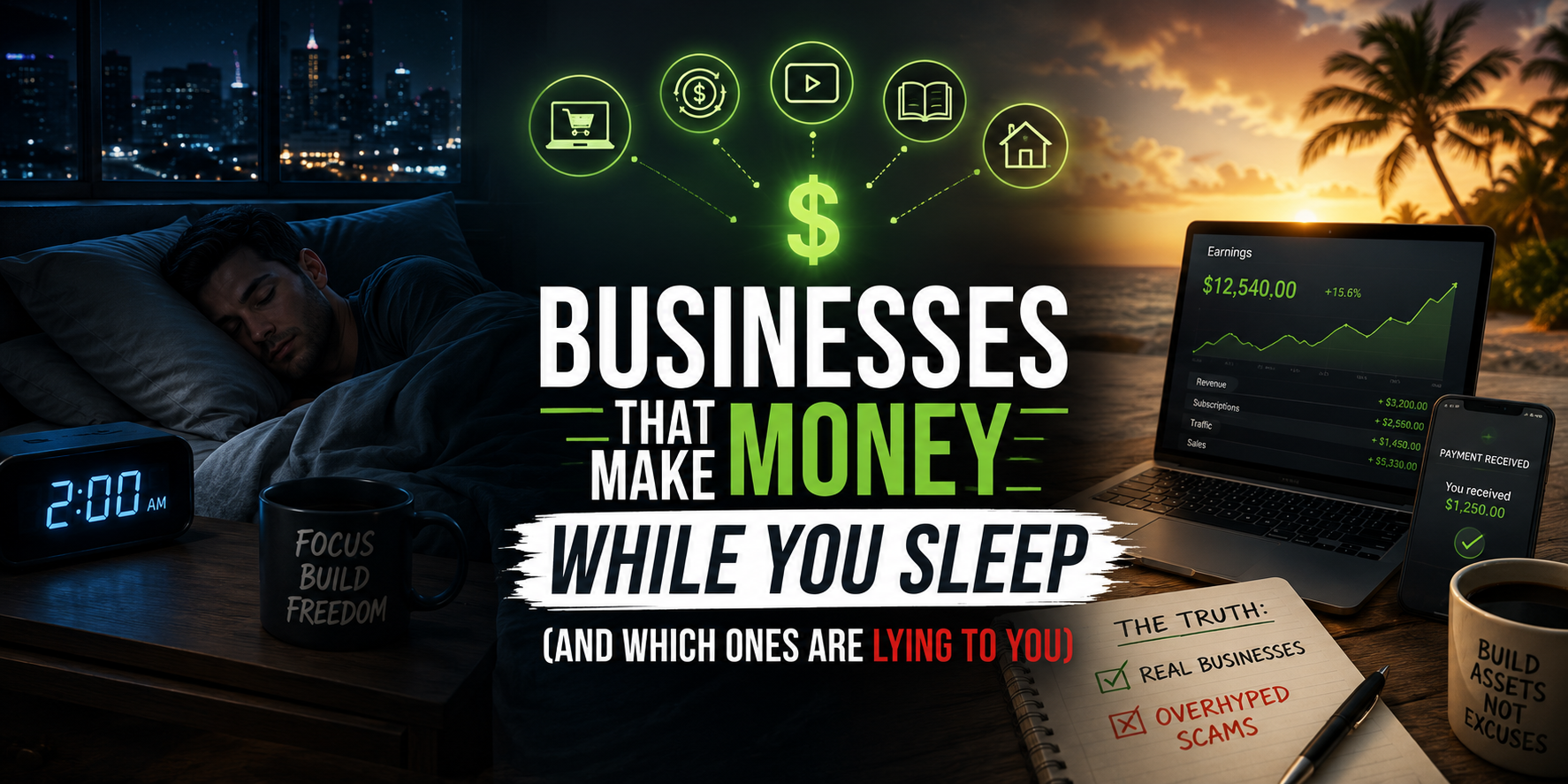
Every few months, another video pops up promising the same thing: build this one business, and money rolls in while you sleep. Vending machines. Dropshipping. “Faceless” YouTube channels. Rental properties. The pitch is always the same — set it up once, then walk away.
Here’s what nobody making real passive income tells you: none of them skipped the hard part. They just don’t film it.
So instead of another hype list, I’m ranking ten of the most-pitched “passive income” businesses by how honest that label actually is — and what it really takes to get there.
The Rating System
To keep this honest, every business gets scored on five things:
- Actually passive — does it run without you, or does “passive” just mean “no boss”?
- Time to first dollar — weeks, or years?
- Capital required — can someone with $500 start this, or do you need $50k?
- Income ceiling — is this a $300/month hobby or a real income replacement?
- Saturation — how burned out is this niche from content creators already?
Every business below gets judged against all five. No cherry-picking the flattering stat.
Tier 1: Complete BS (“Passive” in Name Only)
Print-on-Demand
Capital is low, sure. But saturation is extreme — this pitch has been made a thousand times on YouTube alone, and the market followed. Margins are thin, and you’re competing with everyone who watched the same tutorial you did.
How it actually works: You design graphics (or outsource them), upload them to a platform like Printful, Printify, or Merch by Amazon, connect it to a Shopify or Etsy store, and the platform prints and ships each order as it comes in. You never touch inventory.
What to watch for:
- Profit per item is usually $2-8 after production and platform fees — you need real volume to make this meaningful money
- Trademark and copyright issues are common; designs that lean on pop culture references get pulled or sued over
- Ad costs to drive traffic have risen sharply, and organic traffic to a random T-shirt store is close to zero without one
- Most “success stories” you see are from people selling courses about print-on-demand, not from print-on-demand itself
Dropshipping
Same story, worse economics. Rising ad costs have eaten most of the margin that made this attractive in 2015. It’s not passive — you’re running customer service and ad optimization full-time, just without inventory.
How it actually works: You list products from a supplier (often via AliExpress, CJ Dropshipping, or a wholesaler) on your own store without buying stock upfront. When a customer orders, you buy the item at wholesale price and have the supplier ship it directly to them. Your profit is the markup.
What to watch for:
- Shipping times from overseas suppliers are often 2-4 weeks, which tanks customer satisfaction and drives refund requests
- You’re running paid ads daily to stay visible — the second you stop, sales stop, which is the opposite of passive
- Chargebacks, returns, and customer service complaints land entirely on you, not the supplier
- Winning products get copied fast; by the time a product is “proven,” ten other stores are already selling it at lower margins
Faceless YouTube Automation
The pitch: outsource scripts, voiceover, and editing, collect ad revenue. The reality: the niche is flooded, algorithms punish low-effort content harder than ever, and most channels never hit monetization thresholds before the creator gives up.
How it actually works: You pick a niche (often true crime, space facts, or Reddit story compilations), hire writers and editors on Fiverr or Upwork, use AI voice tools for narration, and publish on a schedule without appearing on camera yourself. Revenue comes from AdSense once you hit YouTube’s monetization thresholds (1,000 subscribers and 4,000 watch hours, or the Shorts equivalent).
What to watch for:
- YouTube’s monetization bar takes most channels 6-18 months to clear, if they clear it at all
- The platform has cracked down on “reused/repetitive” content, and AI-narrated compilation channels are a common target for demonetization or removal
- You’re paying writers and editors every month whether the channel earns or not — this has real recurring costs, unlike a truly passive asset
- Ad revenue (RPM) varies wildly by niche and season; a channel can look profitable in November and barely break even in summer
Verdict on Tier 1: these aren’t passive income businesses. They’re active jobs wearing a passive costume.

Tier 2: Real Business, Fake “Passive” Label
Rental Real Estate
This one’s legitimate as a wealth-building tool. It is not passive. Tenants, repairs, vacancies, and 2 a.m. plumbing calls are the job — unless you pay a property manager, which cuts into the returns that made it attractive.
How it actually works: You buy a property (often with a mortgage, putting down 15-25%), rent it out, and collect monthly rent that ideally covers the mortgage, taxes, insurance, and maintenance, with something left over. Long-term, you’re building equity and betting on appreciation on top of the monthly cash flow.
What to watch for:
- A property manager typically costs 8-12% of monthly rent — factor that in before assuming a number is “profit”
- One bad tenant (missed rent, property damage, eviction process) can wipe out a full year of cash flow
- Maintenance and repairs are unpredictable; a broken furnace or roof can cost thousands with zero warning
- Financing costs (interest rates) directly affect whether a property cash flows at all — the math that worked two years ago may not work today
Laundromats, Car Washes, Vending Machines
These are real, cash-flowing businesses. But they demand real capital upfront (thousands, sometimes tens of thousands) and active management — restocking, maintenance, cash collection — especially in year one. Passive only after you’ve built systems or hired someone to run it.
How it actually works: For vending, you buy machines ($2,000-5,000 each), place them in high-traffic locations (often paying the location owner a small commission), and restock/collect cash on a route weekly or monthly. Laundromats and car washes work similarly but at a bigger scale — you either buy an existing location or build one out, and the equipment does the “work” while you handle maintenance and cash collection.
What to watch for:
- Location matters more than the business itself — a great vending machine in a dead location earns nothing
- Machines break, get vandalized, or get stolen from; budget for repairs and losses, especially early on
- Cash-heavy businesses need a system for theft prevention, whether that’s cashless payment options or just discipline about collection schedules
- “Semi-passive” is only true after you’ve either automated restocking (cashless, remote monitoring) or hired someone — both of which take upfront investment beyond the equipment itself
Verdict on Tier 2: legitimate businesses, dishonest marketing. Call them “semi-passive after heavy setup,” not “money while you sleep.”
Tier 3: Passive-ish, If You Survive the Grind
Affiliate / SEO Content Sites
This can genuinely work — once you have months or years of content built up and ranking. The problem: Google’s algorithm updates can wipe your income overnight, and getting there requires consistent, unpaid writing for a long stretch before any money shows up.
How it actually works: You pick a niche, publish articles targeting search terms people are actually looking for, and embed affiliate links (Amazon Associates, software affiliate programs, etc.) or display ads. When articles rank on Google and people click through and buy, you earn a commission or ad revenue.
What to watch for:
- Google’s algorithm updates (several times a year) can cut traffic to a site by 50-90% overnight, with no warning and often no clear explanation
- Ranking competitively usually takes 6-12+ months of consistent publishing before meaningful traffic shows up
- AI-generated content at scale has been specifically targeted by recent Google updates — thin, unoriginal content is a fast way to get penalized
- Affiliate commissions are usually small (often 1-10% of sale price); you need real volume of traffic and clicks to add up to real money
Courses and Digital Templates
Only works if you already have an audience willing to buy from you. Without that audience, you’re not selling a course — you’re trying to build one from zero, which is a much bigger project than the course itself.
How it actually works: You package expertise you already have into a course (video lessons, a cohort program) or a template (spreadsheets, Notion boards, design files), host it on a platform like Teachable, Gumroad, or Kajabi, and sell it to your existing audience or through their referrals.
What to watch for:
- Without an existing audience, customer acquisition cost can exceed what you’d earn per sale — you’d be building an audience and a product at the same time, which rarely works
- Refund rates on courses are often higher than physical products, since expectations are harder to set and buyers can’t “try before they buy”
- The market has genuinely gotten more skeptical of low-effort courses; a thin or outdated product gets called out publicly, often on the same platforms you’re marketing on
- Updating and supporting the product (answering questions, fixing outdated info) isn’t optional if you want to keep selling it long-term — it’s rarely fully hands-off
Verdict on Tier 3: real potential, but the “passive” part only kicks in after a serious, often unpaid, buildup phase.
Tier 4: Actually Passive (Eventually)
SaaS / Apps
Once built, a good app can generate revenue with minimal daily input. But “once built” is doing a lot of work in that sentence — this usually means months of development, iteration, and finding product-market fit before it runs itself.
How it actually works: You identify a specific, recurring problem people or businesses will pay to solve, build software that solves it (yourself, with a co-founder, or by hiring developers), and charge a monthly or annual subscription. Once built and stable, it can run with minimal daily involvement beyond support and updates.
What to watch for:
- Most SaaS ideas fail not from bad code but from building something nobody actually wants — validate demand before writing a line of code
- Customer support, bug fixes, and security updates don’t stop once the product is “done” — this is ongoing, even if it’s lighter than the build phase
- Churn (customers canceling) is the silent killer of SaaS; a product can gain 100 customers a month and still shrink if 100 cancel
- If you’re not technical, development costs (hiring engineers) can run into the tens of thousands before you have a working product, let alone revenue
Dividend Stocks / Index Funds
The most honest one on this list. It requires capital, it’s slow, and it won’t make headlines. But it’s the closest thing to true “money while you sleep” that exists — because the work (earning and investing the capital) happened long before the passive part starts.
How it actually works: You put money into dividend-paying stocks or broad index funds (like an S&P 500 fund) through a brokerage account, and either collect dividend payouts or let the investment grow through market appreciation over time. Reinvesting dividends compounds the growth further.
What to watch for:
- The “passive” income is proportional to the capital you put in — meaningful monthly income requires a genuinely large invested amount, not a few hundred dollars
- Markets go down as well as up; this isn’t a guaranteed return, and downturns can last years
- Dividend yields are usually modest (often 2-5% annually), so this is a long-term wealth-building strategy, not a fast cash-flow business
- This isn’t a business you can “start” this weekend and see results from — it rewards patience and consistency over any clever tactic
Verdict on Tier 4: genuinely passive, but only after the least glamorous, least filmable phase of all: patience and capital.
The Uncomfortable Truth
Every single option on this list requires real work up front — building, writing, investing, or managing — before any income becomes passive. The businesses that look effortless in a 60-second video clip usually took months or years of invisible effort first.
The “sleep money” is real. It’s just not free, and it’s not fast.
So What Should You Actually Do?
- No capital, some time: Start an SEO content site or build an audience first — slow, but it costs nothing but effort.
- Some capital, want a real business: Vending machines or a laundromat are legitimate, if you’re honest that they’re not hands-off for at least a year.
- Have capital, want true passivity: Index funds and dividend stocks are boring, but they’re the only thing on this list that’s passive from day one — because you already did the work to earn the capital.
- Have an audience already: Courses and templates are the fastest path, since you skip the “build an audience” step entirely.
Pick based on what you actually have right now — time, capital, or an audience — not on which one looks best in a thumbnail.
Here’s why that distinction matters more than it sounds. Most people choose a “passive income” business the same way they pick a Netflix show — based on what looks appealing in a 60-second clip. That’s backwards. The video doesn’t know your bank balance, your schedule, or whether you already have 10,000 people who’d buy something from you tomorrow. It’s just optimized to get views.
Ask yourself which bucket you’re actually in:
- You have time but no money. Skip anything requiring capital. An SEO content site or building an audience from scratch costs nothing but the hours you put in. It will be slow, and most people quit around month four when nothing’s happening yet. That’s also exactly when it starts working for the people who don’t quit.
- You have some money but no audience. Vending machines, laundromats, or a small rental property are real options — but budget for the fact that year one is a part-time job, not a hands-off investment. Don’t buy into the version where you sign paperwork and the checks start arriving.
- You have money and want it to actually be passive. Index funds and dividend stocks won’t make a good video, but they’re the only entry on this list that’s passive starting day one. The tradeoff is that the “work” already happened — you had to earn the capital somewhere else first.
- You already have an audience. This is the shortcut almost nobody talks about. If people already trust you, a course or a template skips the hardest part of every other option on this list: finding customers. You’re not starting from zero, you’re monetizing something you’ve already built.
The mistake isn’t picking the “wrong” business. It’s picking a business that assumes you have resources you don’t actually have, then getting frustrated four months in when it isn’t working — not because the business is a scam, but because it was never designed for your starting point.
Want more breakdowns like this? [Subscribe to the channel / check out related articles].