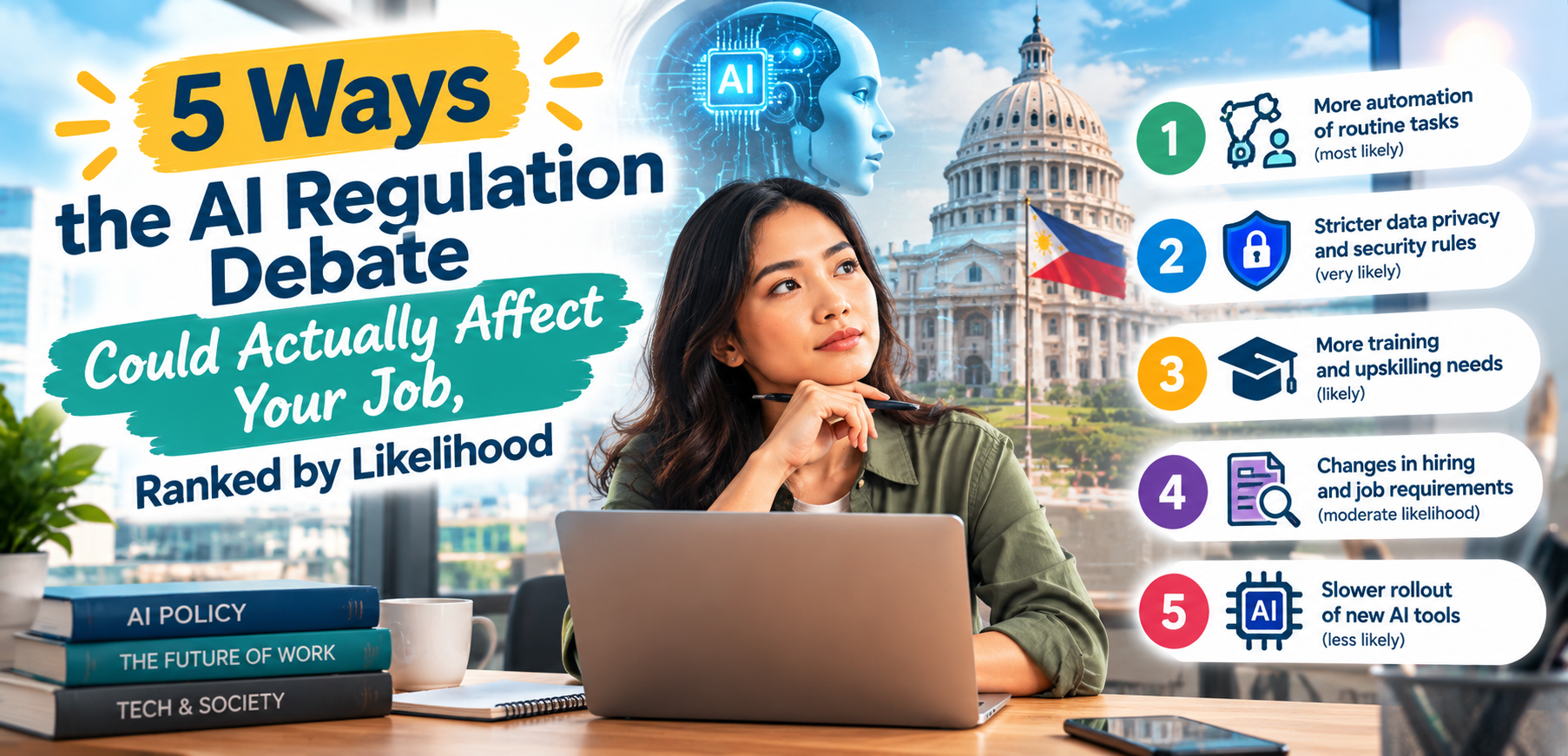
Congress hasn’t passed a federal AI law. States have — dozens of them, all different, all colliding with a White House actively trying to override them. Somewhere in that fight is a real answer to a question that affects millions of working people right now: if an algorithm rejects your job application, or decides you’re part of a layoff, do you have any right to know, or any way to push back?
We ranked five ways this unresolved fight could actually reach your job, from what’s already happening to what’s still just a threat on paper.
1. Whether you’re protected when AI screens your job application depends entirely on which state you live in
This isn’t hypothetical — it’s already the law in a growing patchwork of places, and it isn’t the law almost everywhere else. Illinois requires employers to notify you and get your consent before AI analyzes your video interview. New York City’s Local Law 144 requires companies to run — and publish — bias audits on the automated tools screening candidates. Colorado’s AI Act, once it’s enforceable, would require formal risk assessments and give rejected applicants a right to human review and an appeal. Maryland and New Jersey separately restrict how AI can be used in hiring decisions specifically.
If you’re job hunting in any of those places, you have real, enforceable rights over how an algorithm evaluates you. If you’re job hunting almost anywhere else, you likely don’t — and the company screening you may not even have to tell you AI was involved at all.
Why it’s ranked highest: this isn’t a future possibility, it’s your reality right now, today, determined entirely by your ZIP code rather than anything about the job itself.
2. If you were rejected by an AI hiring tool in the past few years, you may already be part of active litigation
Mobley v. Workday is the case reshaping this entire space, and its stakes are genuinely enormous: Workday’s AI-powered screening tools are used by more than 10,000 employers, including over 60% of the Fortune 500. The lead plaintiff alleges he was rejected from over 100 jobs specifically because of Workday’s screening tools, discriminating by age, race, and disability. In 2026 alone, the case has moved fast — a March ruling confirmed the age-discrimination protections extend to job applicants (not just current employees), and a June 22 ruling let claims covering race, sex, and disability move forward too. Workday has already been ordered to hand over the list of employers using its AI screening features, specifically so a third-party administrator can notify people who may be eligible to join the case.
Why it’s ranked here: if you applied to a mid-size or large company any time in the past several years and got an unexplained rejection, there’s a real, non-trivial chance a Workday-powered tool screened you out — and a real, active legal process now exists to challenge exactly that.
3. If you’re part of a mass layoff, you may soon have a right to know if AI was a factor
Starting October 1, 2026, Connecticut will require any employer conducting a mass layoff under the federal WARN Act to disclose, in writing, to the state Department of Labor whether AI or similar technology was a contributing factor in the decision. It’s a narrow rule — one state, tied specifically to WARN-qualifying layoffs — but it’s the first of its kind, and it directly answers a question most laid-off workers currently have no legal way to ask: was I let go because of a human decision, or an algorithm’s recommendation?
Why it’s ranked here: real, but narrow and not yet in effect — a genuine advance in worker visibility, just not one most people can use yet, and only if their state follows Connecticut’s lead.
4. Whether any of this survives at all is being actively fought over in federal court, right now
On December 11, 2025, President Trump signed Executive Order 14365, explicitly targeting what it calls “excessive state regulation” of AI, and directing federal agencies to challenge, defund, or preempt state AI laws — naming Colorado’s algorithmic discrimination law as a direct example of what it wants gone. The Department of Justice stood up an AI Litigation Task Force on January 9, 2026 to carry that out. It’s already had a real, concrete effect: on April 27, 2026, a federal court in Colorado enjoined enforcement of the state’s AI Act in the case xAI v. Weiser, leaving that law unenforceable while litigation continues.
Why it’s ranked here: this is a genuine, live threat to everything in #1 through #3 — but as of the most recent tracking, the DOJ’s task force hadn’t yet initiated litigation against most state laws beyond the Colorado case, and the executive order itself doesn’t directly repeal anything on its own. It’s a serious, active fight with real early wins for preemption, not a settled outcome either way.
5. Federal enforcement of AI hiring discrimination has already quietly shrunk, regardless of how the bigger fight ends
This is the one most people haven’t noticed yet. On January 23, 2025, President Trump signed Executive Order 14179, directing federal agencies to review and roll back existing AI policies — and within days, the EEOC removed its 2023 technical guidance explaining how AI hiring tools could trigger Title VII liability. A separate order in April 2025, EO 14281, went further, directing agencies to deprioritize disparate-impact discrimination enforcement generally, and the EEOC has since stepped back from pursuing exactly the kind of claims at the center of cases like Mobley.
One nuance worth knowing: the underlying law hasn’t actually changed. Title VII, the ADEA, and the ADA still apply to AI-driven hiring decisions exactly as they did before — what’s changed is enforcement posture, not the statute itself. Several independent legal trackers have confirmed the guidance remains removed more than a year later, with no public indication of when or whether it returns.
Why it’s ranked lowest on likelihood of directly changing your specific outcome, but worth knowing: this shift already happened, quietly, regardless of which way the state-versus-federal preemption fight resolves. Practically, it means your realistic path to challenging an unfair AI hiring decision increasingly runs through state law and private litigation (like Mobley) rather than federal regulators — worth knowing before you assume a federal agency will be the one to help you.
The bottom line
If you’re job hunting right now, the single most useful thing you can do is know which category your state falls into — a small handful of states currently give you real, enforceable transparency and appeal rights over AI hiring decisions, and most don’t. Beyond that, this entire landscape is genuinely in motion: state protections are expanding, federal efforts to override them are escalating, and private litigation is currently doing more to establish real consequences than either state or federal regulators are managing on their own. Nothing on this list is settled — check back on any of it in six months and expect it to have moved.
Compiled and cross-checked against Epstein Becker Green, K&L Gates, Holland & Knight, Cooley, ReedSmith, the National Law Review, Baker Botts, DarrowEverett LLP, the Association of Corporate Counsel, and direct case tracking of Mobley v. Workday (N.D. Cal., Case No. 3:23-cv-00770), current as of August 2026. This is legal and regulatory analysis, not legal advice — if you believe you’ve experienced AI-driven employment discrimination, consult an employment attorney about your specific situation and state.