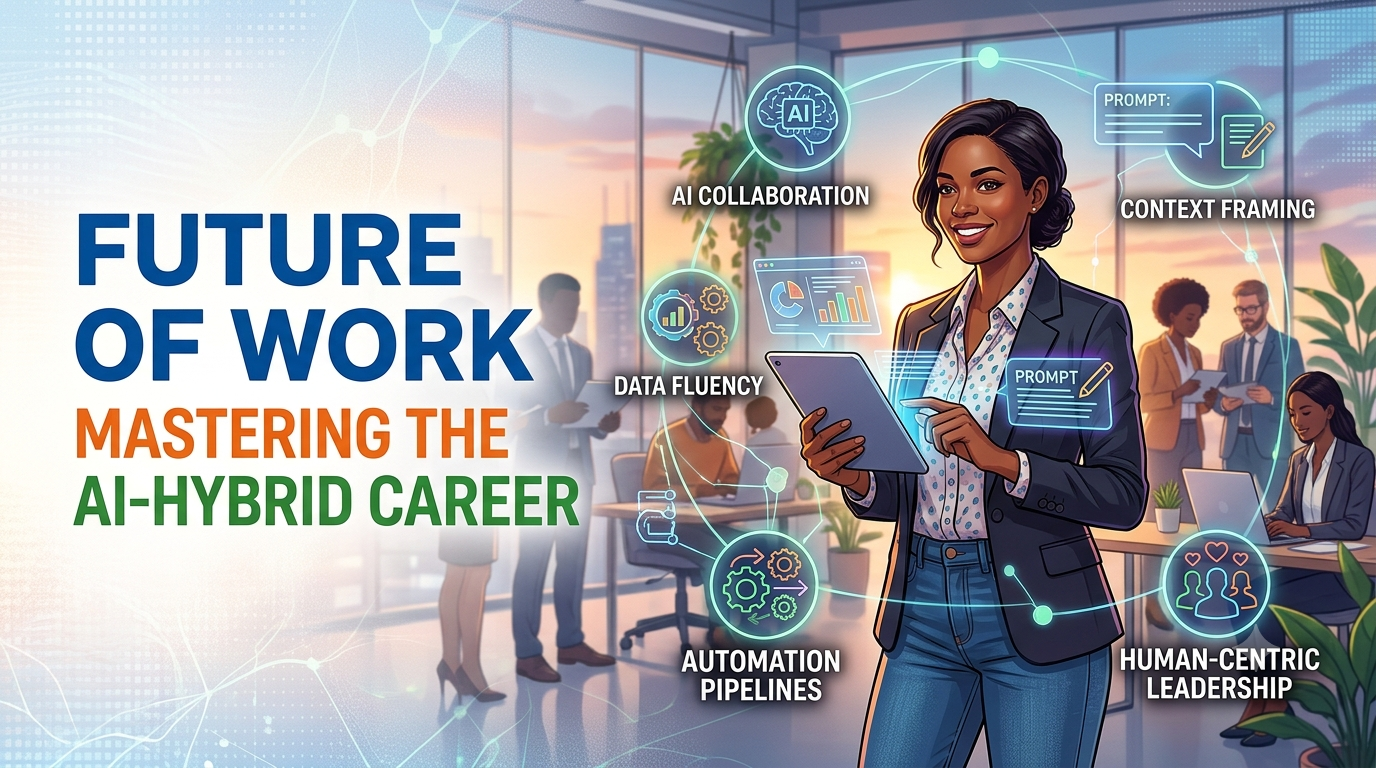
A Practical Guide to Micro-Skills and the AI-Hybrid Career
There is a distinct flavor of anxiety in the office right now. Doesn’t matter if you’re a graphic designer, a financial analyst, or a mid-level project manager tracking timelines in Jira. Everyone is looking over their shoulder at AI. The headlines are a total circus, too—alternating wildly between “AI is stealing your job by Monday” and “AI will solve all human misery by Friday.”
Look, the reality of the situation is way more boring than the sci-fi doomsday scenarios.
AI isn’t going to wholesale replace your entire department next month. Instead, it’s quietly ripping apart and restructuring your job from the inside out. The roles themselves will stay on the company org chart, but the actual, minute-to-minute tasks required to do them? Completely different.
If you want to stay highly employable and—more importantly—well-compensated, you don’t need to panic-enroll in a four-year computer science program. Seriously, don’t. You just need to build an AI-Hybrid Career by stacking up a few hyper-specific micro-skills.

The Anatomy of an AI-Hybrid Career
For decades, career advice followed a predictable, mind-numbing script: pick a lane, keep your head down, build a deep well of domain expertise, and climb the corporate ladder. You were a marketer, an accountant, or a copywriter.
Except that single-track model is a total liability now.
If your value to a company is tied entirely to a static set of repetitive, manual tasks—even complex ones like drafting standard real estate contracts or writing basic boilerplate CSS code—you are standing on a trapdoor.
The people winning right now are building hybrid careers. Think of it as a two-layer system:
- The Baseline Layer (Your Actual Brain): This is your core industry expertise. Your deep understanding of human psychology, your knowledge of quirky corporate tax codes, or your ability to keep a chaotic supply chain from collapsing. AI doesn’t have real-world context or company political awareness. You do.
- The Amplification Layer (The Tech): This is a messy, dynamic toolkit of bite-sized technical capabilities—micro-skills—that let you use AI to execute your baseline work at five times the speed.
Multiply your industry knowledge by AI amplification. That’s the shortcut to exponential market value. You stop being the person grinding away at the keyboard, and you become the director running the entire system.
5 Micro-Skills to Snag Right Now

A micro-skill isn’t some massive academic discipline. It’s a hyper-focused, tactical capability you can muck around with and get comfortable using in a couple of weeks. If you want the absolute highest return on your time, start here.
1. Hardcore Context Framing (Better Prompting)
Forget those basic, lazy prompts like “Write a blog post about real estate trends.” Anyone can do that. And the output is always that generic, soulless, robotic garbage that makes people immediately hit the back button.
Real prompting is about constraint management and injecting messy, raw data. The real skill is learning how to feed an LLM specific personas, giving it explicit stylistic rules, and using “few-shot prompting”—which is basically just giving the AI three killer examples of your own past writing before asking it to generate something new. When you can make a model output a highly nuanced piece of text that actually sounds like a human wrote it on the very first try, you have a massive asset.
2. No-Code Automation Pipelines
The real magic happens when your software tools talk to each other without you having to click anything. Knowing how to use platforms like Zapier or Make to bridge the gap between AI tools and your regular office software is a superpower.
Imagine setting up a pipeline where every time a frustrated user fills out a contact form on your site, an AI instantly reads the complaint, cross-references it with your product database, drafts a personalized apology, alerts a sales rep on Slack, and logs the whole mess into a spreadsheet. Learning how to stitch that together takes zero coding knowledge, but it saves you from losing your mind to manual data entry.
3. AI Data Auditing & Insight Extraction
You don’t need to learn SQL or Python to be a data analyst anymore. Modern AI models can ingest massive, bloated spreadsheets or messy PDFs and parse them in seconds.
The micro-skill here is knowing how to cross-examine your data. You need to be able to upload a chaotic Q3 sales report and tell the AI to spot hidden anomalies, isolate geographic trends, or call out why a specific product line is tanking. The value isn’t in crunching the numbers anymore; it’s in knowing what the numbers actually mean for the business.
4. Agentic Oversight
We are moving incredibly fast away from simple chatbots toward “autonomous agents.” These are AI systems where you give them a single overarching goal, and they figure out the steps to achieve it entirely on their own.
The shift here is moving from a traditional doer to an editorial director. You need to know how to set boundaries for these digital agents, catch where their logic goes off the rails, and audit their final outputs for quality control. Managing AI agents takes a lot of the same strategic oversight as managing a team of fresh interns.
5. Human-Centric “Soft” Anchors
As technical execution becomes incredibly cheap and fast, uniquely human traits become premium, high-dollar commodities.
Empathy, reading the room during a tense Zoom call, handling complex corporate politics, and ethical judgment cannot be automated. The ultimate micro-skill is actually a soft one: the ability to listen to a client’s chaotic, emotional explanation of their business problems, translate it into a clear strategy, and use AI to build the solution in record time.
The “Prompt Engineer” Myth vs. Reality
A year or two ago, tech evangelists on LinkedIn were screaming that “Prompt Engineer” would be the hottest new career on earth, fetching six-figure salaries for people who just typed things into a text box.
Yeah. That didn’t happen. And it won’t.
“Prompt Engineer” isn’t a standalone job description; it’s just a baseline literacy requirement for every white-collar job now. Expecting to get hired solely because you know how to talk to ChatGPT is like expecting to get hired in 2005 solely because you know how to use Google Search. The market doesn’t care if you can write a prompt. It cares what you can actually build, fix, or sell using that prompt.
How to Build Your Toolkit: A 30-Day Blueprint
If you want to start building an AI-hybrid career but feel entirely overwhelmed by the sheer volume of new tech dropping every single day, take a breath. Seriously. You don’t need to learn everything. Just follow a simple, four-week transition plan.
- Week 1: Audit Your Daily Grind. Keep a notepad next to your mouse for five days. Every time you find yourself doing a repetitive, soul-crushing manual task—like summarizing long meeting transcriptions, formatting boring emails, or organizing client data—write it down. Those are your prime targets.
- Week 2: Adopt One Core Tool. Pick one mainstream AI platform and commit to using it every single day for work. Don’t worry about complex setups yet. Just focus on moving your daily brainstorming, drafting, and editing into the tool to figure out its limitations, strengths, and exactly where it tends to hallucinate and invent fake facts.
- Week 3: Build a Single Automation. Go to a no-code platform and set up just one simple automation that links an AI tool to your email or calendar. Automating a single, minor recurring task breaks the psychological barrier of dealing with automation software.
- Week 4: Document Your Proof of Work. Don’t just learn in secret. When you figure out a prompt that saves you an hour of work, or an automation that fixes a messy internal email pipeline, document it. Share it with your manager, post a quick breakdown on LinkedIn, or put it in your portfolio.
Showing that you know how to tangibly improve efficiency is how you build undeniable career leverage. The landscape is shifting quickly, but the advantage belongs to the curious, not the deeply technical. You don’t need to predict where the technology will be in five years. You just need to look at the work sitting on your desk today and find the small, smart ways to break the old patterns.