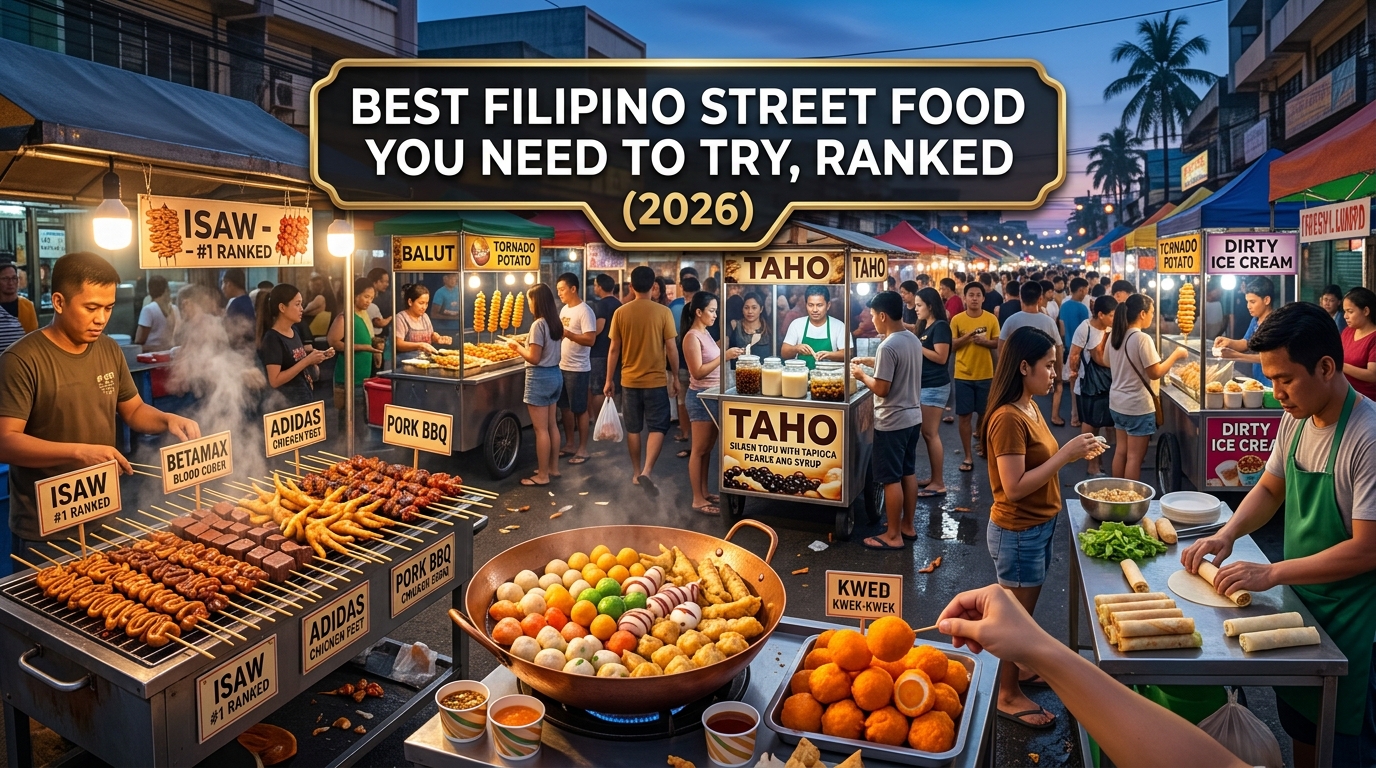
Filipino street food didn’t start as a food trend — it started as necessity. Vendors turned cheap cuts, offal, and simple ingredients into something genuinely craveable, and decades later those same dishes are showing up on tasting menus at some of Manila’s most celebrated fine-dining restaurants, reimagined but recognizably the same soul. We ranked ten dishes every visitor and every homesick Filipino abroad should know, from the easiest starting point to the one that separates tourists from locals.
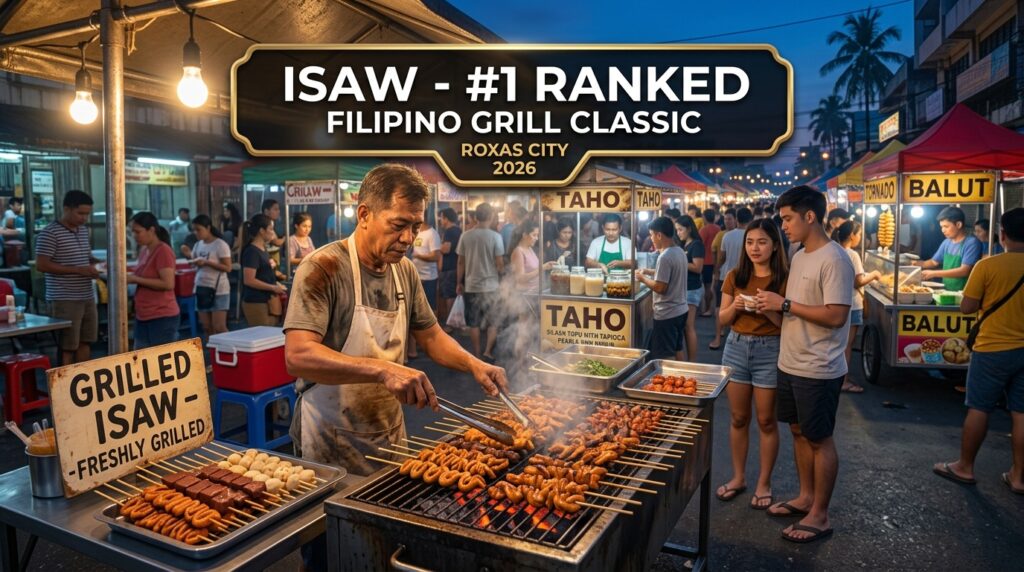
1. Isaw — grilled chicken or pork intestines (₱10–15 a stick)
Skewered, grilled over charcoal until smoky, and dipped in spiced vinegar — isaw is the dish most food writers call the true gateway into Filipino street food, and locals have given it an entire set of affectionate nicknames (including, bluntly, “I.U.D.” for the chicken version, a joke about its shape). It’s sold everywhere from Manila night markets to provincial roadside stalls, and it’s now serious enough as a dish that Toyo Eatery — one of the country’s most celebrated fine-dining restaurants — features grilled skewers like isaw on its actual tasting menu.
2. Kwek-kwek — orange-battered fried quail eggs (₱5 each)
The most visually distinctive entry on this list: hard-boiled quail eggs coated in a bright orange batter and deep-fried until crisp, best eaten dipped in spiced vinegar with chili and onions. Think of it as a corndog logic applied to a quail egg instead of a sausage. Its cousin, tokneneng, uses full-size chicken or duck eggs in the same batter — same flavor, bigger bite.
3. Fish balls and squid balls (₱5–10 per stick)
The most classic “one peso, one ball” street-cart experience in the country, and usually the first street food a Filipino kid ever eats on their own. Deep-fried, skewered, and dipped in a choice of sauces ranging from sweet to spicy — the sauce selection is half the fun, and every vendor’s blend is a little different.
4. Banana cue and turon (₱10–20)
Banana cue is sliced plantain, deep-fried, and coated in caramelized brown sugar on a stick — Filipino comfort food in its simplest form. Turon takes the same banana, wraps it in a spring roll wrapper, sometimes adds a strip of jackfruit, and fries it until the wrapper turns glass-crisp. Both are sold from the same carts, usually side by side, and both are the easiest entry point on this entire list for anyone easing into Filipino street food for the first time.
5. Taho (₱15–25)
A warm, silky soft tofu dessert topped with arnibal (caramelized brown sugar syrup) and sago pearls, traditionally sold by vendors carrying two large aluminum containers on a shoulder pole, calling out “Taho!” through neighborhoods at sunrise. It’s less a street food and more a genuine daily ritual for a huge share of Filipino households — the food writers who cover this dish consistently describe it as bookending the day, isaw at dusk, taho at sunrise.
6. Balut — fertilized duck egg (₱15–25)
The single most internationally famous entry on this list, and the one every guide agrees is the real test. Balut is a fertilized duck egg, boiled and eaten in the shell with a pinch of salt or spiced vinegar — you crack a small hole at the top, drink the broth first, then eat the rest. It genuinely divides Filipinos themselves; some grew up eating it as a completely normal snack, others avoid it entirely, and it’s less about the food itself than the shared social ritual and dare-you-to-try-it moment it creates, especially for visitors encountering it for the first time.
7. Lugaw and goto — rice porridge (₱30–60)
The Filipino answer to congee: glutinous rice cooked down into a savory, hearty porridge, often topped with fried garlic, scallions, and a boiled egg. Goto adds beef tripe to the same base. Both are the default comfort food during rainy season or when anyone in the household is feeling under the weather — the closest thing the Philippines has to chicken soup.
8. Mami — noodle soup with meat and dumplings (₱40–80)
Credited to Ma Mon Luk, a Chinese settler and street food vendor who is widely said to have introduced chicken-and-noodle soup to the Philippines around 1920 — over a century of history in a bowl that’s still sold from carts today. A genuine example of how deeply immigrant food culture has been absorbed into what’s now considered classically Filipino street food.
9. Sisig (₱120–200, more restaurant staple than street cart)
Chopped pig face and ears, seasoned and served sizzling on a hot plate, often finished with a raw egg cracked on top and a squeeze of calamansi. Sisig originated in Pampanga — widely regarded as the culinary capital of the Philippines — and has since become the country’s definitive beer-drinking food, showing up on nearly every bar menu nationwide. It’s technically more restaurant fare than street cart these days, but its roots are pure street-food resourcefulness: turning parts of the pig other cuisines discard into the dish everyone orders first.
10. Ginanggang, dinamita, and the deep-fried offal category
The most acquired-taste tier — grilled banana skewers glazed in margarine and sugar (ginanggang, a Mindanao specialty), chili peppers stuffed with ground meat and deep-fried (dinamita), and other grilled offal collectively called “helmets” and “Adidas” (chicken heads and feet, named with exactly the dry humor you’d expect). If you’ve worked through the first nine dishes on this list, these are where you find out how far you’re actually willing to go.
How to actually eat your way through this list
Start small and build up. Every serious guide agrees on this order of operations: ease in with banana cue or fish balls before working up to balut or the offal tier — don’t front-load the most challenging dish on day one.
Season everything with vinegar. Spiced vinegar is doing more work than people expect across nearly every savory item on this list — it’s not a garnish, it’s half the flavor profile.
Pick vendors by visible turnover, not appearance. Grilled items (isaw) and fresh-fried items (fish balls, kwek-kwek) cooked at high heat in front of you, from a cart with a steady stream of customers, are consistently the safer choice over anything sitting out or reheated.
Budget realistically. A full afternoon of street food snacking runs ₱15–50 per item — you can genuinely eat your way through several dishes on this list for under ₱300–500 total.
Frequently asked questions
Generally yes, if you pick vendors the way locals do: look for a steady stream of customers (high turnover means fresher ingredients) and prioritize items cooked fresh in front of you — grilled isaw, fresh-fried kwek-kwek and fish balls — over anything that’s been sitting out. Avoid raw or undercooked items unless you already know and trust the specific vendor.
Closer to a rich, savory chicken-and-duck broth with a soft, egg-like texture than most first-timers expect — the broth itself tastes similar to a well-seasoned soup, and the texture varies depending on how far along the embryo is. Most guides recommend starting with a younger balut (less developed) for a gentler introduction.
Manila’s night markets and provincial roadside stalls are the classic, most affordable entry point. If you’d rather ease in somewhere more controlled, upscale spots like Locavore, Manam, and Toyo Eatery in Manila now serve elevated, modern takes on the same classic dishes — same soul, cleaner setting.
Expect ₱15–50 per individual item at a street cart, meaning you can realistically sample 6-8 different dishes from this list for around ₱300–500 total — genuinely one of the most affordable ways to eat well anywhere in the country.
Not at all — it’s a normal, common reaction even among Filipinos themselves. The social ritual around daring dishes is meant to be lighthearted, not a test you’re required to pass; most locals will respect a polite “not for me” far more than someone forcing it down just to prove a point.
Compiled from Cozymeal, Migrationology, Federal Land’s culinary guide, and multiple 2026 Philippine food-tourism trackers, cross-referenced for consistency on pricing, origin claims, and dish descriptions. Prices vary by region and vendor; Metro Manila prices are used as the baseline above.