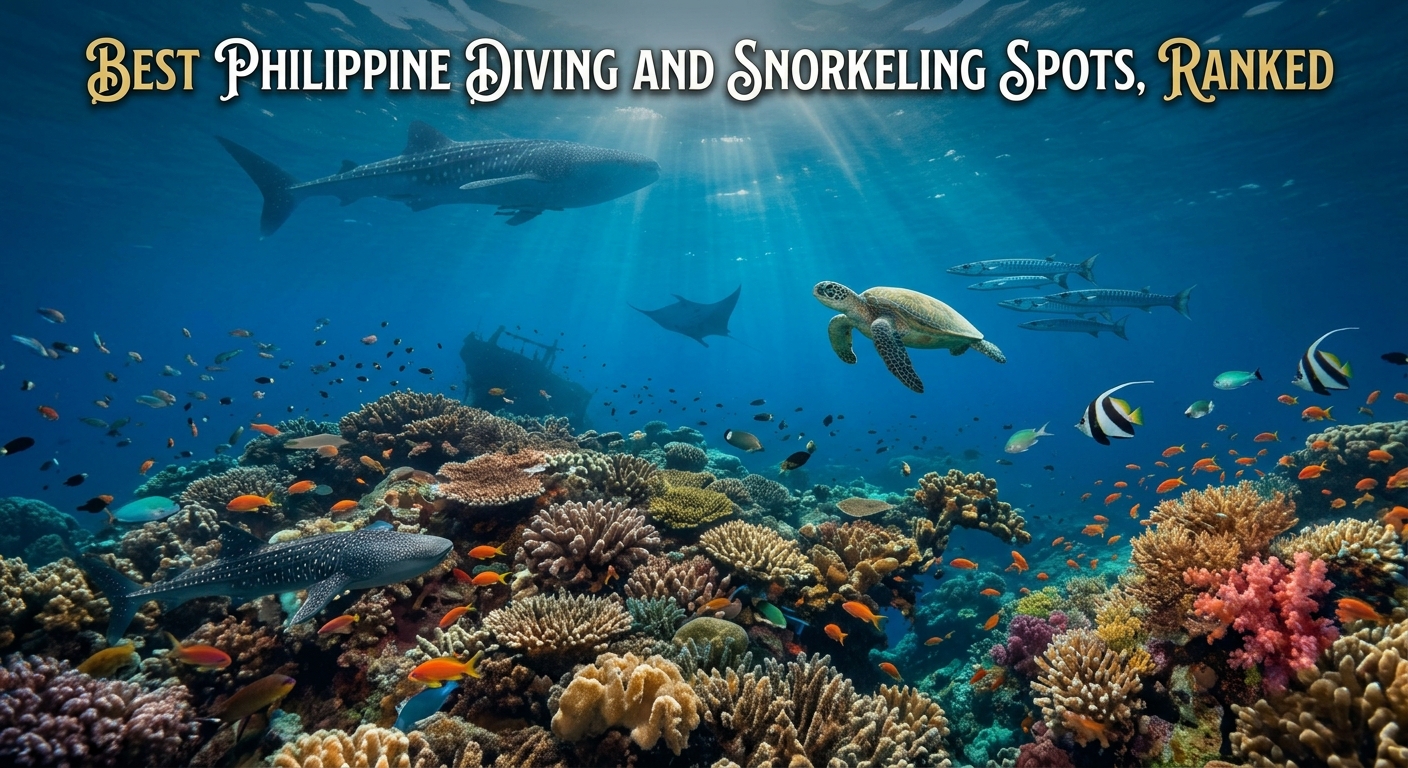
The Philippines sits inside the Coral Triangle, the global epicenter of marine biodiversity, spread across more than 7,000 islands. That’s not a marketing line — it’s why the same short stretch of coastline can offer a WWII wreck dive, a wall of reef sharks, and a shore snorkel with sea turtles, all within a few hours of each other. We ranked the destinations actually worth building a trip around, by what you’ll see, how hard it is to get there, and whether you need dive certification or just a mask and fins.
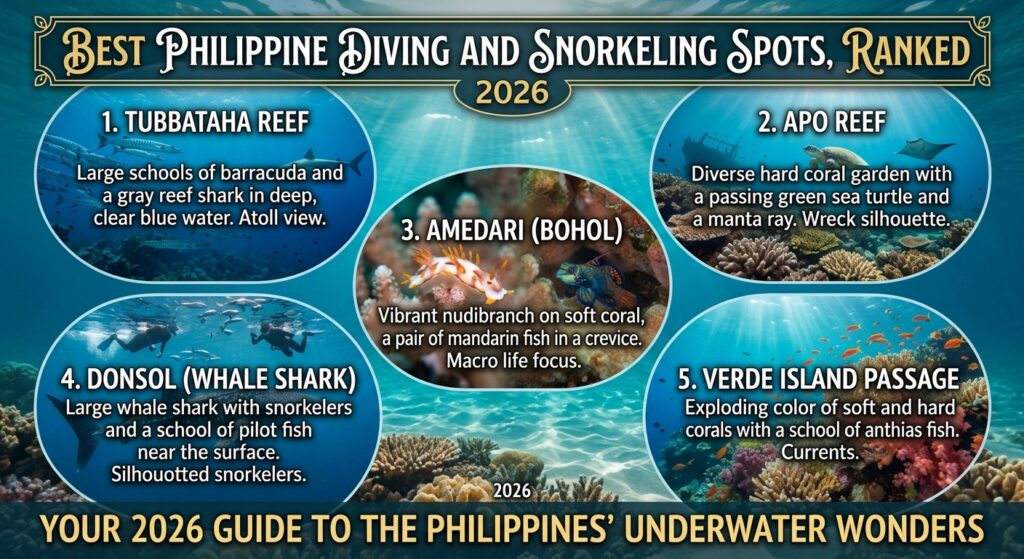
1. Tubbataha Reefs, Palawan (liveaboard only, mid-March–mid-June)
Consistently named the best diving in the Philippines, and often in the same breath as the best diving anywhere in the world. A UNESCO World Heritage Site sitting in the middle of the Sulu Sea, Tubbataha offers dramatic wall dives, resident reef sharks, and genuinely pristine coral, protected precisely because it’s this hard to reach. It’s liveaboard-only — no shore access or accommodation exists — and the park is entirely closed to diving outside a narrow mid-March to mid-June window, when calm seas make the roughly 150 km, 12+ hour crossing from Puerto Princesa safe. This is not a beginner destination; strong, unpredictable currents on wall dives and channels demand real experience.
Access: liveaboard trip only, typically departing from Puerto Princesa.
2. Moalboal, Cebu (shore-accessible, year-round)
The single best entry point on this list for snorkelers, and a genuine standout for divers too. Moalboal is famous for the Sardine Run — a massive, shimmering bait ball of millions of sardines, visible right off Panagsama Beach, viewable with just a mask and fins, no scuba gear required. Pescador Island, a short boat ride away, adds a dramatic underwater canyon with swim-throughs for certified divers. Shore snorkeling here costs as little as ₱200 (about $3.50) for mask rental and the marine fee — one of the best value experiences on this entire list.
Access: shore entry directly from Panagsama Beach; Pescador Island via short boat ride.
3. Apo Island, Negros Oriental (shore and boat access, year-round)
One of the world’s oldest marine protected sanctuaries, and the most reliable place in the country to snorkel or dive alongside sea turtles. The protection status here isn’t incidental — it’s the reason the coral cover and turtle population have stayed healthy for decades. Calm, clear water and drift dives make this genuinely welcoming for beginners, while still offering enough depth and current variation to keep experienced divers interested. A short boat ride from Dauin.
Access: short boat trip from Dauin, Negros Oriental.
4. Coron Bay, Palawan (boat access, year-round, best January–February)
The wreck-diving capital of the Philippines, and one of the best wreck-diving destinations in all of Southeast Asia — a fleet of WWII Japanese ships sunk in the bay, now overgrown with coral and marine life, sitting at depths accessible to both recreational and advanced divers depending on the specific wreck. Coron also offers something genuinely unusual: Barracuda Lake, a meromictic lake where a thermocline sitting at around 14 meters depth shifts the water temperature from a comfortable 28°C to a startling 38°C within seconds — divers consistently describe the sensation as swimming into warm soup. For snorkelers rather than divers, Siete Pecados offers sheltered coves that are genuinely beginner-friendly.
Access: boat-based day trips from Coron town; Busuanga Island’s airport is the main gateway.
5. Balicasag Island, Bohol (boat access from Panglao, year-round)
The most complete dual-purpose destination on this list — genuinely excellent for both divers and snorkelers, without either group feeling like an afterthought. Expect healthy coral reefs, a real chance of sea turtle encounters, and a manageable boat ride from Panglao’s resort strip, making this an easy add-on to a Bohol trip built around the Chocolate Hills or Alona Beach rather than a destination requiring its own dedicated trip.
Access: short boat ride from Panglao, Bohol.
6. Malapascua Island, Cebu (boat access, best November–May)
The destination for one specific, genuinely rare encounter: thresher sharks, reliably sighted at Monad Shoal in the early morning, a sighting that’s difficult to guarantee almost anywhere else in the world. This is a dive-focused destination rather than a snorkeling one — the sharks stay at depth — and it demands real planning, since the best sightings happen on dawn boat departures. The island’s coral gardens offer a solid secondary snorkeling option for those in your group who aren’t diving.
Access: boat transfer from Cebu (Maya port), then a short island-hop.
7. Anilao, Batangas (shore and boat access, year-round, closest to Manila)
The most convenient serious dive destination for anyone based in Manila — a few hours by land rather than a flight. Anilao’s specialty is muck diving: rather than big, dramatic reef structures, this is where underwater photographers come hunting for rare macro species — nudibranchs, seahorses, frogfish — hidden in sand and rubble that would look unremarkable to anyone not specifically looking for it. A genuinely different kind of diving from everywhere else on this list, and worth knowing about even if it’s not your first stop.
Access: overland from Manila (roughly 3 hours), then shore or short boat access.
8. Puerto Galera, Oriental Mindoro (shore and boat access, year-round)
One of the most popular and accessible diving destinations in the country, built around the Verde Island Passage — a strait recognized as one of the most biodiverse marine areas on the planet. Puerto Galera works well as an easy first dive trip: a few hours by bus and boat from Manila, with dive shops, resorts, and beginner-friendly sites all concentrated in one manageable area, alongside more advanced options for those who want them.
Access: bus and ferry combination from Manila, roughly 3-4 hours total.
How to actually plan your trip
Match the destination to your certification level. Balicasag, Apo Island, and Moalboal’s shore snorkeling welcome complete beginners. Tubbataha, Coron’s deeper wrecks, and Malapascua’s current-heavy sites genuinely require prior experience — this isn’t gatekeeping, it’s a real safety distinction.
Snorkeling and diving aren’t an either-or choice at most of these spots. Apo Island, Balicasag, and Moalboal all reward both — plan a trip that mixes group members with different comfort levels rather than assuming everyone needs to dive.
Respect the marine protection rules, without exception. Never touch or stand on coral, and never chase, touch, or ride sea turtles or whale sharks — these are enforced with real, substantial fines in protected areas like Moalboal, Apo Island, and Oslob, not just polite suggestions.
Time your trip around Tubbataha specifically if that’s the priority. The park is entirely closed to diving outside mid-March to mid-June — this isn’t a “less ideal” off-season, there’s no way to visit at all outside this window, so plan your whole trip around Tubbataha’s calendar rather than trying to fit it around anything else.
Frequently asked questions
No — Moalboal’s sardine run, Apo Island, and Balicasag are all excellent with just a mask and fins, no certification required. Tubbataha, Coron’s deeper wrecks, and Malapascua’s shark-viewing sites do require certification, and in some cases advanced experience specifically because of strong currents.
The Philippines’ dry season (roughly November to May) offers the calmest seas and best visibility nationwide. Tubbataha is the one hard exception — it’s only open mid-March to mid-June and fully closed the rest of the year, so if that’s your priority, build the whole trip around that window rather than general dry-season timing.
Moalboal, for the combination of shore access, shallow depth, and the sheer density of marine life (the sardine run) visible without swimming far from the beach. Balicasag and Apo Island are close seconds, both reachable by a short boat ride from established resort areas (Panglao and Dauin respectively).
Sightings are common and generally safe if you follow the rules — but touching, chasing, or riding any marine animal is illegal in protected areas like Moalboal, Apo Island, and Oslob, enforced with real fines, not just guidelines. Keep a respectful distance and let the animal’s behavior dictate how close you ge
As early as possible — the season is only three months long, liveaboard capacity is limited, and trips routinely sell out well in advance of the season even starting. If Tubbataha is the centerpiece of your trip, this is the one booking on this list you shouldn’t leave until the last minute.
Compiled and cross-referenced across Bluewater Dive Travel, Discovery Philippines, SeaCrush, Silver Reef Dive Resort, and multiple 2026 Philippine dive and snorkeling trackers for consistency on access, seasonality, and marine life claims. Conditions, marine life sightings, and seasonal windows can shift year to year — confirm current conditions with a local dive operator before booking a trip built around a specific sighting.
Read: Best Value Countries for Digital Nomads in Southeast Asia, Ranked by Cost vs. Internet Speed