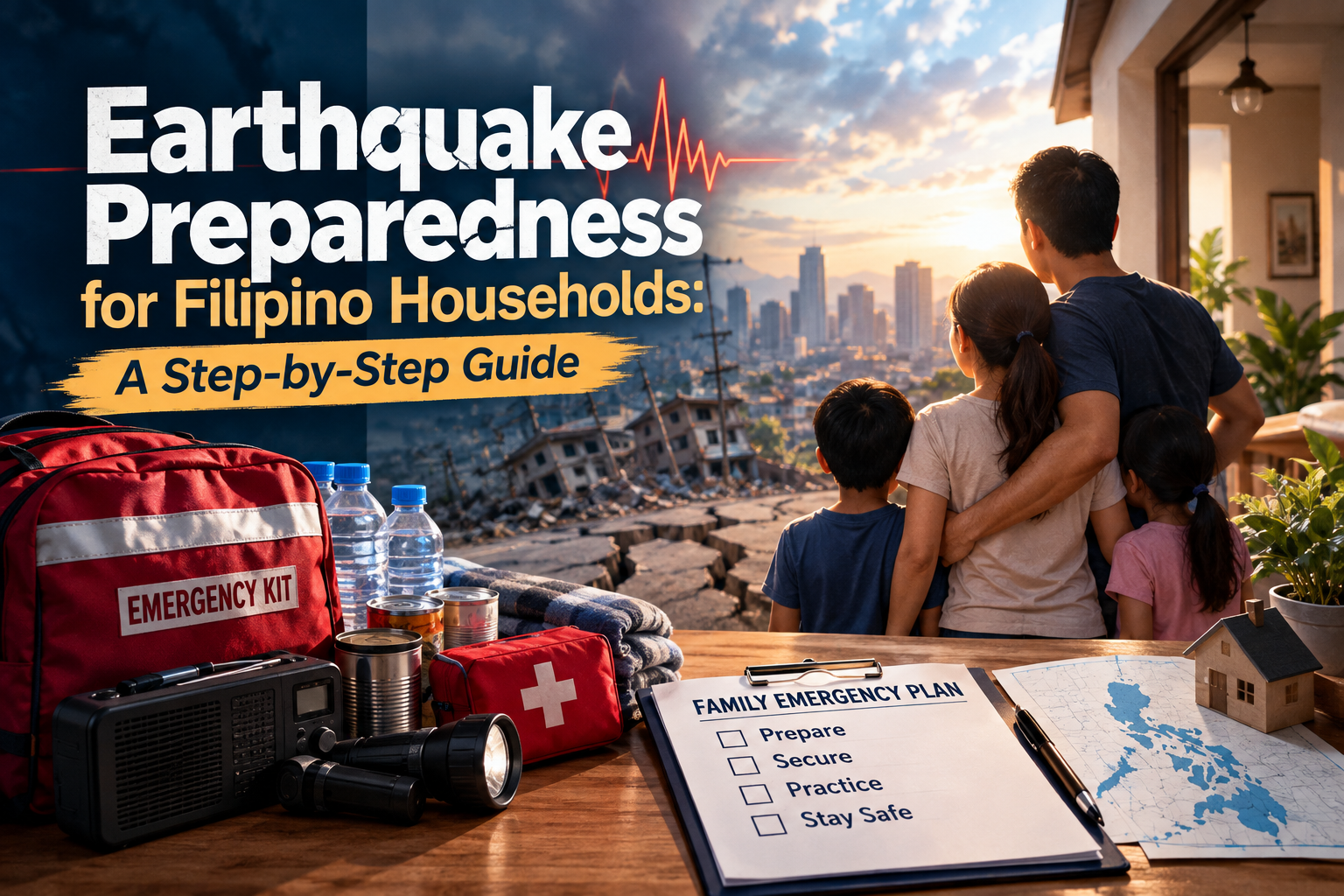
The Philippines sits on the Pacific Ring of Fire, with over 180 active fault lines and more than 100 earthquakes recorded daily — most too small to feel, but not all. Metro Manila in particular straddles the West Valley Fault, last ruptured in 1658, with a natural recurrence cycle of 400 to 600 years. PHIVOLCS is explicit that this isn’t a prediction of exactly when — it’s an estimated 30-37% probability of a major movement within the next 50 years — but the fault is, in their own term, “ripe.”
Here’s what actually matters before, during, and after, including the one thing most preparedness guides underweight.
Step 1: Understand your real risk, not just the headline number
A magnitude 7.2 “Big One” scenario along the West Valley Fault is PHIVOLCS’s own modeled worst case, directly affecting 12 Metro Manila cities sitting on or near the fault trace. Worth knowing: different PHIVOLCS-linked casualty projections have circulated over the years as the underlying model has been refined, ranging from an estimated 34,000 deaths with 114,000 injuries in some reporting to a combined estimate of around 55,000 deaths (37,000 from building collapse, 18,000 from resulting fires) in earlier projections. The exact figure matters less than what every version agrees on: this is a planning scenario, not a forecast — nobody can tell you when this happens, only that the fault is within its expected movement window.
Two free tools matter more here than most preparedness advice: check PHIVOLCS’s HazardHunterPH to see if your home or workplace sits directly on a fault trace or in a liquefaction-prone zone, and ask your building administrator for your structure’s construction year, permit records, and any structural assessment reports. PHIVOLCS itself has publicly stated that if the National Building Code and National Structural Code were strictly followed, no structure should collapse in an earthquake below magnitude 8 — meaning code compliance, not just the year a building went up, is the real variable that matters. A newer building isn’t automatically safer; a newer building that was actually permitted, inspected, and built to code is. This single check does more for your actual safety than almost anything else on this list, because a well-prepared family in a structurally unsound building is still in real danger.
Step 2: Learn Drop, Cover, and Hold On correctly — and unlearn the myths
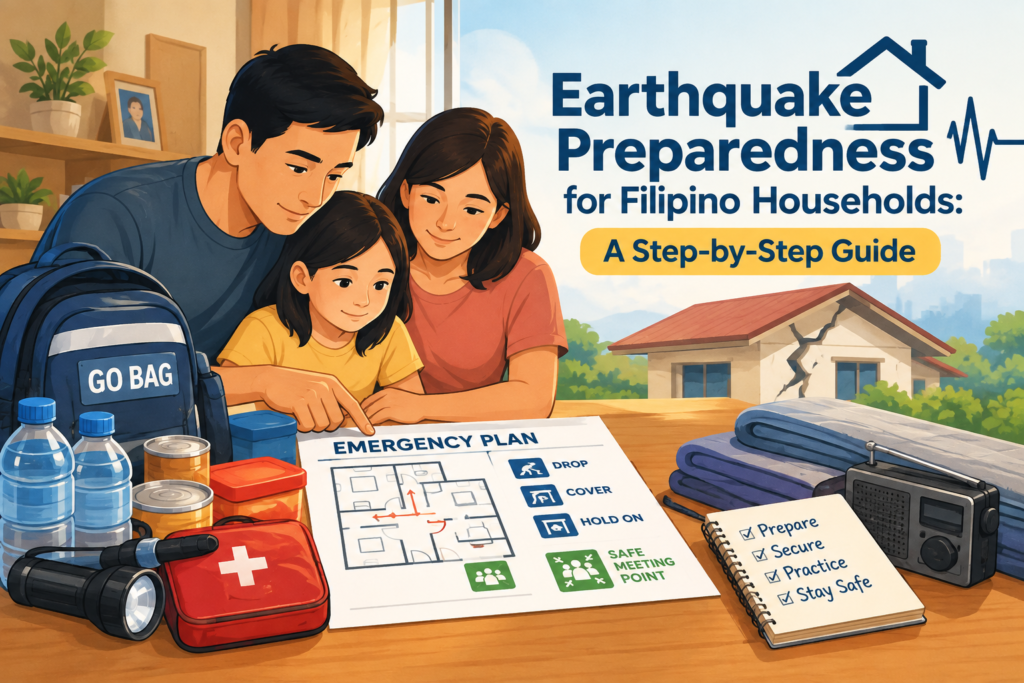
PHIVOLCS and NDRRMC both endorse Drop, Cover, and Hold On as the internationally recommended technique, and it’s simpler than most people remember under stress:
- DROP to your hands and knees immediately, before the shaking knocks you down.
- COVER your head and neck under a sturdy table or desk. If none is available, cover your head and neck with your arms against an interior wall, away from windows.
- HOLD ON to your shelter until the shaking fully stops, moving with it if it shifts.
Two outdated pieces of advice still circulate and should be actively unlearned: standing in a doorway does not protect you in most modern homes (door frames aren’t structurally stronger than the rest of the room in typical Filipino construction), and the so-called “triangle of life” method — lying next to furniture rather than under it — was directly and publicly debunked by then-PHIVOLCS Director Renato Solidum, who confirmed the agency, alongside the American Red Cross and USGS, rejects the theory. Drop, Cover, and Hold On remains the standard for a reason.
Step 3: Secure your space before anything shakes
Most earthquake injuries come from falling objects, not collapsing buildings. Walk through your home now:
- Secure heavy furniture — bookshelves, cabinets, and water heaters — to wall studs with L-brackets or furniture straps, especially anything that could tip onto a bed or a path to an exit.
- Move heavy or breakable items off high shelves, particularly anything above a bed, sofa, or desk where someone sits or sleeps regularly.
- Know how to shut off your gas and main water valves, and keep any tool needed to do so (like a wrench) stored right next to the valve, not in a drawer across the house.
- Identify your safe spots in each room — under a sturdy table, against an interior wall — before you need to find one in the dark, mid-shake.
Step 4: Build an earthquake-specific kit
Much of this overlaps with general disaster preparedness, but a few items matter specifically for earthquakes:
- Sturdy shoes next to your bed — broken glass on the floor after a quake is a common, preventable injury, and you won’t want to walk across it barefoot in the dark.
- A whistle — if you’re ever trapped under debris, a whistle carries much further than your voice and costs far less energy to use repeatedly.
- A fire extinguisher, since gas leaks and electrical damage make post-quake fires a real secondary risk.
- Everything from a standard 72-hour kit otherwise applies: water (3 liters per person per day), non-perishable food, a flashlight, a battery or hand-crank radio, a power bank, cash in small bills, and copies of important documents in a waterproof pouch. If you’ve already built a typhoon go-bag from our typhoon preparedness guide, it covers nearly all of this — just add the whistle and the shoes.
Step 5: Agree on a family plan now, not during the shaking
Decide on a meeting point outside your home and a backup point outside your neighborhood, in case you’re separated or can’t return home. Agree on an out-of-area relative everyone can contact to relay messages, since local phone networks often congest immediately after a major quake. If you have children, ask their school directly what their specific earthquake drill and pickup procedure is — don’t assume it matches what you’d do at home.
Step 6: During the shaking
Drop, Cover, and Hold On immediately — do not run outside. Most earthquake injuries during the shaking itself happen to people trying to move to a different location, not to people who stayed put and took cover. If you’re in bed, stay there and cover your head with a pillow rather than getting up. If you’re outdoors already, move to an open area away from buildings, trees, and power lines, and drop there.
If you’re driving, pull over away from overpasses, bridges, and buildings, and stay in the vehicle with your seatbelt on until the shaking stops.
Step 7: After the shaking stops
Expect aftershocks, and Drop, Cover, and Hold On again each time you feel one — they can arrive minutes, hours, or days later, and some cause additional damage to already-weakened structures.
Check for gas leaks and structural damage before fully re-entering your home. If you smell gas, shut off the main valve, leave immediately, and don’t use any switch or flame until it’s confirmed safe.
Do not use elevators — even if they appear to be working, aftershocks can trap you between floors.
If you’re in a coastal area, move to higher ground immediately if the quake was strong or long-lasting, without waiting for an official tsunami warning — large, undersea, or prolonged shaking is itself the warning in that situation.
Check on neighbors, particularly elderly residents, people with disabilities, and anyone living alone, and follow PHIVOLCS’s official channels and NDRRMC advisories for updates rather than relying on social media rumors, which spread fast and are frequently wrong in the hours after a major quake.
The bottom line
The single highest-leverage thing on this entire list is Step 1 — knowing whether your specific home or workplace sits on a fault trace or in a liquefaction zone, and whether your building actually meets current seismic code. Everything else on this list — the go-bag, the furniture straps, Drop-Cover-Hold-On — matters and saves lives, but it operates within whatever risk your building itself already carries. Check HazardHunterPH today; it takes five minutes and tells you more about your actual risk than any amount of general preparedness advice can.
Frequently Asked Questions
No — PHIVOLCS is explicit that this isn’t a prediction. The West Valley Fault is considered “ripe” because it’s within its natural 400-600 year movement cycle, with an estimated 30-37% probability of a major movement in the next 50 years. That’s a real risk worth preparing for, not an imminent, dated forecast.
Stay in bed and cover your head and neck with a pillow rather than getting up and trying to move — most earthquake injuries happen to people moving during the shaking, not people who stayed where they were and took cover.
No, this is an outdated myth. In most modern Filipino homes, a doorframe isn’t structurally stronger than the rest of the room, and standing in one leaves you exposed to swinging doors and falling objects. Drop, Cover, and Hold On under a sturdy table remains the PHIVOLCS- and NDRRMC-endorsed standard.
Use PHIVOLCS’s free HazardHunterPH tool — it takes about five minutes and tells you whether your specific address sits on a fault trace or in a liquefaction-prone zone, which matters more for your actual safety than almost any other single preparedness step.
Almost entirely, yes — water, food, flashlight, radio, documents, and cash all carry over directly. Add a pair of sturdy shoes kept right next to your bed and a whistle, since broken glass and the risk of being trapped under debris are specific to earthquakes rather than typhoons.
Compiled and cross-checked against PHIVOLCS public advisories and statements (including direct reporting of Director Renato Solidum’s and geologist Jeffrey Perez’s public remarks), fault hazard assessments, NDRRMC and Office of Civil Defense disaster guidance, USGS and American Red Cross earthquake safety research, and multiple 2026 Philippine earthquake-preparedness trackers, current as of August 2026. Casualty projections for a major West Valley Fault earthquake have varied across different PHIVOLCS-linked reports over the years as modeling has been refined — treat any specific figure as illustrative of scale, not a precise prediction. This is general safety information, not a substitute for your specific building’s structural assessment or your local DRRM office’s guidance — check both directly for anything beyond general preparedness.