Your 13th month pay isn’t a bonus. It’s a legal right under Presidential Decree No. 851, and private-sector employers must pay it to their rank-and-file employees on or before December 24. In 2026, that’s a Thursday, about two months away.
Most confusion isn’t about whether you get it. It’s about how much, because a few common assumptions are wrong. It isn’t automatically one month’s salary, overtime doesn’t count toward it, and a payment in January is late no matter how it’s explained. Here’s how to check your own.
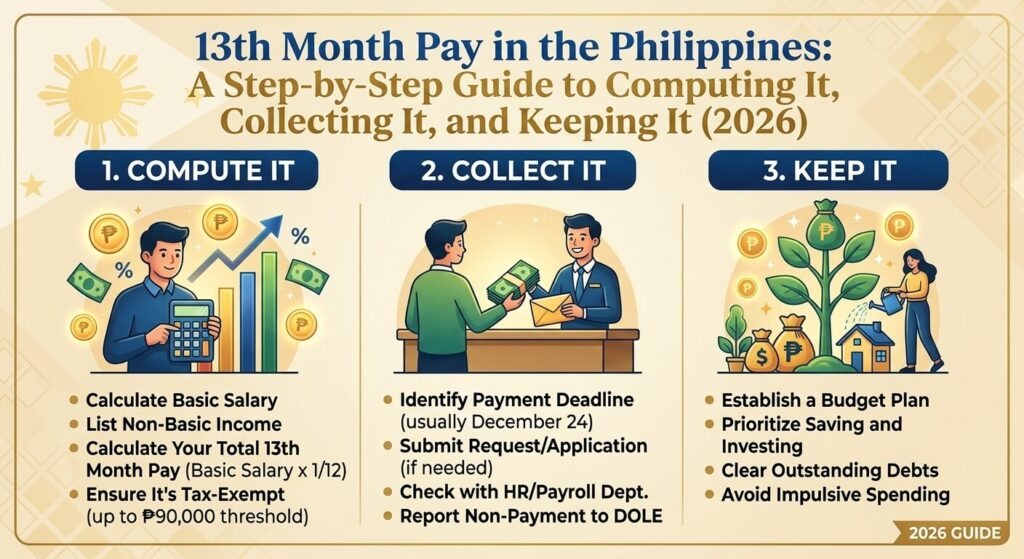
Step 1: Find out whether you’re covered
PD 851 covers rank-and-file employees in the private sector, regardless of the nature of their employment, who have worked at least one month during the calendar year. Managerial employees aren’t covered.
A few groups sit outside PD 851:
- Government employees, who are covered by separate rules and benefits.
- Employers who already pay an equivalent benefit (more on that in Step 3).
- Workers paid purely on a commission, boundary, or task basis. Piece-rate workers are covered.
- Household helpers, who aren’t covered by PD 851 itself. Kasambahay get their own 13th month pay under Republic Act 10361, after at least one month of service.
A business can’t skip it just because money is tight. The rules allow exemption for distressed employers only with the Labor Secretary’s prior authorization.
Step 2: Compute your amount
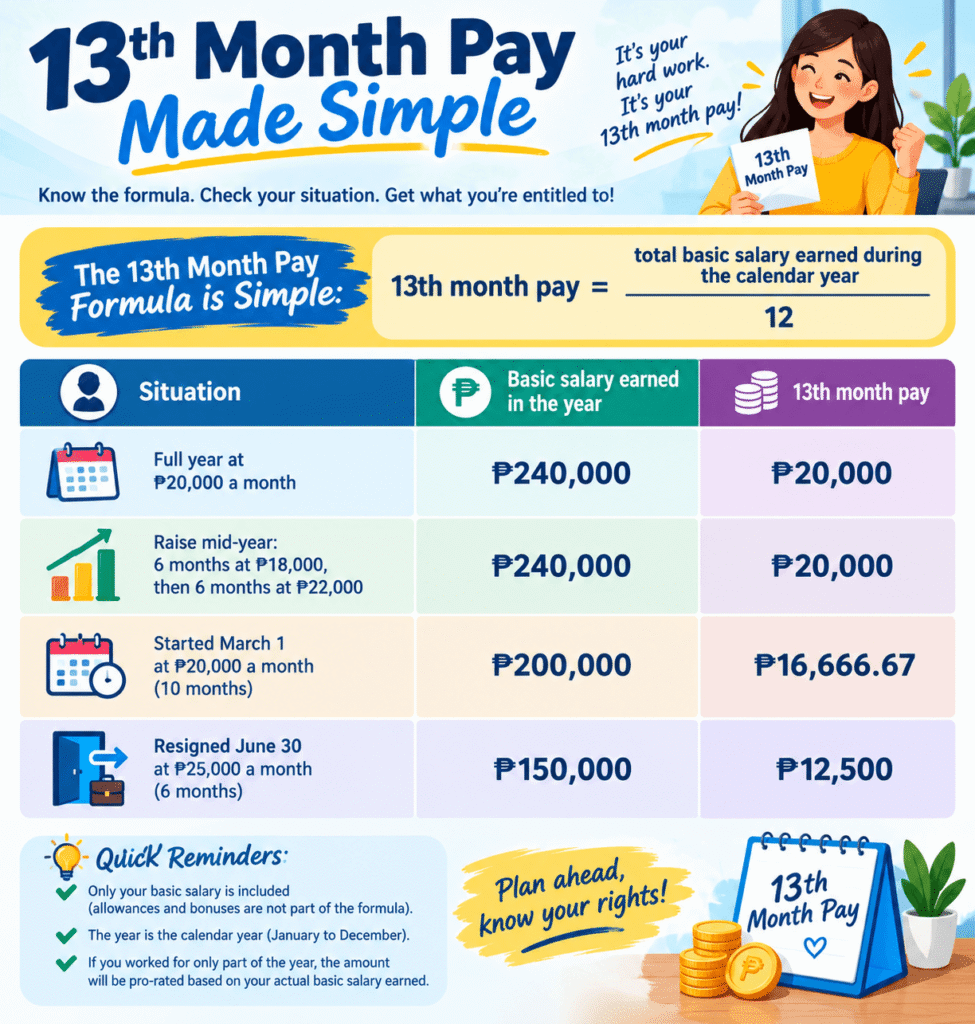
The 13th month pay formula is simple:
13th month pay = total basic salary earned during the calendar year ÷ 12
It equals one month’s salary only if you worked the full year with no raise. The part that trips people up is what counts as “basic salary.” DOLE’s guidance excludes overtime pay, premium pay, night shift differential, holiday pay, the cash value of unused leave, and allowances or other benefits that aren’t integrated into your regular basic salary. If your pay includes those, don’t count them, and don’t assume you were shortchanged if your 13th month pay comes out lower than your take-home.
| Situation | Basic salary earned in the year | 13th month pay |
|---|---|---|
| Full year at ₱20,000 a month | ₱240,000 | ₱20,000 |
| Raise mid-year: 6 months at ₱18,000, then 6 months at ₱22,000 | ₱240,000 | ₱20,000 |
| Started March 1 at ₱20,000 a month (10 months) | ₱200,000 | ₱16,666.67 |
| Resigned June 30 at ₱25,000 a month (6 months) | ₱150,000 | ₱12,500 |
A few more notes on the numbers:
- Partial years are pro-rated. Anyone who worked at least one month gets a proportionate amount, including people who resign or are separated, who should ask for it as part of their final pay.
- It’s based on pay you actually earned, so unpaid absences lower the total.
- If part of your pay is commission, your treatment depends on your arrangement. Workers paid only on commission aren’t covered, but workers with a guaranteed wage plus commission are. How the commission counts depends on whether it’s direct pay for your services, so ask HR or DOLE if the amount looks off.
Step 3: Know the payment rules
- December 24 is a deadline, not a payday. Your employer can pay earlier, and DOLE encourages it. The legal limit isn’t the next regular payday, an audit, or when customers pay the company. A release after December 24, including in January, is late.
- It can be split. Employers may pay in two installments, one before the school year opens (around June) and the balance by December 24, or pay it all in December. What matters is that the full amount is paid by the deadline.
- A Christmas bonus only substitutes if it’s big enough. If your company already gives a Christmas bonus or similar benefit, it counts as the equivalent only if it’s worth at least one-twelfth of your basic salary. If it’s less, your employer owes the difference.
Step 4: Understand the tax
Your 13th month pay and other bonuses and benefits, such as a Christmas bonus or productivity incentive, are tax-exempt up to a combined ceiling of ₱90,000 a year under the TRAIN Law (Republic Act 10963). Only the amount above that is added to your taxable income. The ceiling is shared, not ₱90,000 for each benefit.
Example: ₱30,000 in 13th month pay, a ₱30,000 Christmas bonus, and a ₱40,000 productivity incentive add up to ₱100,000. Only the ₱10,000 above the ceiling is taxable. For most workers, the 13th month pay alone is well under the cap, since you’d need a basic salary above ₱90,000 a month to reach it by itself.
You may see bills in Congress proposing to raise the ceiling to ₱150,000. Those are proposals, not law, and the ₱90,000 ceiling is unchanged for 2026.
Step 5: Plan the money before it lands
This isn’t financial advice, and your situation is your own. But a common order of priorities, from the simplest financial-literacy advice, is:
- Cover what’s due. Upcoming tuition, utilities, rent, and any payment that carries a penalty if you miss it.
- Pay down high-interest debt, especially credit cards, since interest compounds faster than almost any savings account earns.
- Top up an emergency fund before spending on wants.
- Set the holiday budget as a number before you shop, not after.
If part of your plan is trimming recurring costs, our bill negotiation guide walks through how to lower the bills you already pay. And be wary of “Christmas loan” and online-selling offers that show up around payday season. If it asks for money or a deposit first, it’s not an opportunity.
Step 6: If it doesn’t arrive, or it’s the wrong amount
- Check your own math first using Step 2, including what’s excluded from basic salary.
- Ask HR in writing, stating the amount you computed and the December 24 deadline. Keep a copy.
- After December 24, file a Request for Assistance with DOLE through its Single Entry Approach (SEnA). It’s a free, mandatory 30-day conciliation-mediation process and the usual first step for unpaid wages and benefits. You can file at your DOLE regional or field office or through DOLE’s online SEnA portal, and call DOLE’s hotline, 1349, if you’re not sure where to start.
- Bring your records: payslips, your contract, and your computation. A partial payment doesn’t end your claim. If you were paid less than you’re owed, you can pursue the difference.
You don’t have to accept a postponement if your employer offers one after the deadline, though some workers choose to wait for a credible written schedule.
The bottom line
December 24 is the deadline, the formula is one-twelfth of basic salary actually earned, and overtime and allowances don’t count. Check your computation now, so you know what to expect, and so you can spot a shortfall in time to do something about it.
Frequently asked questions
No. The 13th month pay is mandatory under PD 851. A Christmas bonus is discretionary unless your contract or company policy promises it. A bonus can substitute for the 13th month pay only if it’s worth at least one-twelfth of your basic salary.
Yes, a proportionate amount based on the basic salary you earned up to your last day of work. Ask for it as part of your final pay, and check your computation with Step 2.
PD 851 applies regardless of the nature of employment, as long as you’re a rank-and-file employee who worked at least one month, and your amount is based on the basic salary you actually earned. Freelancers and independent contractors aren’t employees, so PD 851 doesn’t apply to them.
Kasambahay are entitled to a 13th month pay under RA 10361, after at least one month of service. Government employees aren’t covered by PD 851 and receive benefits under separate rules.
Not on its own say-so. The deadline is December 24, and the rules allow exemption for distressed employers only with the Labor Secretary’s prior authorization. If your pay is delayed, you can raise it with DOLE after the deadline.
Compiled and cross-checked against the text of PD 851 and its implementing rules as reproduced by legal publishers, DOLE Labor Advisory No. 018-18 (the definition of basic salary), DOLE Labor Advisory No. 16, series of 2025 (the most recent annual guidance available) as circulated by PMAP and Grant Thornton Philippines, the TRAIN Law’s tax ceiling (NIRC Section 32(B)(7)(e) as amended by RA 10963), and legal explainers on DOLE’s Single Entry Approach. Rules are current as of late October 2026. DOLE usually issues a fresh advisory shortly before the December 24 deadline, so check it when it’s released. This is general information, not legal, tax, or financial advice.