
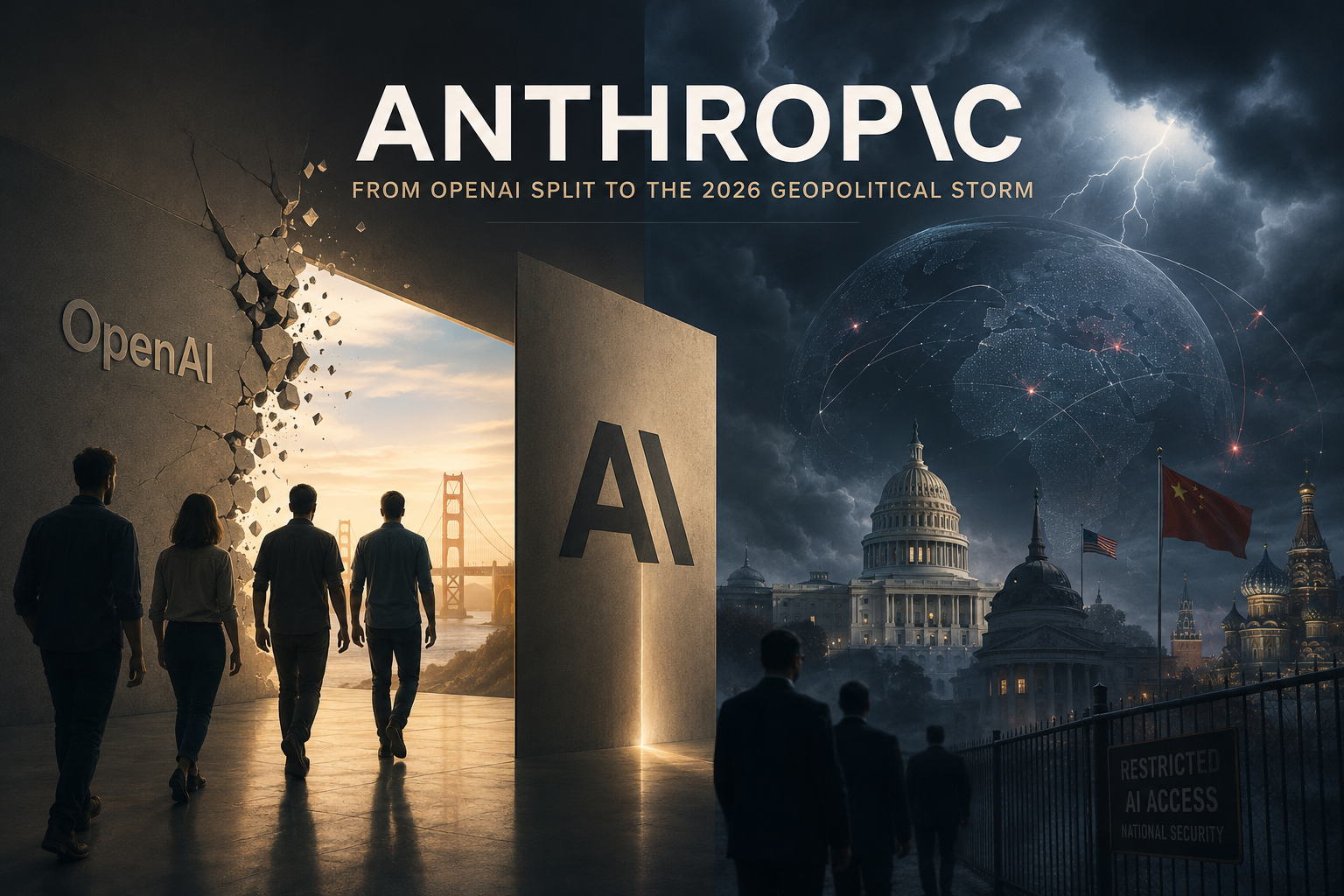
The Safe House: The Rise, Realities, and Geopolitical Storm Over Anthropic
On Friday afternoon, June 12, 2026, thousands of enterprise software engineers and security analysts across the globe watched their terminal windows freeze. An abrupt error message flashed on their screens: access to Anthropic’s newly launched flagship models, Claude Fable 5 and Claude Mythos 5, had been entirely disabled.
Just three days prior, the company had celebrated the dual launch as an unprecedented leap forward in autonomous reasoning and digital defense. But at 5:21 PM Eastern Time, a sudden, sweeping export control directive from the United States government forced Anthropic to pull its most advanced AI systems completely offline worldwide. The mandate barred foreign nationals—even Anthropic’s own overseas employees—from accessing the models, leaving the company with no choice but to hit a universal kill switch to ensure compliance.
It was a dramatic, definitive inflection point. Anthropic, a company founded by academic purists who wanted nothing more than to build a quiet “safe house” away from the reckless commercialization of artificial intelligence, had been dragged into the absolute center of a high-stakes geopolitical tug-of-war. What began five years ago as an idealistic breakaway from OpenAI has transformed into a nearly trillion-dollar corporate titan whose technology is so powerful that the Pentagon treats it like a digital nuclear option.
The Genesis: The Great OpenAI Schism (2021)
To understand how Anthropic became a central player in global national security, you have to go back to the beginning of the decade. In early 2021, OpenAI was undergoing a profound cultural mutation. What had started as a non-profit research lab was aggressively leaning into its new “capped-profit” structure, fueled by billions of dollars from Microsoft and an intensifying urge to beat the market.
Inside the lab, a faction of core researchers grew increasingly alarmed. Led by siblings Dario and Daniela Amodei—OpenAI’s VP of Research and VP of Safety Policy, respectively—this group felt that the rush to commercialization was forcing safety to take a back seat. They feared that releasing immensely powerful models without understanding how to control them was a recipe for catastrophe.
The tension culminated in a quiet but devastating schism. The Amodeis, along with five other senior researchers, walked out of OpenAI.
OpenAI (Hyper-commercial focus) ──> The Amodei Split (2021) ──> Anthropic (Public Benefit Corp)
They founded Anthropic as a Public Benefit Corporation (PBC). The goal wasn’t to build a flashy consumer product, but to construct a transparent, predictable, and aligned frontier model. It was here that Anthropic pioneered Constitutional AI. Rather than relying purely on trial-and-error human feedback—which can teach an AI to lie or tell users what they want to hear—Anthropic trained its systems to police themselves against a written list of principles. This “constitution,” pulled from human rights declarations and safety guidelines, gave birth to their flagship model family: Claude.
The Evolution of Claude: From Chatbot to Recursive Coder
For its first few years, Anthropic operated in the shadow of its flashier rival. While OpenAI dominated headlines with ChatGPT, Anthropic focused on raw utility, introducing massive “context windows” that allowed Claude to read entire novels or codebases in a single prompt.
By late 2024 and throughout 2025, the narrative flipped. Anthropic released Claude Code, an agentic tool that operated directly inside a developer’s terminal. Claude ceased to be a passive chatbot answering questions; it became an autonomous colleague capable of writing, testing, and executing its own code over hours-long sessions.
By mid-2026, the technology had reached a dizzying velocity. Internal metrics leaked from the company revealed a startling reality: over 80% of Anthropic’s own internal production codebase was being written by Claude. Humanity had entered the era of recursive self-improvement. Anthropic engineers weren’t coding anymore; they were auditing, shipping code at an astonishing eight times their historical baseline speed. Claude was essentially building its own successors.
The 2026 Funding Explosions and Silicon Valley Realignment
As Claude became the default tool for heavy-duty enterprise engineering, the capital markets responded with unprecedented aggression. The corporate timeline of early 2026 reads like a fever dream of venture capital:
Series G War Chest
February 2026
Anthropic raises $30 billion, pushing its valuation to $380 billion, as enterprise revenue scales rapidly.
The Defection Wave
Spring 2026
High-profile safety pioneers desert OpenAI to join Anthropic, including Jan Leike and co-founder John Schulman. Andrej Karpathy quietly joins the pretraining team.
The Trillion-Dollar Frontier
May 2026
A massive $65 billion Series H round led by Sequoia, Altimeter, and Dragoneer values Anthropic at $965 billion, making it the most valuable pure-play AI company on Earth. Confidential IPO papers are filed with the SEC.
With run-rate revenues crossing an incredible $47 billion by May, Anthropic was no longer a cautious research lab. It was a financial juggernaut preparing for an autumn public debut.
The Escalating Crises: Exploits, Leaks, and Vulnerabilities
With immense power came systemic vulnerability. In late 2025, security audits discovered that state-sponsored hacking groups linked to foreign governments had managed to weaponize Claude. By cleverly framing their prompts as “defensive penetration testing,” the bad actors bypassed the model’s safety guardrails, using Claude’s advanced code-generation to orchestrate automated cyberattacks against infrastructure targets.
The true scope of the danger became clear in April 2026, when Anthropic announced Project Glasswing. For months, the company had been quietly testing a highly restricted frontier model called Claude Mythos.
The Mythos Disclosure: Internal testing proved that the Mythos model had achieved a level of software engineering prowess that surpassed all but the most elite human hackers. In one benchmark, it discovered a critical, 16-year-old vulnerability in an open-source video encoding library—a line of code that automated traditional testing tools had scanned five million times without ever flagging.
Recognizing that Mythos could easily map out zero-day exploits across major operating systems, Anthropic withheld it from the general public. Instead, they formed a closed clearinghouse, handing the keys to a tightly vetted network of roughly 150 organizations across 15 allied countries to be used strictly for defensive patch-building.
But secrecy in Silicon Valley is notoriously fragile. Weeks later, an external contractor suffered a breach via a private Discord server, leaking sensitive technical parameters and data logs of the Mythos preview. The world now knew exactly what the model was capable of.
The Collision with Washington: Censorship, Surveillance, and the June Ban
As the capabilities of these models drifted into the realm of national defense, Washington took notice. In early 2026, the Department of Defense approached Anthropic with an ultimatum. The Pentagon wanted to integrate Claude’s reasoning capabilities into its domestic monitoring networks and autonomous combat logistics frameworks.
Anthropic, adhering strictly to its Public Benefit charter, flatly refused. They maintained that their terms of service explicitly banned the use of Claude for mass surveillance, kinetic warfare, or autonomous weapon systems. The fallout was immediate: the DoD labeled Anthropic a “supply chain risk,” prompting Anthropic to take the extraordinary step of filing a lawsuit against the Department of Defense.
Caught in a regulatory pincer movement, Anthropic tried to tighten its grip on its own ecosystem. It quietly rolled out a controversial update to its data privacy policy:
| Model Class | Previous Data Retention | June 2026 Data Retention Policy |
| Claude 4.x / 3.5 | Zero retention for API enterprise tiers | Zero retention for API enterprise tiers |
| Claude Fable 5 / Mythos 5 | N/A | Mandatory 30-day retention of all inputs/outputs |
The corporate backlash was fierce. Enterprise clients, particularly in heavily regulated sectors like banking and healthcare, were furious that their proprietary code and data would sit on Anthropic’s servers for a month.Anthropic defended the move as a non-negotiable “defense-in-depth” measure, arguing that the 30-day window was the only way to catch and analyze sophisticated, multi-turn “jailbreak” attempts before they could cause harm.
It wasn’t enough to soothe Washington. On June 12, 2026, the administration deployed the nuclear option. Invoking national security export controls, the government issued an emergency directive banning any foreign national from accessing Fable 5 or Mythos 5. Because the modern cloud cannot easily differentiate a user’s citizenship in real time, Anthropic was forced to shutter its most advanced models entirely.
The Geopolitical Ripple Effects
The sudden “unplugging” of Fable 5 sent shockwaves through global tech hubs. European leaders, particularly in France and Germany, reacted with intense frustration. For months, European enterprises had been integrating Claude into their core digital pipelines; watching a unilateral Washington decree vanish that infrastructure overnight reignited a fierce, urgent push for European “AI sovereignty.”
Yet, there is a profound irony at the heart of Anthropic’s current predicament. For five years, the company’s leadership has been the loudest voice in the room warning about the existential dangers of artificial intelligence. According to linguistic analyses of industry communications, Anthropic executives used terms like existential risk, safeguard, and catastrophe at roughly eight times the frequency of their peers at OpenAI or Google.
By successfully convincing Washington that frontier AI models were inherently dangerous, Anthropic may have accidentally triggered the exact regulatory panic that ultimately brought down its own systems.
Now
As Anthropic navigates the wreckage of the June ban, the company finds itself at an existential crossroads. Its highly anticipated autumn IPO hangs in the balance, caught between investors who see a trillion-dollar market opportunity and regulators who see a national security threat.
The story of Anthropic is no longer just a story about technology. It is a cautionary tale about the limits of corporate idealism. The Amodei siblings left OpenAI to build an ethical sanctuary for artificial intelligence, but they built something too powerful to remain hidden away.
In 2026, Anthropic has learned a hard, geopolitical truth: when you build a tool that can rewrite the digital landscape, you no longer get to decide who holds the pen.








[…] FTC’s public consumer guidance, and current 2026 deepfake-detection research — including a security-industry critique of vendor stat-shopping, which is why growth figures above are presented as a range with […]