A Comprehensive Guide to Modern Impersonation Scams
There was a time when spotting a scammer was easy. You’d open your inbox to find a poorly formatted email from a distant foreign prince, riddled with spelling errors and offering a suspicious multi-million-dollar inheritance. You’d laugh, hit delete, and move on with your day.
Those days are officially over.
Today, impersonation scams have evolved into highly sophisticated, psychologically weaponized operations. Driven by artificial intelligence, massive data breaches, and cutting-edge social engineering, modern scammers don’t just ask for your money—they manipulate your reality. They look like your bank, sound like your boss, and can even mimic the voice of your children.
To protect yourself, your family, and your business, you need to understand exactly how these digital predators operate, how to spot their traps, and how to build an airtight defense against them.
1. The Anatomy of Modern Impersonation Scams
At its core, an impersonation scam occurs when a criminal adopts a trusted identity to manipulate you into handing over money, sensitive data, or personal credentials.
While the tools have changed, the fundamental psychological triggers remain deeply rooted in human nature. Scammers don’t exploit technical glitches in our computers; they exploit vulnerabilities in our psychology.
[Scammer Deploys Persona] ➔ [Triggers Emotional State] ➔ [Bypasses Logical Thinking] ➔ [Extracts Value]
The Psychological Triggers
- The Illusion of Authority: Human beings are conditioned to obey authority figures. When a communication appears to come from the IRS, the FBI, a high-ranking corporate executive, or a utility company, our default response is compliance. Scammers weaponize this instinct to bypass your natural skepticism.
- Manufactured Urgency and Fear: Logic takes a backseat when the brain enters a state of panic. Phrases like “Your account will be terminated in two hours” or “A warrant has been issued for your arrest”are designed to induce stress, forcing you to act instantly before you have time to think critically or verify the claim.
- The “Helpful Savior” and Greed: Not all scams rely on fear. Some exploit our desire for a windfall or relief. An unexpected refund notice, a technical support agent “reaching out to fix a virus you didn’t know you had,” or a notification that you’ve won a lottery can lower your guard through sheer excitement.
2. The Rogue’s Gallery: Common Scam Personas
Scammers are digital actors, and they have a revolving wardrobe of characters. The most prevalent personas operating today include:
The Government Agent
This is the blunt-force weapon of impersonation. Someone posing as a tax official, law enforcement officer, or Social Security administrator contacts you claiming you owe back taxes, have committed identity fraud, or face imminent arrest. They demand immediate payment to “settle the case” outside of court.
The Trusted Brand
You likely receive emails or texts from Amazon, Netflix, PayPal, or your bank every week. Scammers capitalize on this familiarity by sending fake notifications about “suspicious login attempts,” “locked accounts,” or “unauthorized purchases.” When you click the link to resolve the issue, you are directed to a spoofed page designed to steal your credentials.
The Tech Support Savior
This scam usually begins with a sudden, loud pop-up on your web browser claiming your computer is infected with malware. It provides a “toll-free” number to call. Once on the phone, the fake technician convinces you to download remote-access software, giving them complete control over your computer, personal files, and bank accounts.
The Workplace Executive (CEO Fraud)
Targeting businesses of all sizes, this scam involves an email disguised to look exactly like it came from the CEO, CFO, or an established vendor. It typically requests an urgent wire transfer, a change in vendor payment routing details, or the immediate purchase of gift cards for an “employee appreciation event.”
The Distressed Relative
Often referred to as the “Grandparent Scam,” this heart-wrenching tactic targets older adults. The scammer poses as a grandchild or child who has been arrested, involved in a car accident, or stranded in a foreign country. They beg for money to be sent immediately via wire transfer or cryptocurrency, pleading, “Please don’t tell mom and dad.”
The Romantic Interest
Playing the long game, these scammers create elaborate, highly attractive fake profiles on dating apps or social media. Over weeks or months, they build genuine emotional bonds. Once you are emotionally invested, disasters inevitably strike—medical emergencies, visa issues, or failed business deals—requiring you to send financial aid.
3. The Digital Toolkit: How Scammers Mask Themselves
Modern scammers possess an impressive array of technological tools that allow them to wear their stolen identities with near-flawless precision.

Spoofing and Channel Delivery
Scammers rarely use their actual phone numbers or email addresses. Instead, they use technology to manipulate what appears on your screen:
- Phishing (Email): They alter email headers so the “From” field displays a legitimate domain, or they use typosquatting—registering domains that look remarkably similar to real ones (e.g.,
support@amazeon.com). - Smishing (SMS/Text): Using internet-based texting services, scammers can make their text messages appear in the exact same conversational thread as legitimate messages from your bank or delivery service.
- Vishing (Voice calls): They manipulate caller ID spoofing software so your phone screen displays the name of your local police department, utility company, or bank.
AI Voice Cloning and Deepfakes
The newest and most terrifying tool in the scammer’s arsenal is generative AI. Using a snippet of audio as short as 30 seconds—often harvested from a public video on Instagram, TikTok, or YouTube—scammers can clone a person’s exact voice. When they call a target pretending to be a kidnapped or injured relative, the voice on the other end sounds genuinely indistinguishable from the loved one.
Data Harvesting
Scammers don’t always guess your information. Thanks to countless corporate data breaches, large amounts of your personal data are readily available on the dark web. A scammer might call you already knowing your full name, home address, date of birth, and even the last four digits of your Social Security number or credit card, using these facts to manufacture instant credibility.
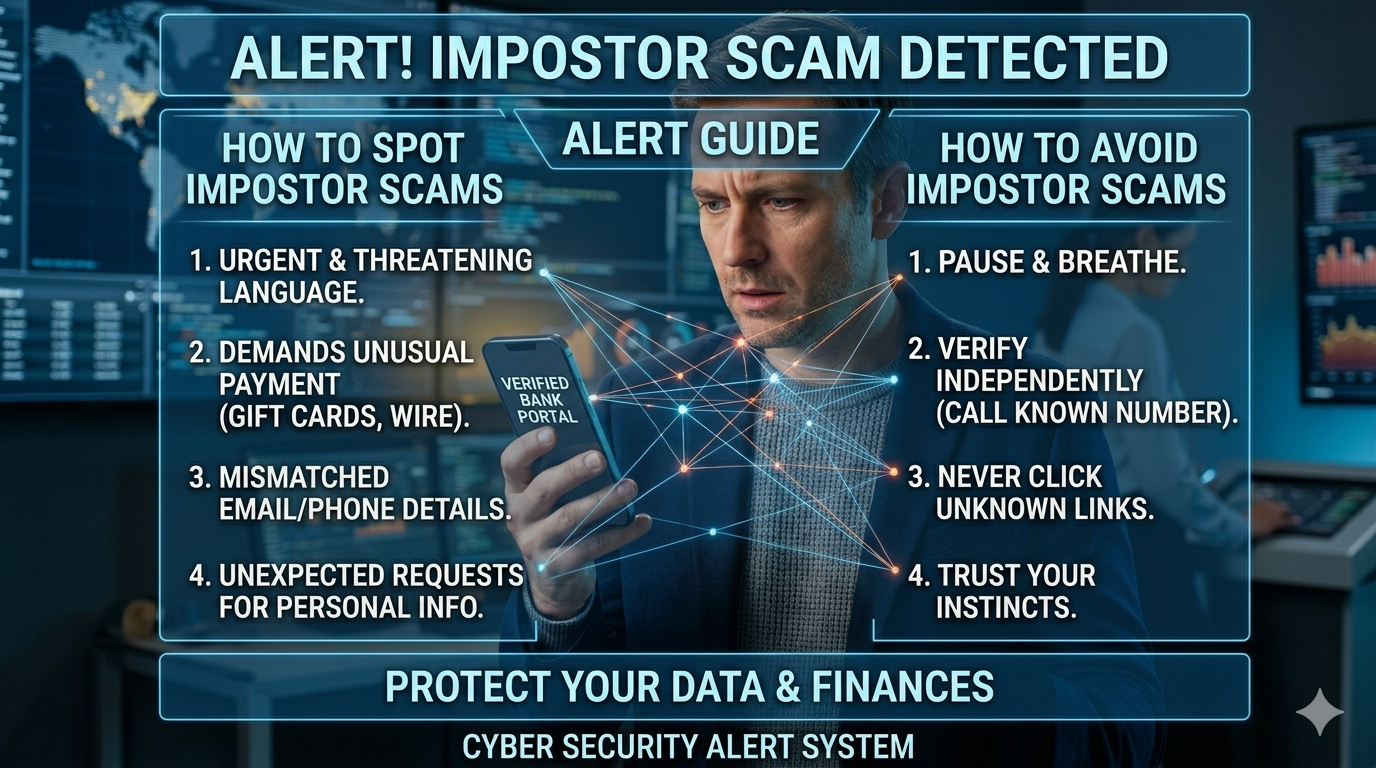
4. Red Flags: How to Spot an Impersonation Attempt
Despite their sophistication, scammers almost always leave clues. If a communication displays any of the following characteristics, treat it as a definitive red flag.
| Red Flag | What It Looks Like | Why Scammers Use It |
| Unusual Payment Methods | Demands for gift cards, cryptocurrency, or immediate wire transfers. | These methods are irreversible, untraceable, and bypass standard banking fraud protections. |
| Mismatched Digital DNA | The display name says “IRS,” but hovering over the email reveals agent532@gmail.com. | They can fake the display name easily, but masking the underlying server domain is much harder. |
| The “Circuit Bypasser” | A manager texting your personal phone demanding a wire transfer, bypassing corporate Slack/Teams. | Moving you off standard, monitored communication channels prevents internal security systems from catching them. |
| Emotional Extremes | High-pressure tactics, threats of legal action, or demands for absolute secrecy. | Panic and excitement short-circuit your critical thinking, forcing compliance before logic kicks in. |
| Generic Salutations | Messages starting with “Dear Customer” or “Dear Policyholder” from a service you use daily. | Mass-scale phishing campaigns often lack the capability to dynamically inject individual names. |
5. Proactive Defense: How to Avoid and Neutralize Scams
Protecting yourself requires implementing a strict set of personal communication protocols. Think of these as building digital firewalls around your daily interactions.
The “Circuit Breaker” Protocol
If you receive an unexpected message that causes your heart rate to spike or requests sensitive actions, immediately execute these three steps:
1.Stop and Breathe:Immediate.
Force a deliberate pause. Acknowledge that the urgency you feel is artificially manufactured by the sender. Do not click any links, download attachments, or reply.
2.Sever the Connection:Within 10 seconds.
Hang up the phone, close the email, or lock your device. Do not engage, argue, or attempt to outsmart the scammer—just cut the line.
3.Verify via Trusted Channels:Within 5 minutes.
Look up the organization’s official, public phone number or website independently (e.g., from a utility bill, the back of your credit card, or an official government portal). Call them directly to verify the claim. Never use the phone number or links provided within the suspicious message.
Essential Digital Hygiene Habits
- Implement Multi-Factor Authentication (MFA): Ensure MFA is active on all vital accounts—especially email, banking, and social media. Even if a scammer steals your password via a fake page, they won’t be able to log in without your secondary verification token.
- Audit Your Social Media Privacy: Scammers scrape social media to learn your family members’ names, travel plans, and voice samples. Set your profiles to private and restrict your friend lists to people you actually know in real life.
- Establish a Family Safe Word: Sit down with your family and establish a secret word or phrase that is never written down or shared online. If you ever receive a frantic, high-stakes phone call from a loved one demanding money, ask them for the safe word. If they cannot provide it, you know instantly it’s an AI voice clone.
6. The Cleanup: What to Do If You’ve Been Scammed
If you realize you have fallen victim to an impersonation scam, time is your most valuable asset. Shame and panic will only freeze you; decisive action can mitigate the damage.
Immediate Action Required: If you shared banking details or sent money, your first call must be to your bank’s fraud department. They can often freeze funds, recall wire transfers, or close compromised accounts if notified quickly enough.
1. Secure Your Identity
If you gave up personal details like your Social Security number or date of birth, contact the major credit bureaus (Equifax, Experian, and TransUnion) to place a credit freeze on your file. This prevents scammers from opening new credit cards or loans in your name.
2. Triage Your Devices and Accounts
If you granted remote access to a “tech support” scammer, disconnect your device from the internet immediately. Take it to a certified professional to be wiped and scanned for persistent malware or keystroke loggers. Change the passwords to every single account you accessed while the scammer had control, prioritizing your email and financial portals.
3. File Official Reports
Report the incident to local law enforcement and national consumer protection watchdogs (such as the Federal Trade Commission at reportfraud.ftc.gov if you are in the United States). While it may feel like shouting into the void, these reports help authorities track scam networks, shut down fraudulent infrastructure, and occasionally recover assets.
Impersonation scams will continue to evolve as technology advances, but their core weapon will always remain the same: manipulating your trust. By maintaining a healthy level of skepticism, verifying every urgent request at the source, and keeping your digital footprint secure, you can ensure that you stay one step ahead of the deception.