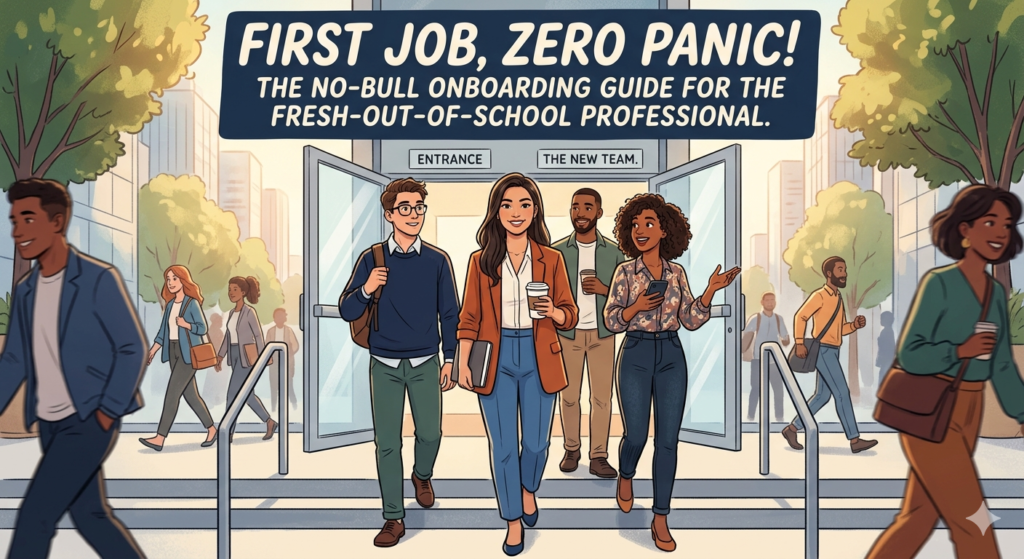
The No-BULL Onboarding Guide for the Fresh-Out-of-School Professional
So, you did it. You survived the brutal gauntlet of resume edits, polished your LinkedIn profile until it practically sparkled, survived three rounds of interviews, and landed the job. The excitement lasted for about twenty-four hours. Then, the reality hit. Your stomach did a slow flip, and that tiny, annoying voice in the back of your head started whispering: “What if they realize I have absolutely no idea what I’m doing?”
First off: take a deep breath. Drop your shoulders. What you are feeling right now is the textbook, universally experienced “Oh crap, I’m an adult” moment. It is the cocktail of pure excitement mixed with a heavy splash of imposter syndrome.
Here is the absolute truth about your first day: no one expects you to walk in and build a rocket. Your new manager doesn’t expect you to save the company millions of dollars by lunchtime. In reality, they are mostly just hoping you show up on time, don’t microwave fish in the breakroom, and don’t accidentally delete a shared cloud drive. Your first day is not a test of your skills; it’s just an orientation. This guide is your roadmap to navigate that transition seamlessly, without the corporate fluff.
The Invisible Prep (The Night Before)
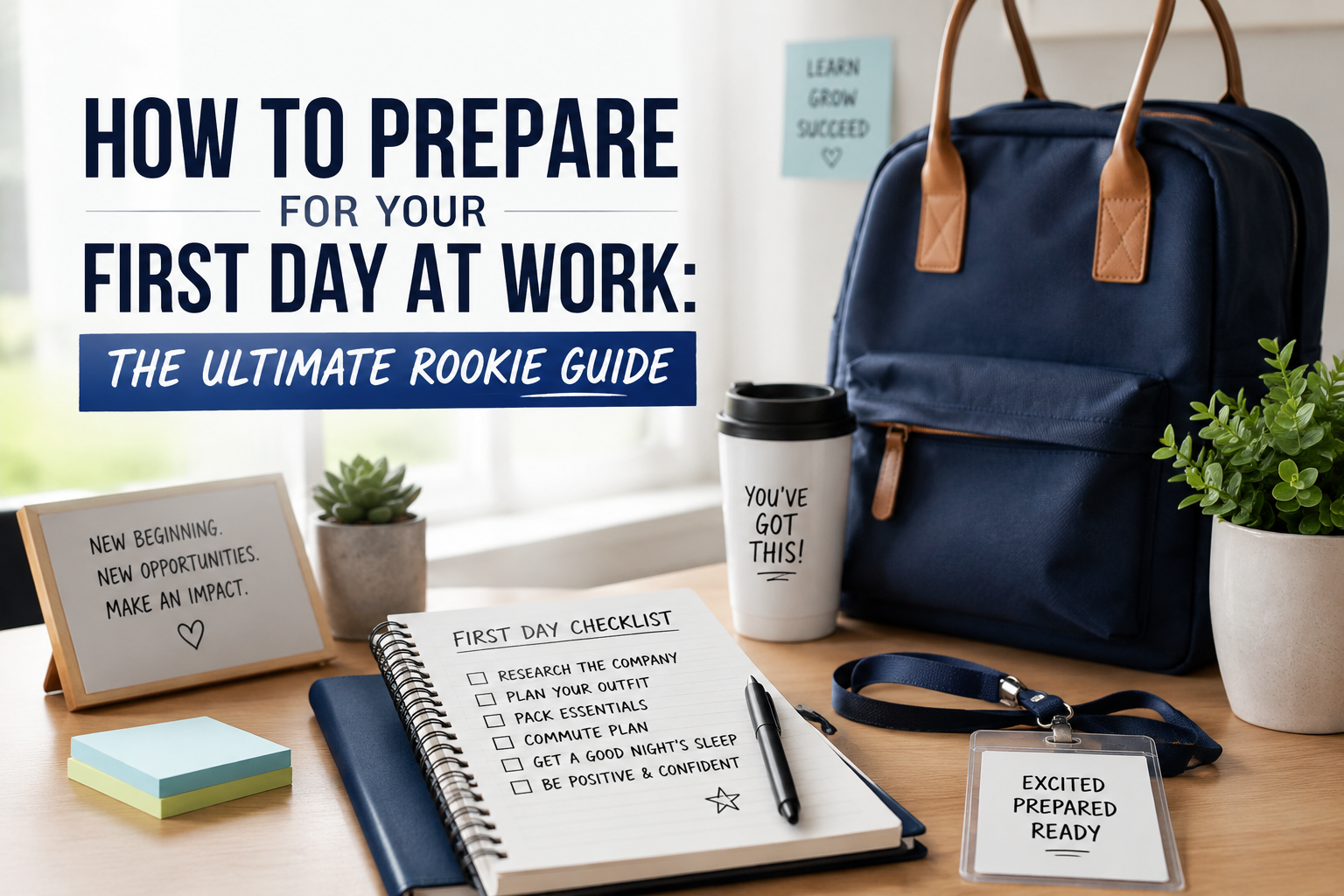
The secret to a flawless first day actually happens the night before. When you are nervous, your brain experiences decision fatigue incredibly fast. If you wake up on day one trying to decide what to wear, what to eat, and where your keys are, you’re already starting on the back foot.
Do the “parent move.” Pick out your outfit before you go to sleep. Go a tiny bit sharper than you think you need to—it is always safer to be slightly overdressed on day one than the person who showed up in casual weekend wear because they misjudged the vibe. Pack your bag. Put a notebook, a couple of pens, a water bottle, and a snack in there.
Next, map your commute. Check the route the night before, and then add a ridiculous 20-to-30-minute buffer to whatever the GPS tells you. If there is a random transit delay or an unexpected traffic jam, you won’t be sweating through your shirt. If you end up arriving 45 minutes early, do not go inside. Walking into an office nearly an hour early makes you look a bit like a stalker, and it stresses out your manager because they aren’t ready for you yet. Park down the street, grab a coffee, and kill time until exactly 10 or 15 minutes before your start time. That is the golden window.
If You Are Remote (The WFH Reality Check)
Working from home doesn’t mean you get to roll out of bed at 8:59 AM. Treat the night before the exact same way. Test your Wi-Fi. Clear the visible clutter behind your desk chair so your background looks clean on camera. Most importantly, plug in your work laptop and turn it on the night before. There is nothing worse than opening your computer at 8:55 AM only to see the words: “Installing Update 1 of 47… Estimated time remaining: 1 hour.”
Day One: Navigating the Human Jungle
When you step through those doors, your main mission isn’t to do work—it’s to manage your presence. You are going to meet a blur of faces, and you will almost certainly forget every single one of their names within thirty seconds. That is completely fine. Nobody expects you to remember everyone.
Instead, just focus on being warm and approachable. Have a dead-simple, un-cringey introduction script ready so you don’t stumble over your words. Something like:
“Hi, I’m Alex. I’m joining the team as the new marketing coordinator. It’s really great to meet you!”
Say it with a smile, make eye contact, and give a firm handshake if that’s the vibe of the office.
💡 THE NOTEBOOK WEAPON
Always carry a physical notebook and pen with you on day one.
Even if you have a laptop or a phone, pulling out your phone to
take notes makes you look like you're checking your text messages.
Writing things down physically shows you are engaged, respect
the person's time, and are actively trying to learn.
When someone is showing you how to log into the software, use the printer, or access the shared drive, write it down. Your brain is going to be hit with a massive firehose of information, and by 3:00 PM, your memory will be absolute mush. You will thank your past self tomorrow when you don’t have to ask how to log into the HR portal for the fourth time.
Finally, if someone invites you to lunch or a coffee break, always say yes. Even if you brought a packed lunch, put it back in the fridge. This casual, non-work time is where the real onboarding happens. It’s where you find out who actually knows how to fix the printer, which manager prefers emails over Slack messages, and where the good coffee is hidden.

Surviving the Corporate Firehose (The First Week)
By Wednesday of your first week, reality will start to set in. You’ll likely be handed training manuals, compliance videos, and a mountain of HR paperwork. It is notoriously boring, but it’s a rite of passage.
During this phase, adopt the “Sponge Strategy.” When you are fresh out of school, it is incredibly tempting to want to prove your worth immediately. You might see a process that looks inefficient and want to jump in and say, “Hey, we learned a way better way to do this in my college classes!”
Resist that urge. For the first few weeks, your job is just to observe. You need to understand why a system is broken before you try to fix it. Sometimes, that inefficient spreadsheet exists because a major client requires it, or because of a specific legal regulation. Learn the rules of the house before you try to remodel it.
The Art of the “Dumb” Question
A lot of new hires stay silent because they are terrified of looking stupid. So they nod, say they understand, and then spend three hours panicking at their desk because they don’t know what an acronym means.
Good Question: "Just to make sure I'm on the right track, you'd like me to pull the Q3 data from this folder and format it like the example you showed me, correct?"

Bad Question: "What am I supposed to be doing right now?"
Asking for clarification isn’t a sign of weakness; it’s a sign of competence. It shows you care about doing the job right the first time. Just make sure you check your notes first to see if the answer is already written down.
The 30-Day Transition: Settling into the Groove
Once the initial novelty wears off, you’ll start transitioning into your actual day-to-day routine. This is where you have to learn to manage a new kind of physical and mental fatigue. Working a full 8-to-5 shift is vastly different from a college schedule where you had breaks between classes. You might find yourself completely wiped out by Thursday night. Give yourself time to adapt to this new rhythm.
This is also the time to set healthy boundaries. When you want to impress people, it’s easy to fall into the trap of answering emails at 10:00 PM or staying late every night just to look dedicated. But doing that sets an unsustainable expectation. Work hard while you are on the clock, but when the day is done, log off.
Lastly, try to find your “work bestie.” Look for someone who has been there a bit longer but is still approachable. Having just one person you can text to ask, “Hey, is this email tone okay?” or “How do I submit an expense report?” makes the workplace feel 200% friendlier and less intimidating.
Give Yourself Some Grace
When Friday afternoon finally rolls around on your first week, your brain is going to feel completely fried. You might sit in your car or on the transit ride home feeling overwhelmed by how much you still don’t know.
That is totally normal. It’s a feature of the transition, not a bug. Remind yourself of this very important fact: they interviewed a lot of people, and they chose you. They saw your potential, your attitude, and your drive, and they deemed you the right person for the team. You earned your seat at the table. Now, go home, treat yourself to a great dinner, unplug, and get some rest. You’ve got this.