I Had No Idea What I Was Watching — Until Someone Explained the Tour de France to Me
The first time I watched the Tour de France, I was completely lost.
A friend had it on in the background at his place, and I remember staring at the screen thinking — why is everyone cheering? Some guy in a yellow shirt just crossed the finish line in what looked like the middle of the pack. A different rider had actually come in first. Nobody seemed to care about that guy. I asked my friend what was going on, and he launched into this ten-minute explanation that somehow made me more confused.
That was five years ago. Now I’m the annoying one explaining it at parties.
So here’s everything I wish someone had just told me upfront.
The one rule that unlocks everything
Forget about who crosses the finish line first on any given day. That almost doesn’t matter.
The Tour de France is decided by total time across all 21 stages. Every day’s race is timed, and those times stack up over three weeks. The rider with the lowest combined time at the end wins the whole thing.
This is why you’ll watch a stage finish and see one rider celebrate winning the day, while a completely different rider — who maybe finished 40 seconds back — is the one everyone actually cares about. Because maybe that second rider had been a full minute ahead going into the day, and even losing 40 seconds didn’t hurt his overall lead.
Once that clicked for me, everything else started making sense.
The jerseys (this is where it gets fun)
You’ll notice a handful of riders standing out in different colored jerseys. Each one means something different:
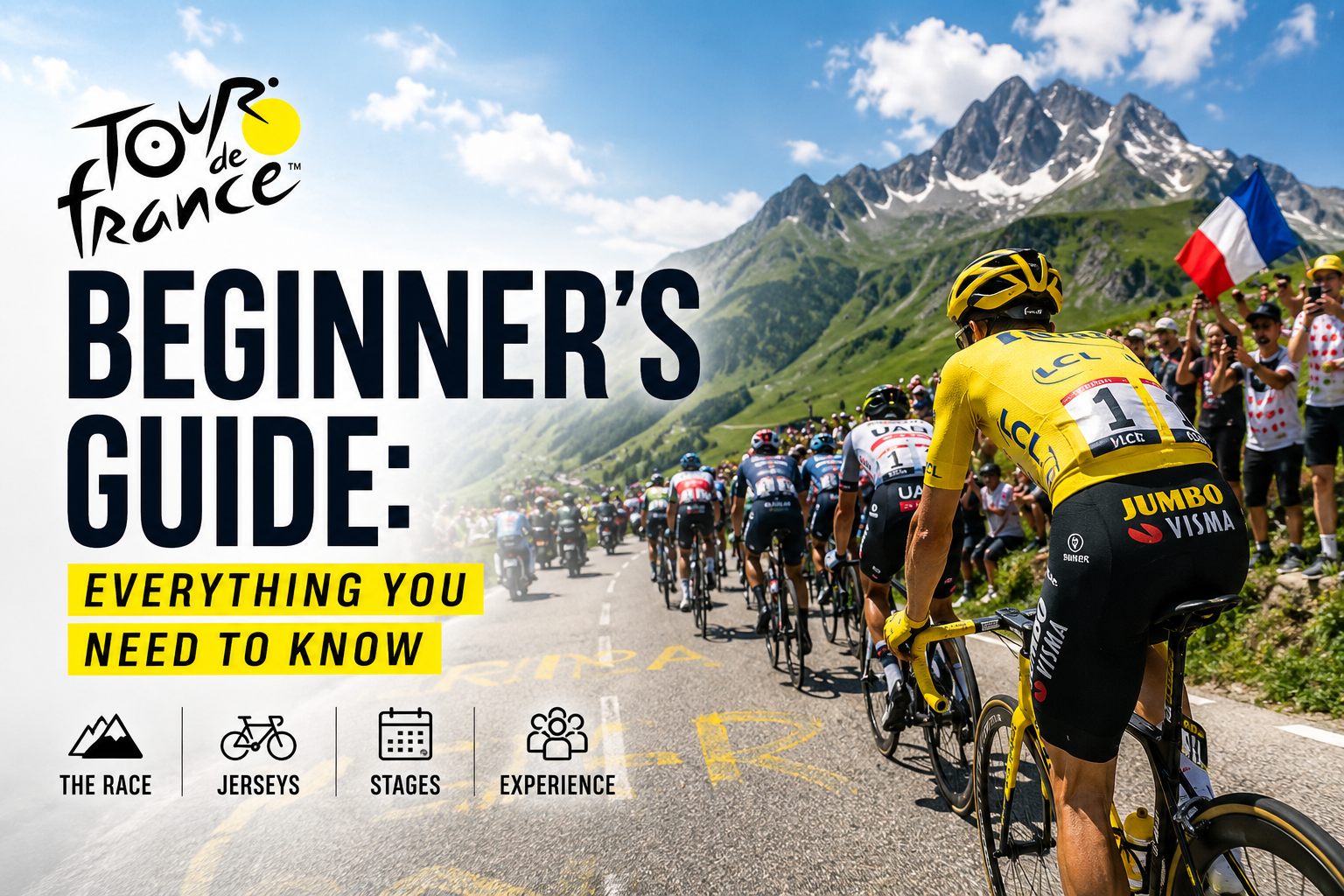
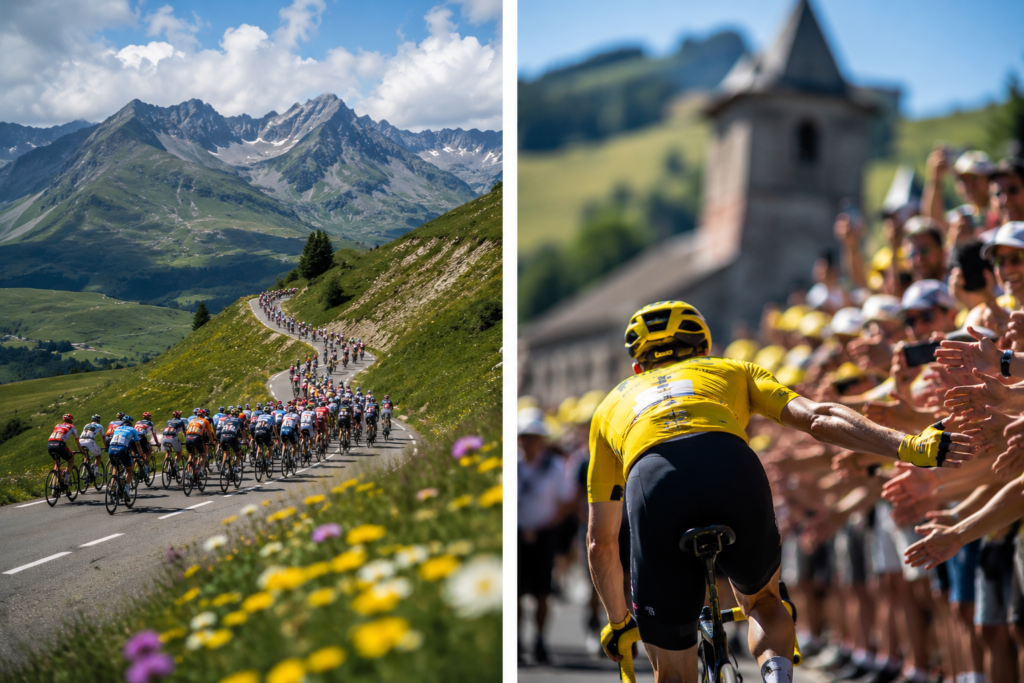
The yellow jersey is the big one. The maillot jaune. Whoever is wearing it has the lowest cumulative time in the race — they’re currently “winning” the Tour. Every rider on the road would give a lung to wear that thing, even for a single day.
The green jersey is for the sprinters. There are points up for grabs at sprint checkpoints throughout stages, and whoever has racked up the most points wears green. The guys in contention for this jersey are usually built like rugby players compared to the skeletal climbers — powerful, explosive, and terrifying to watch at 70 km/h in a crowded bunch.
The polka dot jersey — yes, red polka dots, it looks ridiculous and I love it — goes to the King of the Mountains. Points get handed out at the tops of designated climbs. The riders who hunt this jersey are usually the ones attacking on steep grades while everyone else is just trying to survive.
The white jersey is the best young rider under 26. Think of it as the “future of the sport” jersey. Sometimes the white jersey holder and the yellow jersey holder are the same person, which is when you know you’re watching someone truly special.
Three weeks, 21 stages, and a route that changes every year
The Tour runs for three weeks every July. The specific roads change each year, but the general structure stays the same: a mix of flat stages, mountain stages, and time trials.
Flat stages are basically controlled chaos until the final few kilometers. The whole peloton — the massive main pack of riders — cruises along together for most of the day, and then the sprinters’ teams start lining things up for a terrifying bunch sprint at the line. Watch the last 20 minutes and you’re not missing much by skipping the first few hours.
Mountain stages are where the Tour is actually won and lost. The Alps, the Pyrenees, some of the most punishing roads in Europe. Lightweight climbers who seemed unremarkable on flat days suddenly turn into machines, while the heavier sprinters just try to survive long enough to make the time cut. Some mountain finishes are genuinely emotional — riders cracking under the pressure, attacking out of desperation, teammates sacrificing their own races. These are the days worth clearing your afternoon for.
Time trials are the purest thing in cycling. No drafting, no teammates, no tactics. Just one rider at a time riding as hard as they can against the clock. It’s weirdly meditative to watch and often decides the final standings.
The race traditionally ends in Paris, with a relatively relaxed final stage that wraps up with a ceremonial sprint on the Champs-Élysées. It’s understood that nobody attacks the overall leader on the final day — it’s an unwritten rule, a rare bit of sportsmanship that somehow still holds.
Why teammates basically give up their own races
This confused me for ages.
Each team has 8 riders, and in most cases, only one of them actually has a chance of winning the Tour. The rest — called domestiques, which means “servants” in French, which is a bit brutal honestly — spend the race protecting that one person.
What does protecting look like? Riding in front of the leader to block wind (drafting behind someone saves up to 40% of your energy — which is enormous). Dropping back to the team car to grab water bottles and carrying them forward. Pacing the leader back up to the group if they crash or get a flat tire. And in extreme cases, literally handing their own bike to the leader so the leader doesn’t lose precious seconds.
These guys are elite athletes who, in any other context, would be contenders themselves. But at the Tour, their entire job is to make one person’s life easier. There’s something genuinely selfless about it that I find really moving once you understand what’s happening.
The main pack of riders is called the peloton — it moves like a living organism, constantly shifting, and riding inside it is supposedly far easier than riding alone because of all the shared wind protection.
Early in stages, a small group will often sprint away from the peloton to form a breakaway. The main pack usually lets them go, calculating that they’ll catch them before the finish. Sometimes they do. Sometimes they don’t, and a breakaway rider steals a stage win — one of the best storylines in cycling.
A few terms you’ll hear constantly
Bonking (or “the hunger flat”): When a rider runs out of fuel mid-race and suddenly looks like they’re pedaling through wet concrete. It happens fast and it’s brutal to watch. Eating on the bike — sandwiches, gels, little rice cakes — is a legitimate skill.
The publicity caravan: Before the riders arrive at any point on the route, there’s a two-hour parade of sponsor vehicles blasting music and throwing free stuff at the crowds. Caps, keychains, mini-sausages. My friend caught a foam hat shaped like a lion once and acted like he’d won the lottery.
GC contender: “GC” stands for general classification — the overall standings. When commentators talk about the “GC race,” they mean the battle for the yellow jersey.
How to actually watch it without losing your mind
You don’t need to watch five hours of cycling a day. Here’s what I actually do:
For flat stages, I tune in about 20 minutes before the finish. That’s when the sprinters’ teams start lining things up and the speed gets genuinely insane.
For mountain stages, I try to catch the final climb. If there are two big climbs, I’ll have it on for the last two hours. This is where the race changes.
For time trials, watch the whole thing if you can — it’s short, and you can watch riders set times throughout the day while the overall standings shift in real time.
And honestly? Don’t stress about following every detail. Half the joy of the Tour is just having it on while you’re doing something else, then suddenly looking up because the commentator’s voice changed pitch and something extraordinary is happening on some mountain road in France that you’ll never forget.
That’s usually when it gets you.