
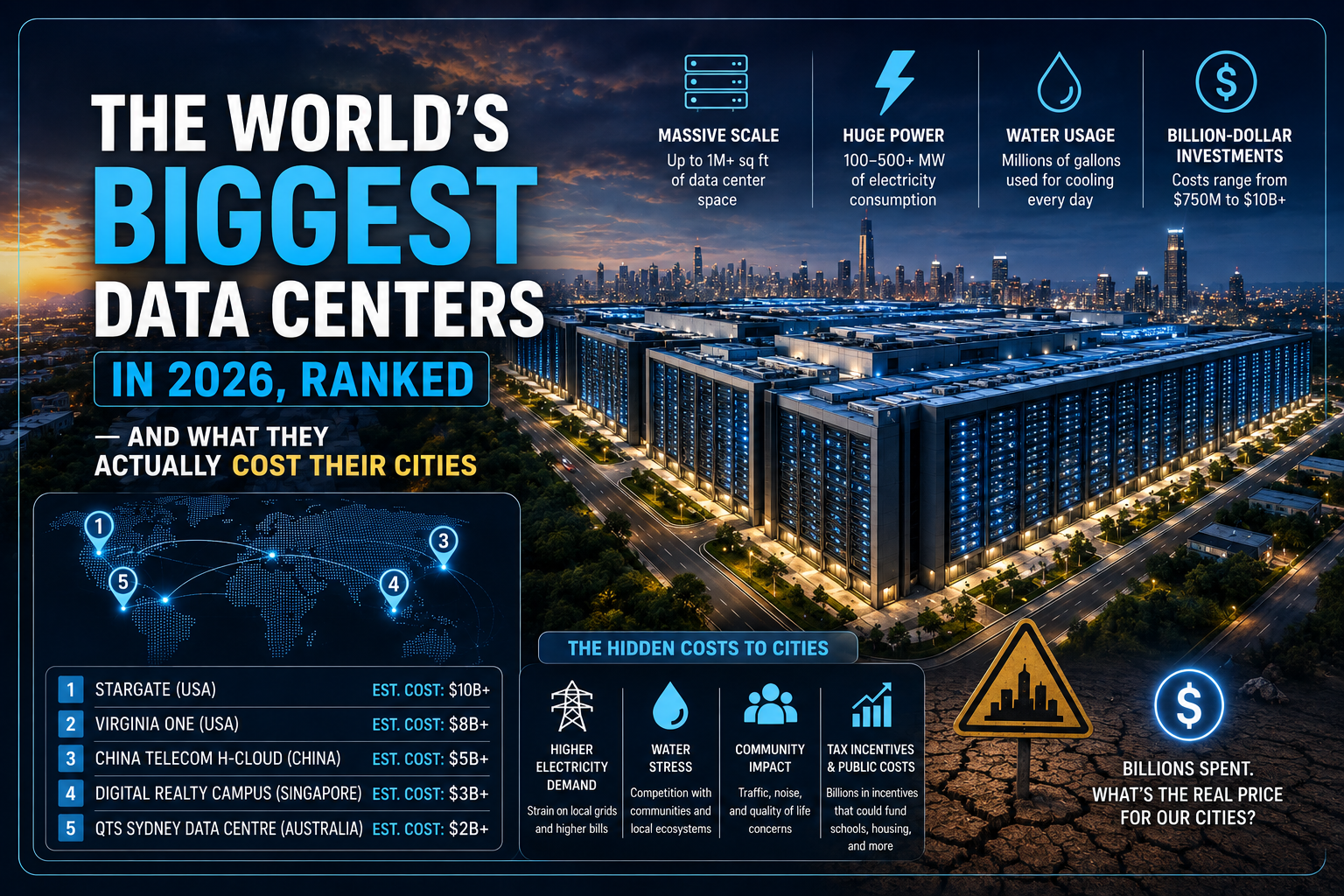
A data center used to mean rows of servers in a warehouse. What’s being built right now is something else — campuses drawing as much electricity as a mid-size city, pulling millions of gallons of water a day, and getting built in 122 days flat because the AI race doesn’t wait for permitting.
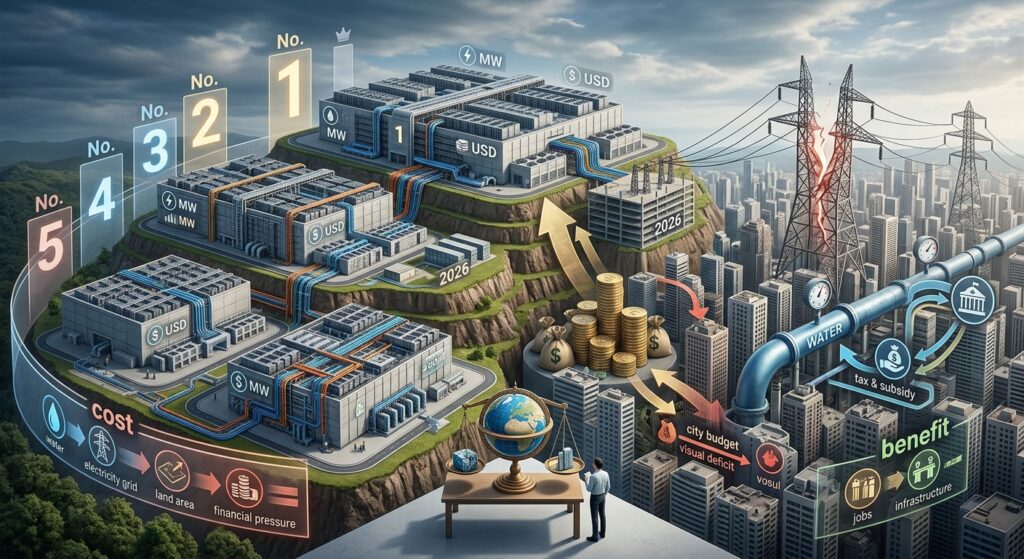
We ranked the world’s largest sites by power capacity — the real currency in this industry now, since raw square footage tells you less than it used to. For each one, we’re giving you what’s actually verifiable: capacity, water use where it’s public, who’s paying for it, and what it’s doing to the community around it. Where a number isn’t public — and for most sites, several aren’t — we’re telling you that instead of guessing.
1. xAI Colossus (Memphis, Tennessee & Southaven, Mississippi) — ~2 GW design capacity
The fastest-built, most-litigated site on this list. Colossus 1 went from empty warehouse to operational supercomputer in 122 days. Across its now-three buildings, the complex houses roughly 555,000 Nvidia GPUs and represents over $35 billion in total investment.
- Power: Design capacity of 2 gigawatts — up from an initial local grid connection of just 8 MW, forcing xAI to bring in dozens of temporary gas turbines to fill the gap.
- Water: Consumed roughly 1.3 million gallons per day as of early 2026, with projections reaching 5 million gallons daily at full build-out. Cooling alone requires over 50,000 gallons per minute at peak.
- The friction: A federal lawsuit, backed by the NAACP, alleges the site’s gas turbines have been operating without required Clean Air Act permits, and links them to roughly 1,700 tons of nitrogen oxide emissions a year in a majority-Black community. A planned $80 million wastewater recycling plant has been approved but is currently on indefinite pause.
- Employees: Not publicly disclosed at a site level — typical for this category of facility, where headcount is small relative to footprint.
2. OpenAI/Oracle/SoftBank Stargate — Abilene, Texas (flagship site of a ~9 GW, $500B national program)
Abilene is the flagship of Stargate, OpenAI, Oracle, and SoftBank’s $500 billion buildout — but it’s important not to confuse the flagship site with the whole program. Stargate spans seven U.S. sites, together targeting roughly 9 gigawatts of capacity by 2029, comparable to the peak power demand of New York City.
- Power, Abilene specifically: Operational at approximately 0.3 GW as of spring 2026, with 1.2 GW targeted by Q4 2026. Notably, OpenAI and Oracle have since capped expansion at Abilene beyond 1.2 GW due to grid-connection delays exceeding a year, and are reportedly in early talks to bring Meta in as a tenant for the space instead.
- Jobs: Oracle’s own figures put onsite construction jobs at over 25,000 across Abilene plus its newly announced sister sites — a real number, though it reflects construction-phase employment, not permanent operational staffing, which remains undisclosed.
- Water: Not publicly broken out at the site level.
3. Meta Prometheus (New Albany, Ohio) — operational at 631 MW, targeting 1–1.5 GW
Marketed as a contender for the world’s first gigawatt-scale AI data center. Built from an unusual mix of weatherproof “tent-style” structures, colocation buildings, and conventional data center halls spanning New Albany Business Park.
- Power: Currently operational at roughly 631 MW of IT power (per Epoch AI’s live satellite-based tracker), with a publicly stated target of 1 GW and industry reporting suggesting a path to 1.5 GW as more buildings come online.
- Energy sourcing: Backed by three separate nuclear power agreements (TerraPower, Oklo, Vistra), supporting up to 6.6 GW of new and existing clean energy capacity by 2035 — one of the more concrete power-sourcing commitments on this list.
- Jobs: Meta’s own materials cite “several hundred” local jobs from the project — a rare instance of a company actually putting a number on staffing, though still far short of a precise operational headcount.
- Water: Not publicly disclosed at a granular level.
4. Meta Hyperion (Richland Parish, Louisiana) — 2 GW by 2030, scaling to 5 GW
Nicknamed “The Beast” internally. A $10 billion investment, still under construction, with a phased target of 2 GW by 2030 and up to 5 GW in capacity beyond that — which would eventually make it the largest single site on this entire list, once complete.
- Status: Under construction; not yet operational.
- Power/water: No site-level water or current power-draw figures published yet at this stage.
5. Switch Citadel Campus (Las Vegas, Nevada) — 650 MW target, 7.75M sq ft
The largest data center outside China by floor area, and the most reliably cited single-campus benchmark in the industry because Switch actually publishes its IT load target — most operators don’t.
- Power: Stated full build-out target of 650 MW.
- Sustainability: Runs on 100% renewable energy and is built to Switch’s own SUPERNAP standard, which meets or exceeds Uptime Institute Tier IV fault-tolerance — the industry’s top resiliency rating.
- Ownership: Acquired by DigitalBridge in 2022 for roughly $11 billion, one of the largest infrastructure acquisitions in the sector’s history.
6. IREN Childress Campus (Childress, Texas) — 750 MW total, 200 MW liquid-cooled GPU load
Built specifically for GPU-heavy Nvidia deployments rather than general-purpose cloud computing. Its liquid-cooled IT load is projected to hit 200 MW in phases through 2026, drawing on Texas’s deregulated grid and access to wind power for a genuinely lower-carbon profile than most sites on this list.
7. Google Data Center (Mayes County, Oklahoma) — 1+ GW, currently operational
Worth including as the counterexample to Memphis — and worth noting this site is already operational at over 1 GW right now, not a future target like several entries above it. Google’s site selection process here involved multi-year community engagement, environmental impact assessments, formal water-use agreements, and a community benefit fund that has distributed over $25 million to local schools and infrastructure. Minimal community opposition, because the slower, more transparent build-out earned it.
8. China Telecom — Inner Mongolia cluster
China leads the world not in single-site capacity but in cluster capacity — Inner Mongolia hosts more combined hyperscale capacity than any other single region on Earth, spread across multiple large facilities rather than one mega-campus. Individual site-level power and water figures are not independently verified or published in the way U.S. operators’ increasingly are, largely due to differing disclosure requirements.
9. CWL1 (Newport, Wales) — 1.85 million sq ft
The largest data center in Europe, with a direct 400 kV connection to the UK’s SuperGrid and a low Power Usage Effectiveness (PUE) rating, meaning less of its power draw is lost to overhead like cooling inefficiency. A genuinely different profile from the Texas/Nevada mega-campuses — built for enterprise colocation rather than AI training clusters.
10. Apple Data Center (Mesa, Arizona)
Notable less for scale than for its power sourcing: Apple built a dedicated 300-acre, 50 MW solar plant in Florence, Arizona specifically to offset this site’s consumption — enough solar capacity to power roughly 12,500 homes. It doesn’t make the facility fully carbon-neutral, but it’s one of the more transparent power-offset arrangements in the industry.
The pattern across all of them
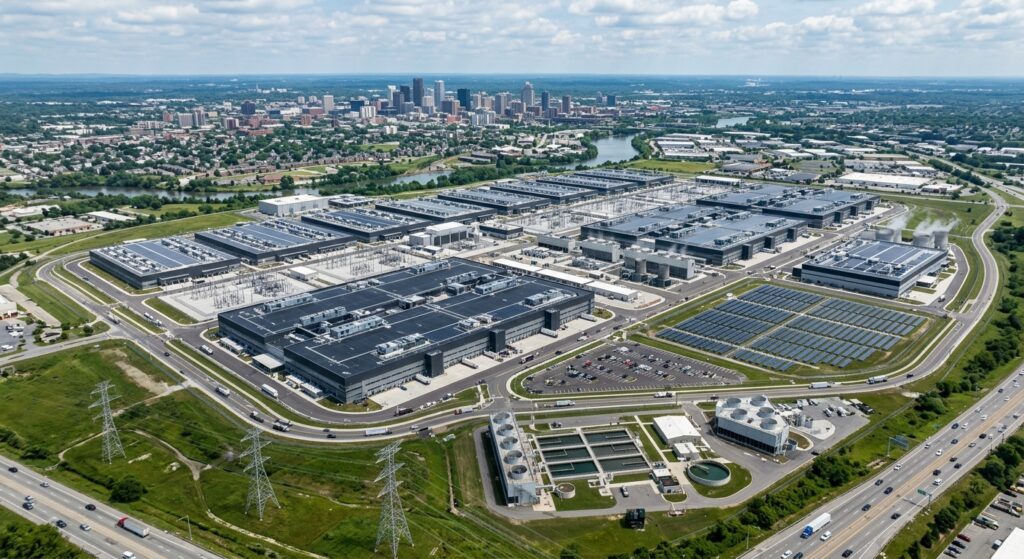
A few things hold true across almost every site on this list, and they matter more than any single number:
Water is the story nobody sees coming. A large data center can use as much water per day as a town of 50,000 people. A 2025 Bloomberg investigation found more than 7 in 10 new data center projects built or proposed since 2022 are located in communities already experiencing water stress — which is exactly why Memphis, a city that relies entirely on a single aquifer for its water supply, became ground zero for the backlash.
Permanent staffing is the one number you still won’t find, anywhere. These are automated, GPU-dense facilities — permanent headcount is deliberately small relative to footprint and power draw. Operators will cite construction-phase job figures when it helps a public narrative — Stargate’s Oracle fact sheet claims over 25,000 onsite construction jobs across its newest sites, and Meta cites “several hundred” local jobs for Prometheus — but essentially none disclose actual permanent site staffing once a facility is running. Treat any “employees per data center” figure you see elsewhere as a construction-phase estimate, not an operational headcount.
Speed and community buy-in are trading off against each other in real time. Memphis got a data center in 122 days and got a federal lawsuit a year later. Mayes County, Oklahoma took years of community engagement and got a gigawatt-plus campus with essentially no opposition. Every new mega-site being announced right now is choosing a point on that spectrum, whether it says so or not.
Global electricity demand from this sector is still climbing fast. Global data center electricity consumption reached roughly 485 terawatt-hours in 2025 and is projected to nearly double to 950 TWh by 2030 — at which point data centers alone would account for around 3% of all global electricity demand.
Figures above reflect the most recent publicly available data as of August 2026, compiled and cross-checked against Epoch AI’s live tracking data, Oracle/OpenAI’s own disclosures, SemiAnalysis, Synergy Research Group, and regional reporting. Capacity figures for sites still under construction or ramping (Hyperion, Stargate’s remaining buildout, Prometheus’s path to 1+ GW) are targets, not current operating figures, and are labeled as such throughout. Where operators have publicly reversed or capped plans — as OpenAI and Oracle did at Abilene — that’s noted rather than left as an outdated projection.














[…] Read: The World’s Biggest Data Centers in 2026, Ranked — And What They Actually Cost Their Cities […]