Introduction: The Unthinkable Is No Longer Unimaginable
For decades after the end of the Cold War, nuclear war seemed to belong more to history than to the future. It was a subject associated with grainy footage of missile silos, civil defense drills, and geopolitical nightmares thought to have faded with the collapse of the Soviet Union. Many came to believe the nuclear age had not ended exactly, but had at least been pushed into the background.
That assumption has weakened dramatically.
Renewed rivalry among major powers, the erosion of arms-control agreements, military modernization, cyberwarfare, and persistent regional flashpoints have returned nuclear risk to serious public discussion. While the odds of a global nuclear war remain low, the possibility is no longer dismissed as impossible.
Yet when people imagine nuclear war, they often imagine extremes: either a dramatic single “red button” moment that ends civilization in hours, or an apocalyptic Hollywood scenario in which the world simply vanishes under mushroom clouds.
Reality would likely be far more complex.
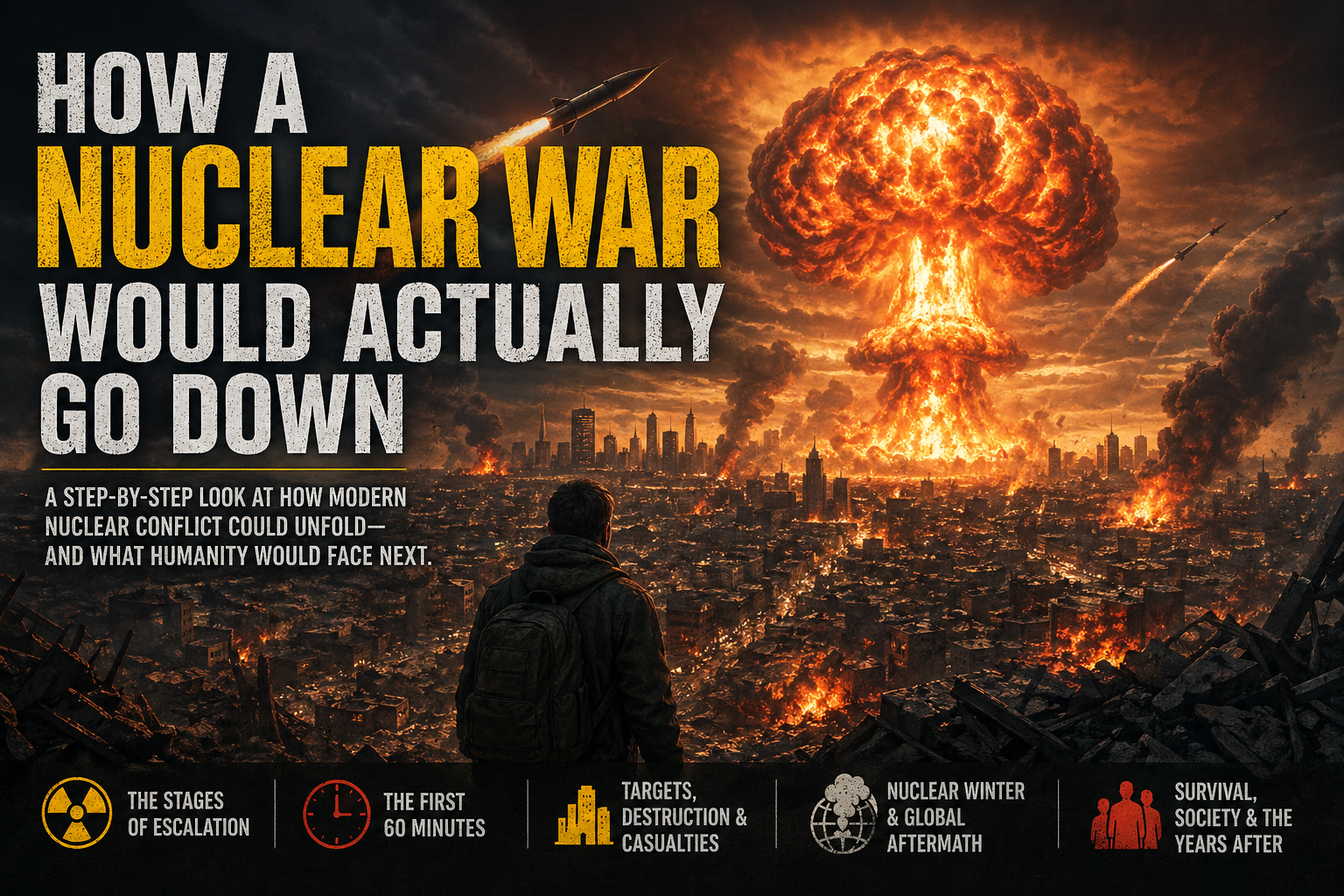
If a nuclear war happened today, it probably would not begin as an instant civilization-ending event. It would more likely unfold through escalating stages—political crisis, cyber conflict, conventional war, possible tactical nuclear use, and only then, perhaps, a strategic exchange capable of threatening civilization itself.
That distinction matters.
Because nuclear war would not simply be one catastrophic moment.
It would be a cascade.
And understanding how such a cascade might unfold reveals why deterrence, diplomacy, and crisis prevention remain so critical.
The World Before the First Missile
A Peace Built on Fear
The paradox of the nuclear age is that its relative stability has often been built on the threat of total destruction.
At the center of that logic is Mutually Assured Destruction—MAD.
Though the term sounds theatrical, the principle is straightforward: if two adversaries each possess enough survivable nuclear weapons to destroy the other even after absorbing a first strike, neither has a rational incentive to start a nuclear war.
In this view, the bomb prevents war precisely because war would be unwinnable.
That logic has shaped military doctrine for generations.
It is why major nuclear powers maintain what strategists call the nuclear triad:
- Land-based intercontinental ballistic missiles (ICBMs) capable of launching within minutes.
- Submarine-launched ballistic missiles (SLBMs) hidden at sea to ensure retaliation even after homeland attacks.
- Strategic bombers that provide flexible, recallable nuclear delivery.
Together, these systems make it extraordinarily difficult for any adversary to eliminate another’s nuclear capability in a surprise first strike.
That survivability is what makes deterrence credible.
But deterrence depends on assumptions:
- Leaders act rationally under pressure.
- Warning systems function correctly.
- Communication survives crisis.
- Miscalculation does not spiral.
History suggests none of these assumptions should be taken for granted.
The Flashpoints That Could Trigger Nuclear Escalation
Nuclear war today would likely not begin because a state simply decides to start Armageddon.
Far more likely, it would emerge from a severe conventional or geopolitical crisis that spirals.
Among the scenarios analysts often examine:
A NATO-Russia Escalation
A direct military confrontation involving Russia and NATO could become especially dangerous if one side faced conventional defeat and considered limited nuclear use for coercive leverage.
A U.S.-China Crisis Over Taiwan
A conflict in the Pacific involving naval warfare, missile strikes, and cyber attacks could create pressures on strategic assets and escalation risks few can fully model.
India-Pakistan Nuclear Conflict
Many experts consider this among the most plausible nuclear scenarios due to historical hostility, short missile flight times, and geographic proximity.
Accidental or False Alarm Launch
This remains among the oldest and most chilling risks.
History has recorded multiple moments when faulty systems or misread signals nearly triggered catastrophe.
Those incidents did not escalate largely because individuals questioned the machines.
There is no guarantee such restraint always holds.
Phase One: Crisis Before Nuclear Fire
The First Battlefield May Be Invisible
If a nuclear conflict began, it might begin not with missiles, but with disruptions.
Cyberwar could become the opening phase.
Possible targets might include:
- Power grids
- Financial systems
- Telecommunications networks
- Satellite systems
- Air defense and warning networks
- Military command-and-control systems
This matters because modern civilization depends on interconnected systems that can fail in cascades.
A cyber assault on communications during geopolitical crisis could create dangerous ambiguity.
Was a radar blackout technical failure?
Or attack?
Was a communications disruption cyber sabotage?
Or preparation for first strike?
In nuclear strategy, uncertainty can itself be destabilizing.
Conventional War May Come First
Another common misconception is that nuclear war begins immediately as nuclear war.
Many analysts believe conventional warfare would likely precede nuclear use.
Potential escalation might involve:
- Air strikes on military targets
- Naval confrontations
- Long-range missile attacks
- Territorial battles
- Attacks on logistics and infrastructure
The danger is that major battlefield setbacks can alter nuclear incentives.
If a state perceives defeat as existential, nuclear use may begin to look, in its calculations, like coercive rescue.
That is where strategic theory grows deeply dangerous.
Because once nuclear thresholds are crossed, controlling escalation may prove impossible.
The First Nuclear Weapon
Why It Might Start “Small”
If nuclear weapons were first used today, many experts believe it might begin with tactical rather than strategic weapons.
Tactical nuclear weapons are generally lower-yield weapons intended for battlefield use rather than city destruction.
Possible first-use scenarios sometimes discussed include:
- A strike against military forces
- A demonstration detonation over unpopulated territory
- A strike against a naval target
- Electromagnetic pulse use to disable infrastructure
The theory behind such use is often coercive:
Use a limited nuclear strike to compel the enemy to back down.
The logic sounds controlled.
Its risks are anything but.
Because once one nuclear weapon is used, every assumption about restraint may begin to unravel.
The Fifteen-Minute Decision Window
Perhaps the most terrifying part of nuclear war is not the weapons.
It is the decision speed.
Intercontinental ballistic missiles may arrive in roughly 30 minutes.
Submarine-launched weapons could arrive faster.
That may leave leaders mere minutes to determine:
- Is warning data real?
- Is this limited attack or decapitation strike?
- Retaliate immediately?
- Wait for confirmation?
- Risk losing the arsenal?
These compressed timelines create the nightmare of “use it or lose it.”
If leaders fear waiting means their nuclear forces will be destroyed, pressure may push launch before certainty.
That dynamic alone explains why even accidental war has long been feared.
When Escalation Breaks
From Tactical Exchange to Strategic War
The gravest fear is not necessarily immediate all-out exchange.
It is escalation collapse.
Imagine:
One tactical weapon detonates.
Retaliation follows.
The response expands.
Targets widen.
Command systems degrade.
Communication breaks.
What began as “limited” spirals.
This is not science fiction.
It is one of the core dilemmas in nuclear strategy.
Because there is little evidence nuclear war can remain neatly contained once begun.
The Strategic Exchange
If deterrence fully failed, a strategic nuclear exchange might unfold in waves.
First Wave: Counterforce Strikes
Initial attacks might prioritize military assets such as:
- Missile silos
- Strategic air bases
- Nuclear submarine facilities
- Command bunkers
- Early-warning systems
- Radar and communications nodes
The objective would be to weaken retaliation.
Second Wave: Countervalue Strikes
Then comes the nightmare scenario.
Cities.
Industrial hubs.
Population centers.
Critical infrastructure.
Ports.
Energy systems.
At this stage the war moves beyond military logic.
It becomes civilization-scale destruction.
The First Hour After Launch
The Speed of Catastrophe
Once launches begin, events may unfold with astonishing speed.
Within minutes:
- Warning systems activate.
- Retaliatory launches occur.
- Strategic bombers scramble.
- Missile defenses engage.
- Emergency protocols begin.
Then warheads arrive.
Possibly in under an hour.
Entire metropolitan regions could be devastated before most people understand what is happening.
What Nuclear Detonation Actually Does
A nuclear weapon devastates through multiple mechanisms simultaneously.
Blast Wave
The shock wave can flatten structures, collapse buildings, and generate massive immediate casualties.
Thermal Radiation
Extreme heat can ignite vast fires, causing urban firestorms that may spread far beyond blast zones.
Ionizing Radiation
Radiation exposure can produce acute sickness, long-term cancers, and lethal contamination.
Electromagnetic Pulse (EMP)
Depending on altitude and weapon type, electronics and power systems could be severely disrupted.
It is not one weapon effect.
It is layered catastrophe.
Civil Society Begins to Fracture
Even outside direct strike zones, systems may fail rapidly:
- Hospitals overwhelmed
- Emergency response crippled
- Communications collapsing
- Supply systems disrupted
- Panic spreading
For many survivors, danger may come less from the initial blast than from the collapse that follows.
The Human Toll
Casualties at Unimaginable Scale
Even a large but limited exchange could produce casualties beyond modern disaster planning.
Millions could die within hours.
Millions more could suffer severe injuries.
And those surviving immediate strikes may face conditions even harder to endure.
Survival May Be More Brutal Than Popular Imagination Allows
Survivors could face:
- Radiation sickness
- Severe burn injuries
- Food shortages
- Water contamination
- Medical collapse
- Disease outbreaks
Popular culture often focuses on surviving the blast.
But survival afterward may be the far greater challenge.
Fallout and the Second Disaster
Radioactive Fallout
Fallout may affect regions far beyond strike zones.
Wind patterns and weather could spread contamination widely.
Agriculture may suffer.
Water systems may be poisoned.
Entire regions could become dangerous.
For survivors, fallout may turn escape routes into hazards.
Nuclear Winter
Perhaps the most profound long-term fear is not radiation.
It is climate disruption.
Large-scale firestorms could inject soot into the atmosphere.
Potential consequences often discussed include:
- Reduced sunlight
- Falling temperatures
- Crop failures
- Disrupted growing seasons
- Global food shocks
This is where nuclear war ceases being national catastrophe.
It becomes planetary crisis.
Global Famine
Modern food systems are interconnected.
Major disruptions to agriculture and logistics could trigger famine far beyond combat zones.
Some analyses have suggested starvation could ultimately exceed direct wartime casualties.
That possibility fundamentally challenges the idea of “limited” nuclear war.
Its consequences may not remain limited at all.
The Hidden Front: Space and Digital Collapse
Space as a Battlefield
Modern civilization depends profoundly on satellites.
They support:
- Navigation
- Communications
- Weather forecasting
- Financial timing systems
- Military coordination
If anti-satellite warfare escalates, disruption could spread globally.
A war fought partly in orbit may have consequences on Earth far beyond military operations.
Digital Civilization’s Fragility
Modern life runs through invisible systems.
Supply chains.
Cloud networks.
Banking infrastructure.
Logistics software.
Destroy enough digital nodes and shortages become physical.
Food may stop moving.
Fuel distribution may stall.
Commerce may fracture.
A modern nuclear war would not attack only populations.
It would attack systems civilization depends upon.
Could Missile Defense Save Us?
The Promise and the Reality
Missile defense exists.
But often public perception exaggerates what it can do.
Intercepting small or limited attacks differs enormously from stopping large strategic salvos.
Challenges include:
- Saturation attacks
- Decoys
- Hypersonic delivery systems
- Short warning times
No defense reliably protects against full-scale exchange.
The Myth of “Winning” Nuclear War
This remains one of the most dangerous illusions.
That advanced technology might make nuclear war survivable enough to be fought.
Yet even a “winner” in civilization-scale devastation may inherit ruin.
Victory may become meaningless.
The Days, Months and Years After
Continuity of Government
Major powers maintain emergency continuity plans.
Command bunkers.
Relocation systems.
Protected communication networks.
But continuity of government is not continuity of civilization.
A surviving command structure does not ensure functioning society.
Resource Scarcity and Secondary Conflict
Postwar dangers could include:
- Refugee crises
- Resource conflict
- Social fragmentation
- Martial rule
- Epidemic disease
Scarcity itself may generate new violence.
Water.
Fuel.
Food.
Medicine.
All become strategic commodities.
Rebuilding a Damaged World
Where recovery is possible, rebuilding may take generations.
Infrastructure could take decades.
Environmental damage may last longer.
Psychological trauma perhaps longer still.
The aftermath may define history as much as the war.
The Regional Nuclear War That Could Still Change the World
Discussion often focuses on superpower Armageddon.
But regional nuclear war may be both more plausible and still globally catastrophic.
Even a limited regional exchange could:
- Kill millions directly
- Trigger climate disruptions
- Damage global food production
- Crash markets
- Cause worldwide humanitarian crises
A “small” nuclear war may still be a planetary disaster.
That may be one of the most misunderstood truths in the nuclear debate.
Could Humans Trigger Nuclear War By Accident?
The Danger of Miscalculation
One unsettling reality often overlooked:
Civilization has come frighteningly close before.
False alarms.
Faulty sensors.
Misinterpreted signals.
Human beings in command chains have, at times, prevented disaster simply by doubting what systems told them.
That history matters.
Because it suggests catastrophe has sometimes been avoided by judgment, not invulnerability.
AI and Machine-Speed Risk
Emerging technologies may create new risks.
Automation can compress decision timelines.
Artificial intelligence may influence warning interpretation.
Cyber attacks may undermine confidence in systems.
The danger may not be machine rebellion.
It may be human decisions made too fast under machine-accelerated pressure.
Could Anything Stop It Once It Starts?
Firebreaks Still Matter
Even in crisis, stabilizers exist:
- Military hotlines
- Emergency diplomacy
- Backchannel communication
- Arms-control verification
- Crisis deconfliction measures
Their value often lies in being invisible.
When they work, disaster never occurs.
Why Arms Control Still Matters
Treaties are often treated as abstract diplomacy.
Yet they reduce uncertainty.
And uncertainty is often what drives escalation.
Arms control has never eliminated nuclear danger.
But it has often reduced opportunities for catastrophe.
That remains profoundly important.
What Strategists Think Would Actually Happen
Experts disagree on pathways.
Some believe escalation could remain partially controlled.
Others argue nuclear thresholds, once broken, would likely collapse rapidly.
Still others envision prolonged multi-stage conflict.
But one point tends to unite serious analysis:
No plausible scenario ends well.
Not one.
That may be the most important fact of all.
What Popular Culture Often Gets Wrong
Nuclear war is often portrayed as singular apocalypse.
Flash.
Explosion.
Aftermath.
Reality may be slower and in some ways worse.
Because the bombs may be only the beginning.
The larger catastrophe may involve:
- Infrastructure collapse
- Famine
- Disease
- Environmental disruption
- Social breakdown
Nuclear war is not one disaster.
It is many disasters layered together.
Conclusion: Nuclear War Is a Cascade, Not a Moment
If a nuclear war began today, it likely would not unfold as a single cinematic event.
It would more likely emerge through escalation:
Political crisis.
Cyber conflict.
Conventional war.
Limited nuclear use.
Potential strategic exchange.
Then fallout.
Climate disruption.
Famine.
Civilizational strain.
Perhaps generations of aftermath.
That is what makes nuclear weapons unlike any other instruments of war.
Their destruction extends beyond battle.
Beyond borders.
Beyond the war itself.
Perhaps the most sobering lesson is this:
The greatest risk may not be a leader consciously choosing apocalypse.
It may be ordinary strategic failure.
A misread signal.
A cyber disruption.
A false alarm.
A crisis moving faster than diplomacy.
That possibility is precisely why deterrence, communication, and arms control remain so essential.
Because once nuclear war begins, events may move faster than human wisdom can recover.
And by then, history may no longer belong to those trying to stop it.