Sixty-six million years ago, a Tuesday just like any other dawned over what is now the Yucatán Peninsula. The air was thick, tropical, and alive with the sounds of a flourishing Cretaceous ecosystem. Overhead, a streak of light appeared—not a shooting star to make a wish upon, but a mountain of rock the size of Mount Everest traveling at forty thousand miles per hour. When it punched through the atmosphere, it compressed the air beneath it so intensely that it instantly became hotter than the surface of the Sun. Within fractions of a second, a multi-billion-megaton blast tore the sky open. Mega-tsunamis hundreds of feet tall radiated outward, global wildfires ignited from falling incandescent glass rain, and a suffocating shroud of vaporized sulfur and rock dust choked out the sun for years.
This was the Chicxulub impact, the catalyst for the Cretaceous-Paleogene extinction. In the blink of an eye, a hundred-million-year dynasty ended.
Pop culture loves to replay this specific scene. From Hollywood blockbusters like Deep Impact and Armageddon to the iconic, terrifying opening minutes of Jurassic Park, we have a collective obsession with the day the sky fell. But truth, as it happens, is far more brutal than fiction. In the grand arc of Earth’s history, life is a resilient, stubborn thing. Yet, it hangs by a surprisingly fragile thread. An Extinction-Level Event (ELE) represents a global catastrophe that fundamentally disrupts the biosphere, threatening not just a few fragile species, but the entire tree of life. While paleontology historically viewed the planet’s shaping as a slow, uniform grind—a philosophy known as Uniformitarianism—the modern scientific consensus embraces Catastrophism. We now understand that Earth’s history is a story of long, peaceful epochs violently punctuated by sudden, apocalyptic resets. Understanding these past collapses isn’t just an exercise in academic curiosity; it is a blueprint for recognizing, and perhaps surviving, the existential threats of our own future.
The Scientific Framework: How Do We Know?
To understand an apocalypse that happened hundreds of millions of years ago, scientists have to act as forensic detectives, reading a crime scene written in stone. The most immediate ledger of global catastrophe is the fossil record. When analyzing a vertical cliff face of sedimentary rock—where older layers sit at the bottom and newer ones at the top—paleontologists occasionally hit a literal wall. A rich, diverse ecosystem teeming with thousands of unique species will suddenly vanish from the rock stratum, replaced in the layers directly above by a haunting silence, or by a few hardy, opportunist species. Sometimes, “Lazarus taxa” occur—species that vanish completely during a crisis, only to mysteriously reappear millions of years later in the fossil record, having survived in hidden, undiscovered ecological refuges.
Beyond bone and shell, the rocks hold a deeper, elemental truth through geochemistry:
- Iridium Anomalies: Iridium is incredibly rare in Earth’s crust because it bonded with iron during the planet’s formation and sank into the core. However, it is abundant in space rocks. A global spike in iridium within a thin layer of clay is a definitive smoking gun of a massive cosmic impact.
- Carbon and Oxygen Isotope Excursions: By testing the ratios of carbon-12 to carbon-13, or oxygen-16 to oxygen-18 in ancient rocks, scientists can reconstruct ancient atmospheres. A sudden swing in carbon isotopes signals a total collapse of the biological carbon cycle (like the death of all land plants), while oxygen shifts map out wild, runaway swings in planetary temperature.
- Mercury Spikes: Mercury is a volatile element pumped out during extreme volcanic activity. When broad layers of rock across different continents all show massive mercury enrichment at the exact same geological moment, it points to a prolonged era of devastating global volcanism.
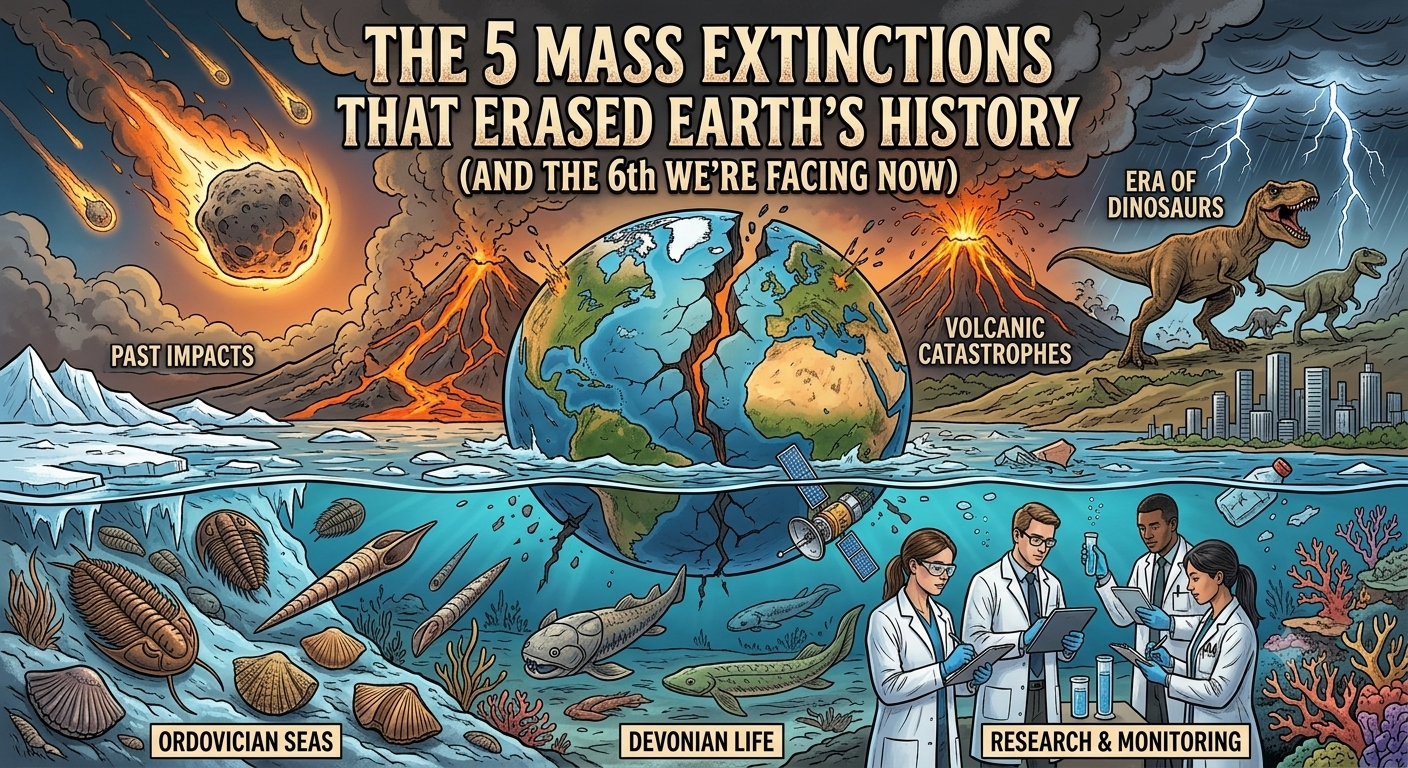
Through these methods, scientists have identified dozens of minor ecosystem crashes, but five massive, catastrophic milestones stand out above the rest: the undisputed “Big Five” mass extinctions.
The Classical “Big Five” Mass Extinctions
1. The Ordovician-Silurian Extinction (~444 Million Years Ago)

Long before life crawled onto land, Earth’s oceans were home to a rich tapestry of trilobites, brachiopods, and massive sea scorpions. The world was warm, and sea levels were high. Then, a sudden drift of the supercontinent Gondwana over the South Pole triggered a profound shift.
Massive continental ice sheets formed rapidly, locking up the planet’s water and causing sea levels to plummet globally. Shallow coastal waters—where the vast majority of marine life lived—simply dried up. This initial freeze wiped out millions of organisms. But the nightmare wasn’t over. A few hundred thousand years later, the glaciers melted just as abruptly as they had formed. Sea levels surged back up, but the newly returned waters were stagnant and severely depleted of oxygen.
This double-whammy of rapid freezing followed by suffocating warming choked out roughly 85% of all marine species, making it the second-deadliest extinction event in Earth’s history.
2. The Late Devonian Extinction (~360 Million Years Ago)
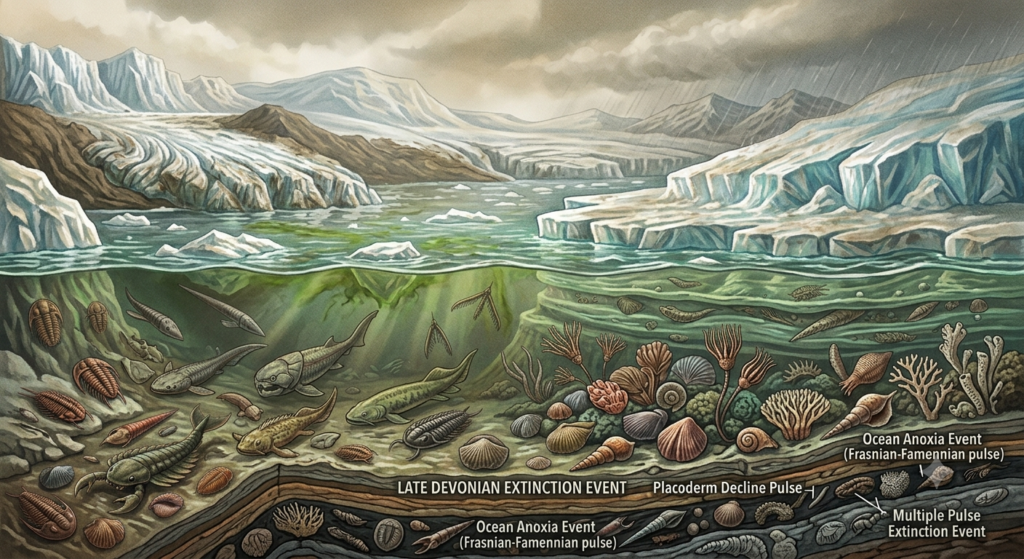
The Devonian period is frequently called the “Age of Fishes,” but it was also the era when plants truly conquered the land. Complex vascular plants evolved roots, grew into the first true forests, and spread aggressively across the continents. Ironically, this evolutionary triumph proved to be a death sentence for the oceans.
As roots broke apart rocky soil for the first time in Earth’s history, they unleashed an unprecedented wave of nutrient runoff and soil erosion into the global water systems. This process, known as eutrophication, triggered monstrous, planet-scale algal blooms. When these trillions of tons of algae died, deep-sea bacteria consumed them, using up nearly all the dissolved oxygen in the water.
The oceans became vast, anoxic dead zones. Marine life literally choked to death in its own home. Reef-building communities were crushed so heavily that it took millions of years for coral ecosystems to recover, ultimately claiming 75% of all living species.
3. The Permian-Triassic Extinction (“The Great Dying”) (~252 Million Years Ago)
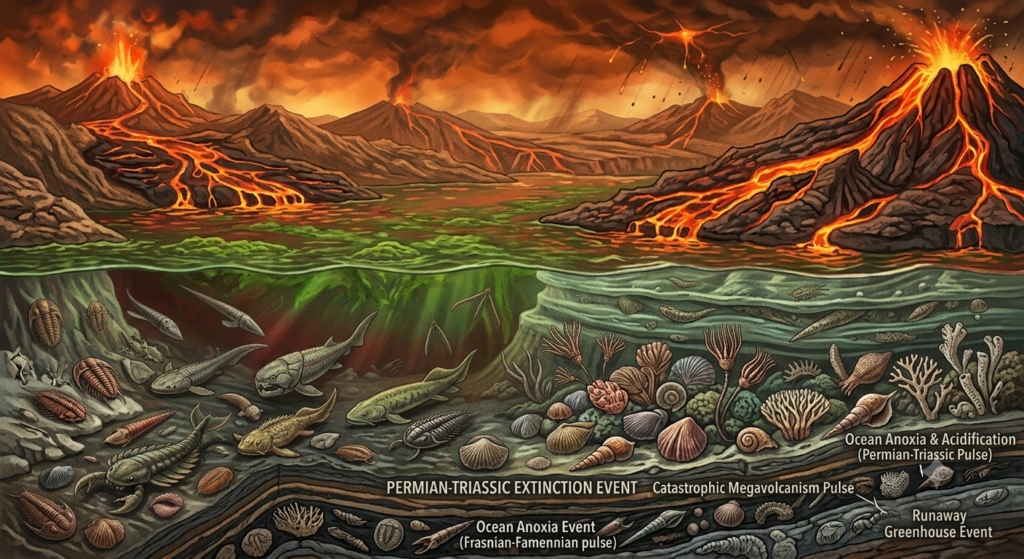
If life on Earth ever had a near-death experience, this was it. The Permian-Triassic event was a planetary cataclysm so absolute that it rewrote the rules of biology.
The trigger was the eruption of the Siberian Traps, an unimaginably massive volcanic system in modern-day Russia. This wasn’t a standard volcanic eruption; it was a flood basalt event that tore open the crust, bleeding out millions of cubic miles of molten lava continuously for hundreds of thousands of years. The lava burned through massive, subterranean coal deposits, pumping trillions of tons of carbon dioxide, sulfur, and methane into the atmosphere.
The resulting runaway greenhouse effect drove global temperatures up by nearly 18°F (10°C). The oceans heated up to the temperature of a hot bath, losing their ability to hold oxygen. As acidification dissolved the shells of marine organisms, the stagnant, suffocating seas became a breeding ground for anaerobic sulfur-reducing bacteria. These organisms burped toxic clouds of hydrogen sulfide gas into the air, poisoning the land and stripping away the ozone layer.
When the dust finally settled, 96% of all marine species and 70% of terrestrial vertebrates were gone. It is the only known mass extinction that almost entirely wiped out insects. Earth was left a barren, smoking wasteland, narrowly escaping total sterilization.
4. The Triassic-Jurassic Extinction (~201 Million Years Ago)

As the planet slowly recovered from the Permian nightmare, early dinosaurs and massive, crocodile-like archosaurs began battling for dominance. But just as the ecosystems stabilized, geology intervened again. The supercontinent Pangea began to split apart, creating a massive rift valley that would eventually become the Atlantic Ocean.
This rifting unleashed the Central Atlantic Magmatic Province (CAMP), another colossal series of volcanic eruptions. Much like the Siberian Traps, CAMP pumped massive amounts of greenhouse gases into the atmosphere. The planet experienced wild, erratic climate swings, shifting from intense global warming to brief periods of volcanic cooling, accompanied by rapid ocean acidification.
The ancestral crocodiles and large amphibians that dominated the land could not adapt to the environmental instability. They died out cleanly, leaving 80% of species extinct. This biological vacuum uniquely benefited a small, nimble group of survivors: the early dinosaurs, who stepped into the newly vacant ecological niches and began their 135-million-year reign.
5. The Cretaceous-Paleogene (K-Pg) Extinction (~66 Million Years Ago)

The final and most famous of the Big Five brought an abrupt end to the age of the dinosaurs. While the Deccan Traps eruptions in modern-day India were already destabilizing the climate with volcanic outgassing, the definitive death blow came from outer space with the Chicxulub asteroid impact.
The sheer kinetic energy threw up a massive cloud of vaporized rock, dust, and sulfur into the upper atmosphere. Carried by high-altitude winds, this shroud blanketed the entire globe, blocking out 90% of solar radiation.
This triggered an “Impact Winter.” Without sunlight, global temperatures plummeted, and photosynthesis ground to a near-total halt. Plants died, herbivores starved, and the massive carnivores that fed on them followed shortly after. Acid rain, born from the vaporized sulfur marine rocks, poisoned water systems, while global wildfires raged through the dying forests.
Weight was the ultimate arbiter of survival: almost no terrestrial animal weighing more than 55 pounds survived. 75% of all species vanished, erasing the non-avian dinosaurs and paving the way for tiny, burrowing mammals to inherit the Earth.
The Anatomy of an ELE: Universal Killing Mechanisms
When looking across all major extinctions, a striking pattern emerges. Whether an event is triggered by a rock from space or an eruption from deep within the earth, the actual “killing mechanisms” that destroy the biosphere are remarkably consistent.
Atmospheric and Climate Disruption
The atmosphere is the planet’s circulatory system, and disrupting it is fatal. Extinctions typically feature one of two extremes: Hyper-Warming or Impact/Volcanic Winter. Hyper-warming occurs when sudden, massive releases of greenhouse gases ($CO_2$ and methane) trap solar heat. The transition happens faster than organisms can evolutionarily adapt, causing heat stroke, metabolic failure, and desertification.
Conversely, winters occur when sulfur dioxide and ash are injected directly into the stratosphere. These particles act as a global mirror, bouncing sunlight back into space. The resulting sudden temperature drops halt photosynthesis, effectively cutting off the power source at the very base of the global food chain.
Oceanic Collapse
Because water covers the majority of the planet, true ELEs always feature an oceanic collapse. This manifests primarily as Anoxia (the severe depletion of oxygen) and Acidification (a drop in the water’s pH).
When the oceans warm up rapidly, they lose their ability to dissolve gases, causing marine life to experience systemic asphyxiation. At the same time, as the water absorbs excess atmospheric carbon dioxide, it forms weak carbonic acid. This process lowers the ocean’s pH level, which actively dissolves calcium carbonate—the vital building block used by corals, clams, and microscopic plankton to construct their protective shells.
Cosmic Triggers
Beyond planetary changes, Earth is always vulnerable to the wider universe. A massive kinetic impact creates an immediate local apocalypse of shockwaves, thermal radiation, and mega-tsunamis, before transitioning into a global atmospheric crisis.
Even more terrifying are deep-space radiation blasts, such as a nearby Gamma-Ray Burst (GRB) or a supernova. If a GRB occurred within a few thousand light-years of Earth and its jet was pointed directly at us, it would instantly strip away our ozone layer. Sunlight would turn into a lethal weapon, blasting the surface with raw ultraviolet radiation, destroying DNA, and killing off the surface plankton that produce the majority of our oxygen.
The Anthropocene: Are We Currently In a Sixth Mass Extinction?
For centuries, mass extinctions were viewed as ancient history—chapters in a textbook about a prehistoric world. Today, a growing body of biologists warns that we are living through a new one: the Anthropocene, or the sixth mass extinction. Except this time, the catalyst isn’t an asteroid or a volcano. It is us.
Humanity has profoundly altered the planet’s surface. Through deforestation, urbanization, and sprawling agriculture, we have destroyed or fragmented the habitats of millions of species. We have overexploited natural resources, wiped out apex predators, and polluted every corner of the globe, from plastic-choked ocean trenches to the high atmosphere.
Furthermore, our burning of fossil fuels is pumping carbon dioxide into the atmosphere at a rate that dwarfs the outgassing of the Siberian Traps. While those ancient volcanoes took hundreds of thousands of years to destabilize the climate, humans have achieved a measurable shift in just over two centuries. The velocity of modern climate change and ocean acidification is unprecedented in the geological record.
What makes this modern shift uniquely dangerous is the co-extinction cascade. Ecosystems are not just collections of isolated animals; they are highly interconnected webs. When a keystone species—like a primary pollinator or an apex predator—goes extinct, the domino effect can trigger a collapse across the entire food chain. While the current extinction rate hasn’t yet reached the absolute percentages of the Big Five, the speed at which species are vanishing is estimated to be anywhere from 100 to 1,000 times higher than the natural background rate. We are actively pulling bricks out of the biological foundation that supports our own civilization.
Future Existential Risks: Cosmic and Planetary Threats
If we look past the immediate horizon of human history, what are the threats that could completely end life on Earth? Future existential risks fall into three distinct categories: natural planetary, astrophysical, and technological.
Natural Planetary Risks
The Earth beneath our feet remains inherently unstable. Supervolcanoes like the Yellowstone Caldera or the Toba system represent ticking geological clocks. A full-scale super-eruption would blanket continents in feet of toxic ash, destroy global agriculture instantly, and trigger a multi-year volcanic winter.
Additionally, the solar system is crowded with remnants from its formation. While we have mapped the vast majority of massive, world-ending asteroids, there are millions of smaller, city-killing Near-Earth Objects (NEOs) and long-period comets originating from the outer solar system that could surprise planetary defense networks with very little warning.
Astrophysical Risks
On a long enough timeline, cosmic scale changes are guaranteed. Over the next few billion years, our Sun will slowly burn through its hydrogen fuel, growing hotter and expanding. Long before it physically swallows the Earth as a red giant, its increased luminosity will cause a runaway greenhouse effect, boiling our oceans away and ending the story of terrestrial life.
On a shorter timeline, our solar system periodically passes through dense arms of the Milky Way galaxy. These stellar encounters can gravity-jostle the Oort Cloud—the icy shell of comets at the edge of our solar system—sending a catastrophic rain of comets inward toward Earth.
Technological Existential Risks (Anthropogenic ELEs)
Ironically, the most immediate, near-term threats of a total ELE come from human innovation. We have developed technologies capable of simulating the killing mechanisms of the past. A global thermonuclear war would ignite firestorms across major cities, lifting millions of tons of black carbon soot into the stratosphere and triggering a devastating Nuclear Winter that would stall global agriculture and induce worldwide starvation.
Similarly, advancements in synthetic biology introduce the terrifying possibility of engineered pandemics—pathogens modified to possess high lethality alongside long incubation periods, capable of collapsing global networks. Finally, as we push deeper into advanced technologies, the risks of unaligned artificial superintelligence (ASI) or molecular nanotechnology accidents (“Grey Goo”) present profound, unprecedented structural risks to the future of the biosphere.
Planetary Defense and Mitigation: Safeguarding the Future
Unlike the trilobites, the armored fish, or the dinosaurs, humanity has a unique advantage: we are aware of our situation. We possess data analysis, historical foresight, and the beginnings of technological intervention. We are the first species in the 4.5-billion-year history of Earth capable of seeing an apocalypse coming and actively choosing to prevent it.
Defending Against Space Threats
Our most mature mitigation strategy is planetary defense against asteroid impacts. Programs like NASA’s Planetary Defense Coordination Office actively scan the night sky, cataloging over 90% of asteroids larger than a kilometer wide.
Furthermore, we have proven we can act. NASA’s Double Asteroid Redirection Test (DART) mission successfully slammed a spacecraft into a minor asteroid, demonstrably altering its orbital trajectory through kinetic impact. For larger or more immediate threats, scientists are modeling gravity tractors (using a heavy spacecraft’s gravitational pull to gently nudge an asteroid off course) and nuclear ablation (detonating a nuclear device near an asteroid to vaporize its surface and push it away via rocket-like outgassing).
Environmental Engineering and Resilience
To counter planetary and climate-scale threats, we are exploring concepts of environmental engineering and global biopreservation. This includes geoengineering theories—such as solar radiation management, which involves deliberately injecting reflective aerosols into the upper atmosphere to mimic a mild volcanic cooling effect and counteract global warming.
On the preservation front, facilities like the Svalbard Global Seed Vault buried deep inside an Arctic mountain act as an insurance policy for human civilization, safely storing millions of crop seeds to protect global agricultural biodiversity against catastrophic failures. Similar deep-freeze archives are actively preserving the genetic data of endangered animals, ensuring that the blueprints of life can survive even if the living organisms face immediate crisis.
Redundancy and Off-World Colonization
Ultimately, the most secure protection against an Extinction-Level Event is removing our single point of failure. As long as humanity, our data, and our agricultural foundation exist entirely on one planet, we are vulnerable to a total reset. This reality underpins the long-term philosophical and practical push for multi-planetary expansion.
Establishing self-sustaining human colonies on the Moon, Mars, or within independent space habitats creates a biological and technological backup drive. If a catastrophic disaster strikes Earth, the story of terrestrial life and intelligence does not end. Redundancy is the ultimate defense against cosmic oblivion.
The Final Verdict: Why Humanity is the Ultimate Survival Variable
Extinction-Level Events are a stark reminder of our place in the cosmos. They show us that the stability we take for granted is an anomaly—a brief, beautiful window of planetary calm in a chaotic and indifferent universe. The history of our world is written in the ashes of civilizations and species that never saw the end coming. If Earth’s history were a 24-hour clock, human civilization has only existed for the last few seconds. Yet, in that blink of an eye, we have accumulated the power to either mimic the volcanic catastrophes of the past or rewrite the script entirely.
Looking back at the long timeline of Earth offers profound hope. After every mass extinction, life has found a way to crawl out of the dark. The Permian nightmare cleared the stage for the dinosaurs; the death of the dinosaurs cleared the stage for us. Every breath we take is a direct gift from the survivors of those ancient apoczlypses.
We now stand at a unique historical crossroads. We are the first species with the tools to map our own existential risks, steer asteroids, and consciously alter our planet’s climate path. We possess an extraordinary, unprecedented power. The question that will define the survival of our world is whether we possess the collective wisdom, foresight, and political will to use that power to protect our fragile blue home—ensuring that the story of Earth remains an open book, rather than a closed chapter in the silent ledger of the stars.