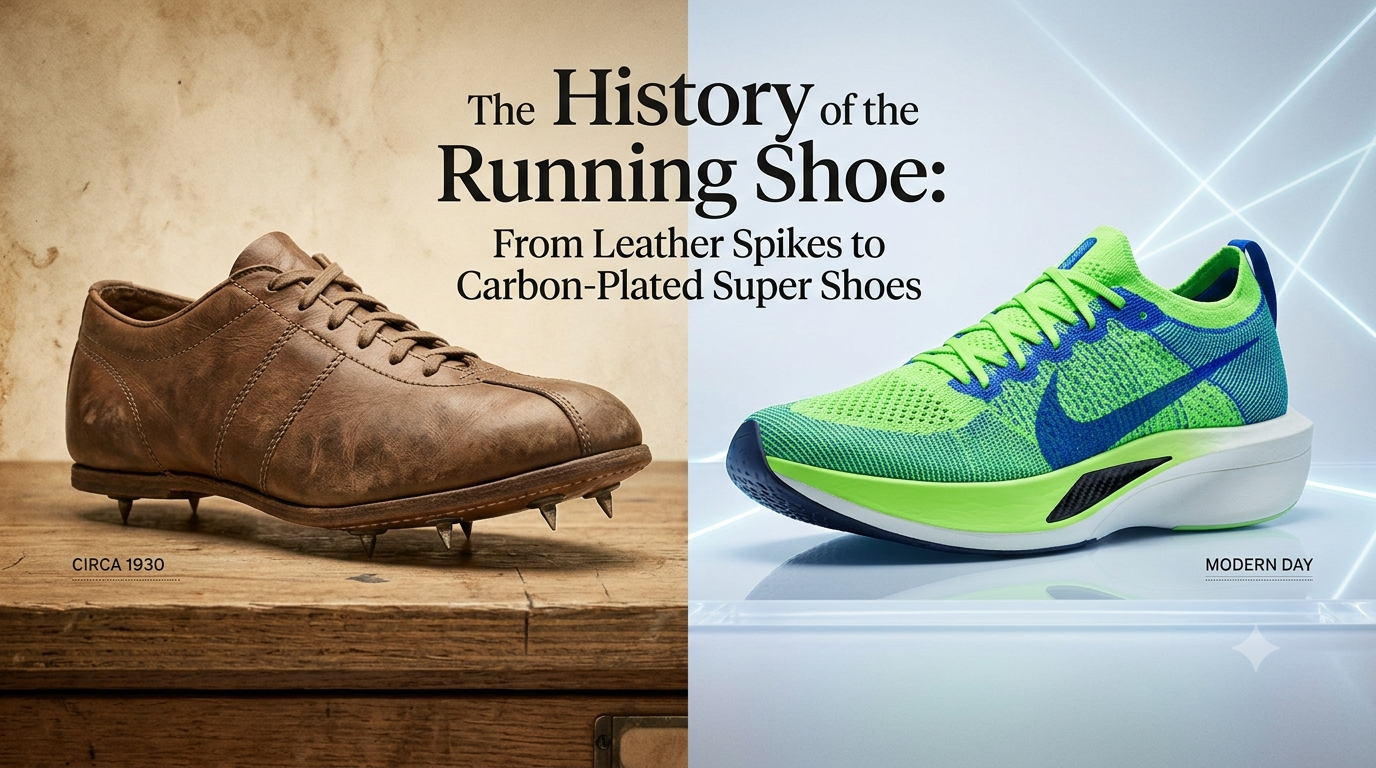
How a Simple Tool Transformed Human Performance
Put a 1920s leather track spike next to a modern carbon-plated racer and it barely reads as the same category of object. One is a stiff, hand-stitched slab of cowhide with metal pins driven through the sole. The other looks like it fell off a spacecraft — a neon foam wedge, springy enough to bounce a coin off, wrapped around a plate of woven carbon fiber and priced like a piece of consumer electronics.
They do the same job, though. Get a foot to the ground and back off it again, as efficiently as possible, thousands of times over. That’s it. That’s the whole brief, and it hasn’t changed since the first person tied a piece of animal hide to their foot.
What has changed is everything around that brief. The running shoe is, on paper, one of the simplest tools in sports — simpler than a tennis racket, simpler than a golf club, just a barrier between skin and ground. And yet over the last century and a half it’s quietly become one of the most engineered objects an athlete touches. A protective layer turned into a biomechanical instrument, tuned and re-tuned across decades of trial, error, obsession, and money. Following how that happened means following culture and business almost as much as rubber and foam.
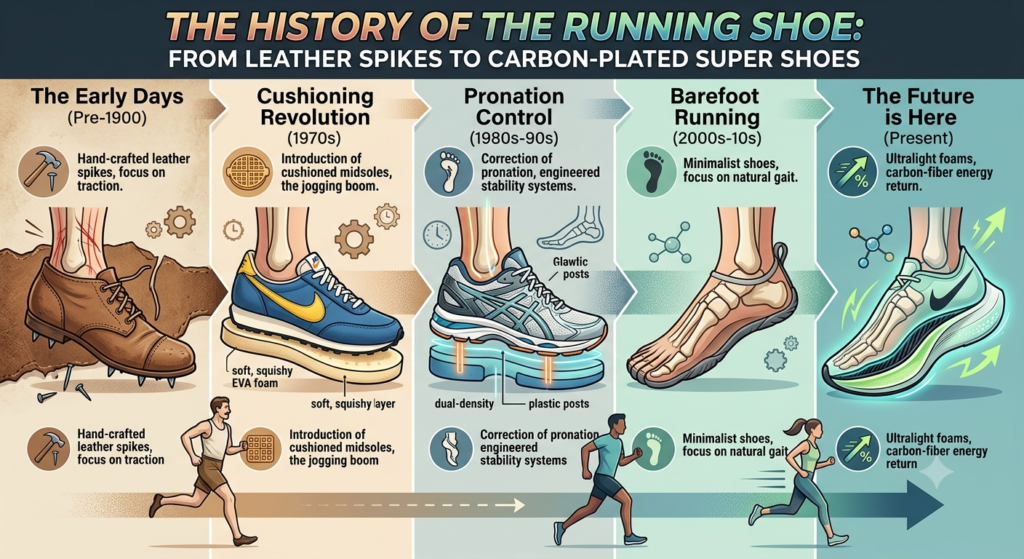
Chapter 1: The Dawn of Athletic Footwear (Late 1800s–1930s)
Before there was a “running shoe” category at all, there was just rubber. And rubber, it turned out, changed everything.
Charles Goodyear worked out vulcanization in the 1840s — treating rubber with sulfur and heat so it held its shape instead of going brittle in the cold or gooey in the sun. That one chemical fix made it possible to bond a flexible rubber sole to a canvas upper, and by the late 1800s companies were turning out what became known as “plimsolls”: soft, quiet, rubber-soled shoes, a world away from the leather boots people had been exercising in up to that point.
Sounds almost too basic to matter. It wasn’t. For the first time athletes had footwear that gripped instead of slid, that didn’t punish the foot with every step. Around the same time, shoemakers dropped a habit nobody had really questioned before — making left and right shoes identical, symmetrical, interchangeable. Anatomically shaped lasts started replacing that, and shoes began to actually resemble the feet they were meant to serve.
The real acceleration came out of a laundry room in Herzogenaurach, Germany, where two brothers were hand-making spiked shoes. Adi and Rudolf Dassler started this in the 1920s — sewing leather uppers, hammering metal spikes through soles themselves, chasing fractions of a second off sprinters’ times. Their work landed on the biggest stage available at the 1936 Berlin Olympics, where Jesse Owens wore Dassler-made spikes to four gold medals, a moment carrying obvious historical weight given exactly whose Games those were. It was also, without anyone calling it this at the time, one of the first great pieces of athletic shoe marketing.
Materials were unglamorous: heavy canvas, stiff leather, hand-forged spikes. But an idea had taken root that mattered more than the materials — a shoe could be designed for performance, not just assembled for protection.
Chapter 2: The Jogging Boom and Road Innovation (1960s–1970s)
Running stayed mostly a track-and-field pursuit for decades — something serious athletes did inside stadiums, in front of crowds, on a schedule. A New Zealand coach named Arthur Lydiard is largely why that changed. He pushed the idea that aerobic base-building through ordinary jogging wasn’t just for elite athletes; it was for anyone.
That idea crossed the Pacific by way of a University of Oregon track coach, Bill Bowerman, and one of his former runners, Phil Knight. The two had started importing Japanese-made Onitsuka Tiger shoes — the company that eventually became Asics — and selling them out of the trunk of Knight’s car, under a company they’d named Blue Ribbon Sports. It would become Nike eventually. In these early years it was just two men who couldn’t stop thinking shoes could be better than they were.
Bowerman especially couldn’t leave well enough alone. Nike’s own well-worn version of the story has him pouring liquid urethane into his wife’s waffle iron in 1971, hunting for a lightweight, high-traction outsole pattern that could replace heavy studded soles. The waffle iron didn’t survive. The waffle sole did, and it became a foundational piece of Nike’s identity — genuinely better traction, genuinely less weight, on a shoe now built for roads instead of just tracks.
Uppers shifted too, away from leather and heavy canvas toward nylon and mesh — lighter, more breathable, dried faster. And underneath, a new midsole material called EVA (ethylene-vinyl acetate) started replacing dense rubber. Lighter, more cushioned, and — this part mattered a lot down the line — a material designers could actually sculpt and experiment with, rather than something they were stuck accepting as-is.
Back in Germany, meanwhile, the Dassler brothers’ relationship broke for good. Adi built Adidas. Rudolf built Puma, right across the same small town, and the bitterness between the two companies — and by extension the two halves of Herzogenaurach — became one of the better subplots in sports business history. Rivalry tends to speed things up. This one did.
Chapter 3: The Cushioning Arms Race and the “Fix-the-Runner” Era (1980s–2000s)
By the 1980s the running boom had built a real consumer market, and shoe companies figured out something worth competing on: technology you could actually see.
Nike rolled out Air cushioning in 1979 and put it in the spotlight with the Air Max line in 1987 — a shoe with a literal window cut into the midsole so you could watch the encapsulated gas pillow do its job. Asics answered with GEL in 1986, a shock-absorbing silicone compound placed at the heel and forefoot. Brooks and Saucony built their own systems — kinetic wedges, grid patterns, dual-density posts — each brand insisting theirs was the real edge.
Some of this was pure psychology. A shoe you could watch working — foam bubbles under clear plastic, colored gel pods on display — felt like it was worth the price tag on the box. But it wasn’t only theater. Real advances in impact absorption were happening underneath the marketing, and runners genuinely ended up with more comfortable shoes than they’d had a decade earlier.
At the same time, the industry got diagnostic. Sports medicine researchers had identified overpronation — the inward roll of the foot after landing — as a possible contributor to injury, and shoe companies built “correction” straight into the product line. Stability and motion-control shoes became their own category: dual-density foams (a firmer wedge on the inner side of the midsole, called a medial post), rigid plastic torsion bars through the arch, structured heel counters meant to keep the foot from rolling too far in.
For roughly two decades this was the dominant idea — the shoe as a corrective device, built to diagnose a runner’s gait and fix whatever it found wrong. Well-intentioned, and it sold enormous volumes of shoes. Whether it actually cut down on injuries the way the marketing implied is still one of the more contested questions in the sport, and it’s fair to say the science never quite settled it either way.
Chapter 4: The Pendulum Swings — Minimalist vs. Maximalist (2009–2015)
Then, in 2009, a book blew the whole premise open.
Christopher McDougall’s Born to Run told the story of Mexico’s Tarahumara people, who covered extraordinary distances in thin sandals, and used it to argue something uncomfortable for an industry built on cushioning: maybe all that foam and correction was making runners weaker and more injury-prone, not less, by doing work the foot and lower leg were supposed to be doing themselves. The book turned into a genuine cultural moment among runners, landing right when the barefoot and minimalist movement already had scientific and popular momentum behind it.
Vibram’s FiveFingers — glove-like shoes with individual toe pockets, almost no cushioning at all — went from oddity to real trend almost overnight. Racing flats and “zero-drop” shoes, no height difference between heel and forefoot, picked up a wave of converts convinced that less shoe meant more natural, more efficient running. For a couple of years it genuinely looked like minimalism might be where the whole industry was headed.
Except almost at the same moment, the opposite idea was forming in the French Alps. Nicolas Mermoud and Jean-Luc Diard, two trail runners, founded Hoka One One in 2009 on a premise that ran directly against the minimalist tide: what if the answer was more cushioning, not less — thick, oversized midsoles built to absorb impact on long descents and ultramarathon distances?
By the logic of the moment, that shouldn’t have worked. More foam was supposed to mean more weight. Hoka’s actual insight was that foam density and foam volume are separable problems — you can build a shoe with a towering stack height that still feels light underfoot, if the foam itself is engineered to be airy rather than dense. Big cushioning without big weight turned out to be the durable idea here, and it planted a seed that mattered enormously in the next chapter.
Chapter 5: The Super Shoe Era and Energy Return (2016–Present)
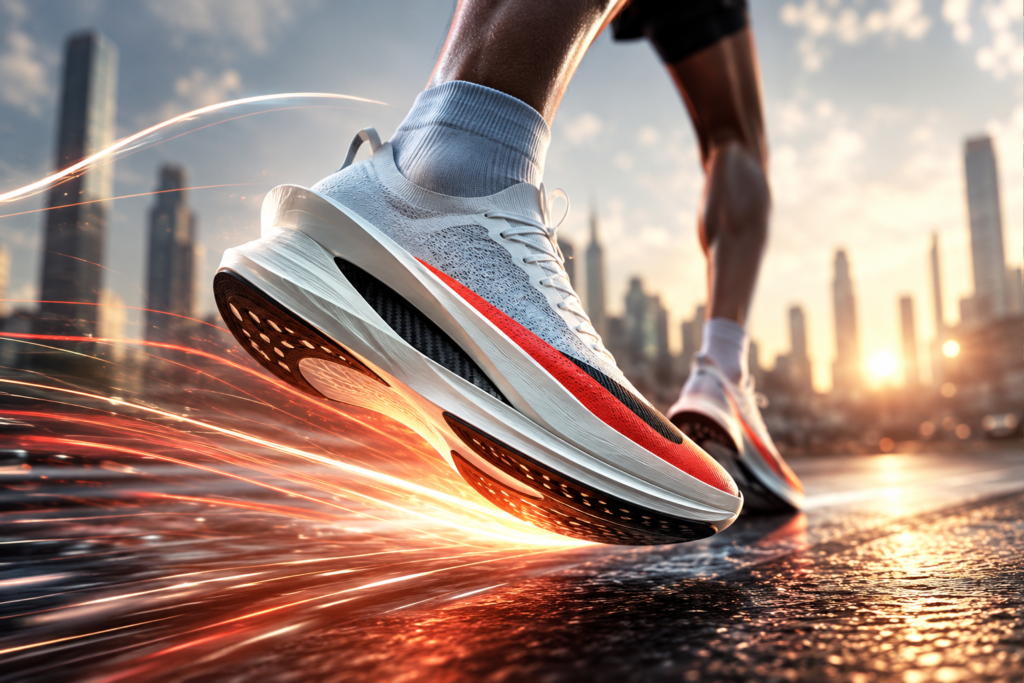
If one moment defines the modern running shoe, it’s Nike’s Breaking2 project in 2017 — an attempt to break the two-hour marathon barrier under quasi-race conditions. The shoe built for the effort, the Vaporfly, didn’t get anyone under two hours that day. It did something arguably more disruptive anyway: it showed a shoe could measurably improve running economy, not just cushion impact or correct a gait.
The Vaporfly’s real breakthrough was a new foam called ZoomX, made from Pebax instead of the traditional EVA. Pebax foams are lighter, and crucially far more elastic — they hand back a much higher share of the energy put into them with each footstrike, closer to a trampoline than a shock absorber. Every rival brand scrambled after the same property: Saucony’s PWRRUN HG, Adidas’s Lightstrike Pro, all of them chasing extreme energy return in an extremely light package.
Sitting inside that foam is the other half of the equation: a full-length, curved carbon fiber plate. Common misconception — the plate isn’t a spring launching the runner forward. Its real job is closer to a lever, or a stiff rocker: it stabilizes the ultra-soft foam around it, keeps the toes from bending too far and bleeding energy at toe-off, and smooths the whole stride into something more like rolling than pushing. Foam and plate function as a system. Neither does much on its own.
And the results are hard to argue with. Marathon world records fell repeatedly in the years after the Vaporfly showed up, in both men’s and women’s fields, and elite times across nearly every road distance took a step change that lined up suspiciously well with shoe technology rather than training breakthroughs. Clear enough, in fact, that World Athletics — the sport’s governing body — stepped in with new rules: capped stack height, one rigid plate per shoe, no more. Something close to an arms-control treaty for footwear.
Chapter 6: The Future of Footwear
Where does a shoe go from here, once it’s already borrowed materials science from aerospace? A few directions are already visible.
Sustainability is the biggest pressure point. Traditional EVA — and even the newer Pebax foams — aren’t easy to recycle, and the industry is under real scrutiny for what all of this actually costs environmentally. Brands like Salomon have experimented with fully recyclable lines, like its Index series, engineered to be broken back down into reusable materials at the end of their life instead of ending up in a landfill. Expect more biodegradable foam, lower-carbon manufacturing, that whole direction, as the pressure keeps building.
Personalization is another one. 3D printing has made it realistic to build midsoles mapped directly to one runner’s foot-strike pattern and pressure distribution — a level of custom fit mass production simply can’t offer, made on demand instead of sitting on a shelf in twelve standard sizes hoping someone’s foot matches.
And then there’s the shoe as a data device. Sensors embedded in the sole that track gait, fatigue, even early injury risk in real time — this is already moving out of research labs and toward actual consumer products. The shoe stops just supporting the run and starts reporting on it.
One Foot in Front of the Other
It’s a long road from a strip of vulcanized rubber glued to canvas to a shoe built with the same foam chemistry used in aerospace parts. Along the way the running shoe absorbed the ambitions of two feuding German brothers, a track coach’s ruined waffle iron, a bestselling book that talked people into running in socks, and a corporate project explicitly built to rewrite the record books.
But underneath all of that, nothing has actually changed. No amount of Pebax foam or carbon fiber does the running for you. It’s still just a person, deciding to put one foot in front of the other, over and over, until they’ve gone somewhere they couldn’t have reached standing still. The shoes got a lot smarter. The sport, at its core, never got any more complicated than that.
Sidebar 1: A Timeline of World Records (And What Was on the Runner’s Feet)
You can basically watch this whole article happen in the numbers. Line up the men’s marathon world record against the shoe that produced it, and the story tells itself.
1960: Abebe Bikila wins the Rome Olympics marathon in 2:15:16 — with nothing on his feet at all. Not the symbolic gesture it’s sometimes made out to be; Ethiopian officials reportedly couldn’t find shoes that fit him properly in time, so he ran barefoot over Roman cobblestones and won anyway. Four years later in Tokyo he broke his own record at 2:12:11, in shoes this time, and the mark kept creeping down through the ’60s and ’70s in modest racing flats from Onitsuka Tiger, Adidas, Reebok — brands most people wouldn’t think to put in the same sentence today, all fighting over the same handful of seconds.
Then it stalls. Belayneh Densamo ran 2:06:50 in Rotterdam in 1988, in an Adidas racing shoe, and that mark just sat there for over a decade — the longest gap between records since before the Second World War. Nobody could line up the right race, the right course, and the right pace all at once. It took until 1998 for Ronaldo da Costa to finally take it down, in Berlin, wearing Nike Air Streaks.
From there it fell in a fairly steady rhythm through the 2000s and early 2010s — Paul Tergat, Haile Gebrselassie twice, Patrick Makau, Wilson Kipsang, Dennis Kimetto — mostly in variations of the Adidas Adizero line, working the record down toward 2:03.
Then 2017. Nike released the Vaporfly and the record started falling faster than it had in fifty years. Kipchoge took it to 2:01:39 in Berlin in 2018, in a Vaporfly Next%. Kelvin Kiptum ran 2:00:35 in a Nike Alphafly at Chicago in 2023 — a number that felt, for a minute, like it might be the actual ceiling on what a human being in shoes could do.
It wasn’t. In April 2026, Sabastian Sawe ran 1:59:30 at the London Marathon — the first sub-two-hour marathon ever run under real race conditions, no choreography, no rotating pacers, nothing arranged — in a new Adidas shoe reportedly weighing under 100 grams. A barrier that used to exist mostly as an argument people had, about whether it was even physiologically possible, came down in an ordinary road race. Hard to think of many other sports where “impossible” turned into “done” this fast, this recently, mostly because of what was strapped to somebody’s feet.
Sidebar 2: Anatomy of a Modern Running Shoe
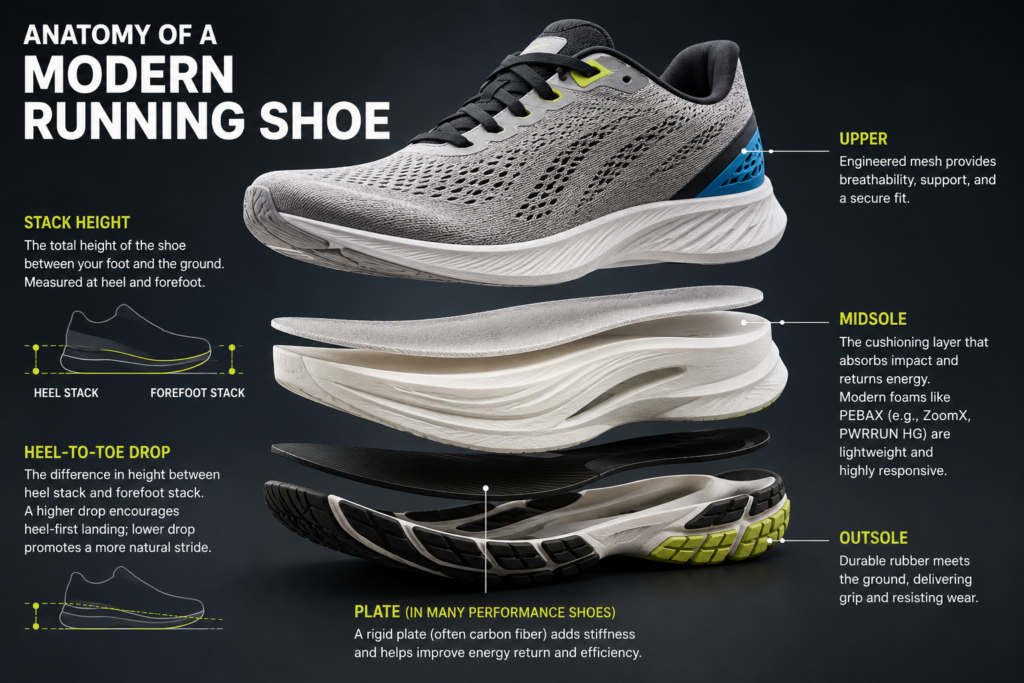
Walk into a running store and the person behind the counter will throw around a handful of terms like they’re self-explanatory. They aren’t. Quick version:
Stack height — how much shoe sits between your foot and the ground, the combined thickness of midsole and outsole, usually measured separately at heel and forefoot. This number has become a real battleground: the tall, springy foam in a modern super shoe is exactly what regulators had to start capping, since more stack — up to a point — tends to mean more cushioning and more energy return.
Heel-to-toe drop — the difference between those two stack heights, how much higher the heel sits than the forefoot. A traditional shoe runs 10 to 12 millimeters of drop, which nudges you toward a heel-first landing. Minimalist shoes go for “zero drop,” heel and forefoot at the same height, on the theory it pushes you toward a more natural, midfoot-first stride.
Upper — everything above the sole, the part actually wrapping the foot. Used to mean stiff leather or heavy nylon. Now it’s almost always some form of engineered mesh, woven breathable in some spots and reinforced in others.
Midsole — the cushioning layer between upper and outsole, and honestly where most of the real innovation of the last fifty years has actually happened: basic EVA foam, then gel and air pockets, now the ultra-light, ultra-bouncy Pebax compounds like Nike’s ZoomX or Saucony’s PWRRUN HG.
Outsole — the part that actually meets the pavement. A tougher rubber compound whose whole job is grip and durability, because none of the fancy foam above it means much if the shoe wears through in a month.