Best Countries for Quality of Life, Safety, and Cost
The dream of packing up a life and moving to Europe is a deeply romantic one. We picture ourselves cycling alongside Amsterdam’s canals, breathing crisp alpine air in Switzerland, or sipping espresso on a sun-drenched terrace in Lisbon. But when you actually sit down to look at a map of Europe, reality hits. You are looking at 44 distinct nations, each operating with its own economy, tax laws, language barriers, and societal quirks. Moving your life to a new country isn’t just about finding a beautiful background for your photos; it is a complex optimization puzzle.
In recent years, the variables we care about have fundamentally shifted. It used to be enough to look at where the jobs were or where the weather was warmest. Today, relocators are asking harder questions. We want to know about a country’s environmental health and long-term social stability. Increasingly, we look at psychological safety—seeking out corners of the world that feel deeply insulated from modern geopolitical flashpoints and war exposure.
This brings us to a persistent continental paradox: the very countries that routinely top global charts for flawless infrastructure and high quality of life are often the ones that demand the heaviest financial toll. If you want the pristine streets and world-class healthcare, you have to pay for it.
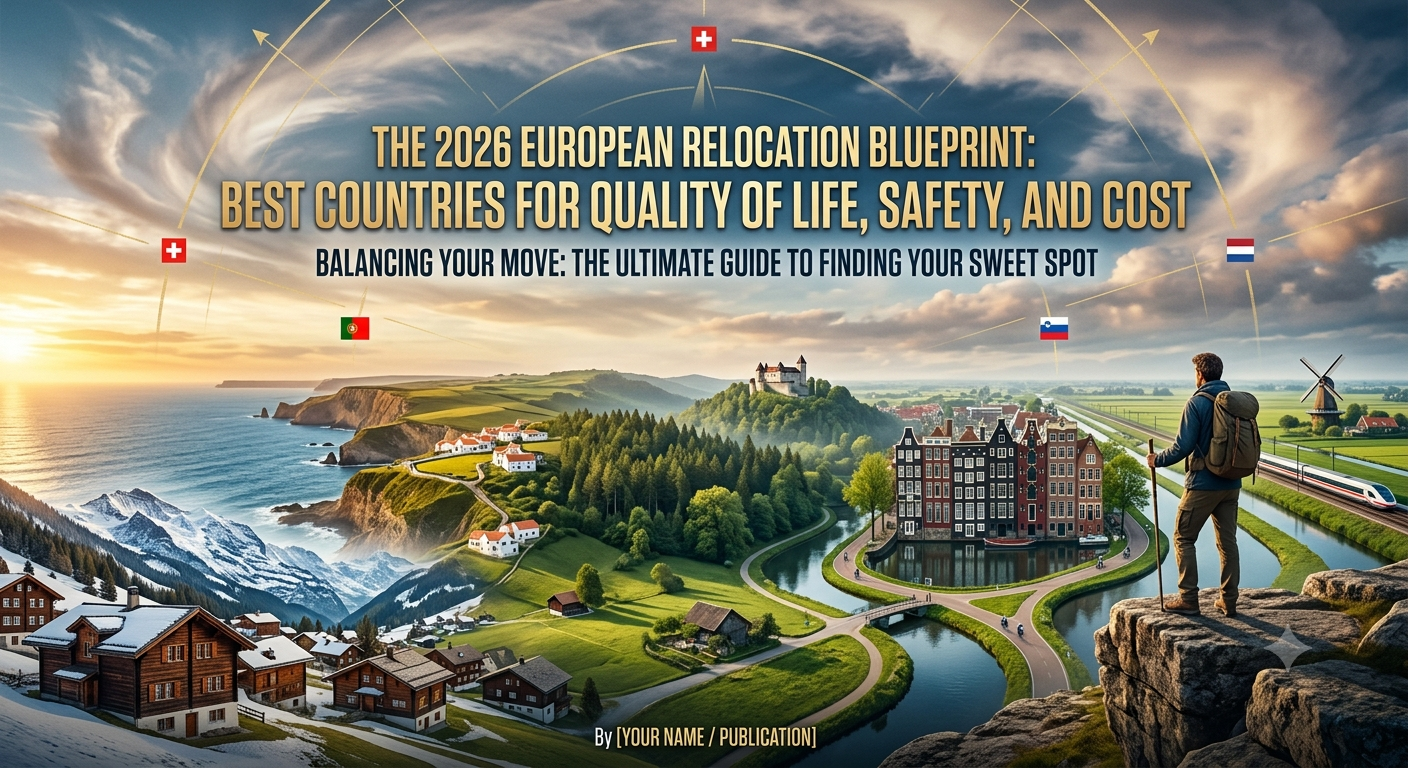
Finding your sweet spot requires looking at Europe’s top contenders through two distinct lenses: the premium gold standards where lifestyle quality is uncompromised but comes at a steep price, and the high-value safe havens where safety, peace, and affordability align beautifully. By analyzing them this way, you can match your personal risk tolerance and financial reality to the right European home.

The Methodology: The 6 Pillars of European Livability
To keep this evaluation fair and objective, we have to move past subjective “vibe checks.” Instead, we filter every destination through a strict multi-variable dataset, anchored by the world’s most trusted global indexes.
Our framework relies on six distinct pillars:
- Quality of Life & Infrastructure: Using data from the Numbeo Quality of Life Index, we look beyond basic GDP to measure local purchasing power, healthcare quality, property-to-income ratios, and daily commute times. Top-tier entry requires an exceptionally high baseline score, which heavily rewards efficient public management.
- Eco-Health & Environmental Cleanliness: We cross-reference Yale University’s Environmental Performance Index (EPI) with local pollution metrics to track air quality, waste management, and green infrastructure, prioritizing an inverse relationship between urbanization and pollution.
- The Financial Ledger: Tied to regional consumer price indexes, this measures the absolute cost of rent, groceries, and utilities relative to a major global baseline like New York City. It highlights the sharp financial cliff between northern and southern Europe.
- Peace, Order, and Safety: Driven by the Institute for Economics and Peace (IEP) Global Peace Index, this tracks societal safety, including internal metrics like crime rates, political stability, and how safe it feels to walk alone at night.
- Cultural Integration & Language Barriers: We use the EF English Proficiency Index to gauge how easily a foreigner can navigate healthcare, taxes, and daily friendships before mastering the local language, which is crucial for preventing expat isolation.
- Geopolitical Insulation: We evaluate a country’s geographic buffer zones, its defensive or neutral military stance, and its distance from major international friction points to assess true peace of mind.
The Premium Gold Standards (Uncompromised Quality, Premium Price)
These are the nations that score flawlessly across almost every societal metric. They are safe, clean, and incredibly well-run, but living here requires a significant financial footprint.
The Netherlands: The Infrastructure and Integration Champion

The Netherlands is a masterclass in human-centric urban design. Boasting a top-tier global quality of life ranking, it is a country where work-life balance isn’t a corporate buzzword—it is a cultural rule. The environment is exceptionally clean; even in high-density urban centers like The Hague or Utrecht, a brilliant cycling infrastructure keeps cars off the road and pollution levels remarkably low. Geographically, it is safely tucked away in Western Europe, heavily protected by defensive alliances, making its direct war risk virtually zero.
For expats, its greatest asset is cultural ease. The Netherlands consistently occupies the number one spot globally on the English Proficiency Index. You can buy a house, file your taxes, and chat with your neighbors entirely in English without hitting a wall of isolation.
However, the Dutch dream hits a hard reality when it comes to housing. The country is facing a historic accommodation shortage, and rent or property prices are astronomically high. A high cost of living index means your wallet will feel the pinch every time you buy groceries or dine out, and local income taxes are steep.
Switzerland: The Fortress of Neutrality and Order
Switzerland is a country that operates with the precision of a luxury watch. It is the gold standard for anyone prioritizing absolute peace, order, and pristine nature. Its safety metrics are legendary, sitting securely in the top five of the Global Peace Index. What truly sets Switzerland apart, however, is its geopolitical shield. The country has maintained a stance of strict, armed military neutrality since 1815. Its mountainous geography and unique institutional architecture make it the ultimate global safe haven from international conflict.
Public transport is flawless, the alpine air and water are perfectly pure, and the economy is rock-solid. If your goal is to completely unplug from global anxieties, this is the fortress.
That perfection comes with an eye-watering price tag. Switzerland is consistently one of the most expensive places on earth to live. Furthermore, the local culture can be quite reserved, making deep social integration a slow, multi-year process, and the path to long-term citizenship is one of the steepest in Europe.
Denmark: The High-Trust, High-Tax Utopia
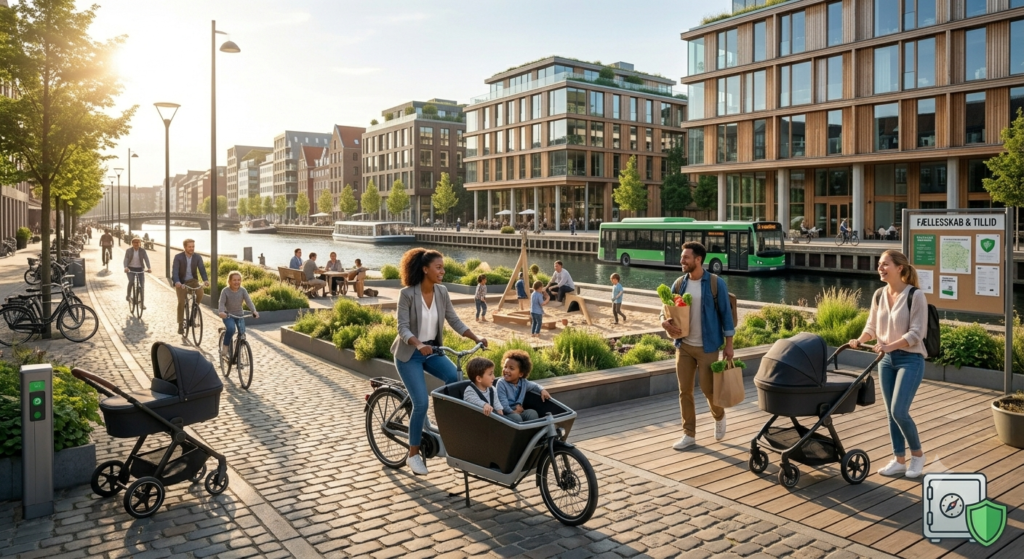
Denmark routinely battles for the title of the happiest country on earth. The society is built on hygge—a cultural focus on coziness, comfort, and community wellbeing—and an incredible level of societal trust. Denmark’s cities are flat, green, and highly sustainable. Crime is so low that it is common to see parents leave strollers outside cafes while they grab a coffee. The social safety net here is unparalleled, offering free healthcare and robust support that virtually eliminates poverty-driven crime.
To fund this utopia, Denmark levies some of the highest income taxes in the world, often exceeding 50%. The cost of consumer goods is incredibly high, and you must be prepared to handle long, dark, damp northern winters that can test anyone’s mental resilience.
The High-Value Safe Havens (Top-Tier Safety, Low Cost)
If you love the safety and order of Europe but don’t want to spend your life savings to experience it, these countries offer an exceptional lifestyle at a fraction of the cost.
Portugal: The Continental Gateway
For remote workers, retirees, and families looking to optimize their capital, Portugal is arguably the most attractive destination in Europe. The value proposition here is unmatched: your day-to-day living expenses, rent, and dining costs scale down by 30% to 40% compared to Western Europe. Yet, you aren’t sacrificing safety. Portugal consistently ranks in the top ten of the Global Peace Index. Geographically sitting on the southwestern edge of the continent, it is thousands of miles away from Eastern European border tensions, offering incredible geopolitical insulation.
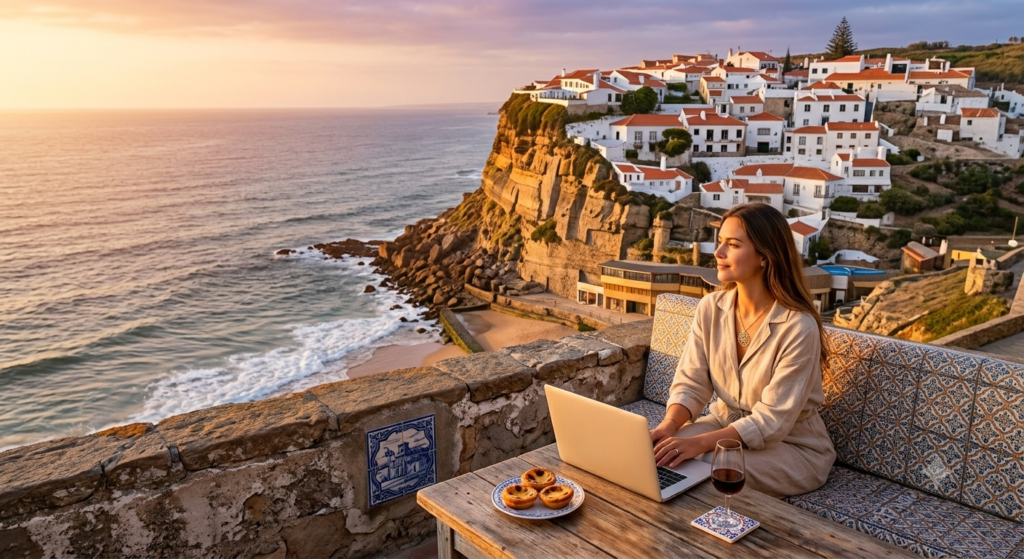
With a warm maritime climate, stunning coastlines, and a remarkably high English proficiency ranking inside the top ten globally, it is easy to see why expat communities are thriving here.
Portugal’s public systems move slowly, though. Navigating the notoriously sluggish and complex state bureaucracy can be an incredibly frustrating experience. Additionally, if you plan to look for a job locally rather than bringing a foreign income or remote role, average Portuguese wages are quite low, creating a sharp divide between expats and locals.
Slovenia: Central Europe’s Green Secret
Slovenia is a hidden gem that frequently outperforms major Western nations in safety, income equality, and environmental purity. It is one of the most biodiverse, forested countries on earth, making it a dream for outdoor enthusiasts. Violent crime is practically non-existent; this is a place where safety is so deeply woven into daily life that it is taken for granted, earning it a spot as the fourth most peaceful country globally on the latest peace indexes. While nestled in Central Europe, its stable, alpine-adriatic positioning keeps it firmly out of geopolitical crosshairs. It offers Western European infrastructure and pristine cleanliness at a Central European price point.
Because Slovenia is still under the radar, it has a much smaller expat footprint than places like Portugal or Spain. The English proficiency is good among the youth, but to truly integrate and handle municipal life, learning basic Slovene is highly encouraged, as the cultural barrier can feel higher than in deeply internationalized hubs.
Strategic Head-to-Head: Choosing Your Trade-Off
Choosing your new home ultimately comes down to identifying which trade-offs you are willing to make. No country offers a perfect score across all six pillars.
If you are looking to climb a corporate ladder, access massive tech hubs, and don’t mind high taxes, northern gold standards like the Netherlands provide the ultimate sandbox. If you are a remote worker, freelancer, or retiree looking to make your dollars or euros stretch as far as possible without sacrificing safety, the high-value safe havens are your sweet spot.
You also have to be honest about how weather affects your mood. The clean air, functional infrastructure, and high trust of Denmark and the Netherlands come with gray skies and early sunsets for half the year. If you need sunshine to thrive, Portugal’s coast is the clear winner. Finally, consider how you view security. If your move is heavily driven by a desire to escape global instability, Switzerland offers security via its centuries-old institutional neutrality. Portugal offers that same peace of mind through pure geographic isolation.
There is no single best country to live in Europe. The ideal destination depends entirely on what you are willing to compromise on. Before making a permanent move, look past the glossy travel brochures. Pack a bag and visit your top choices during the off-season. Walk the streets on a rainy Tuesday in November, talk to local expats, and see how the country feels when the holiday magic wears off. That is where you will find the real answer to your relocation puzzle.