Introduction
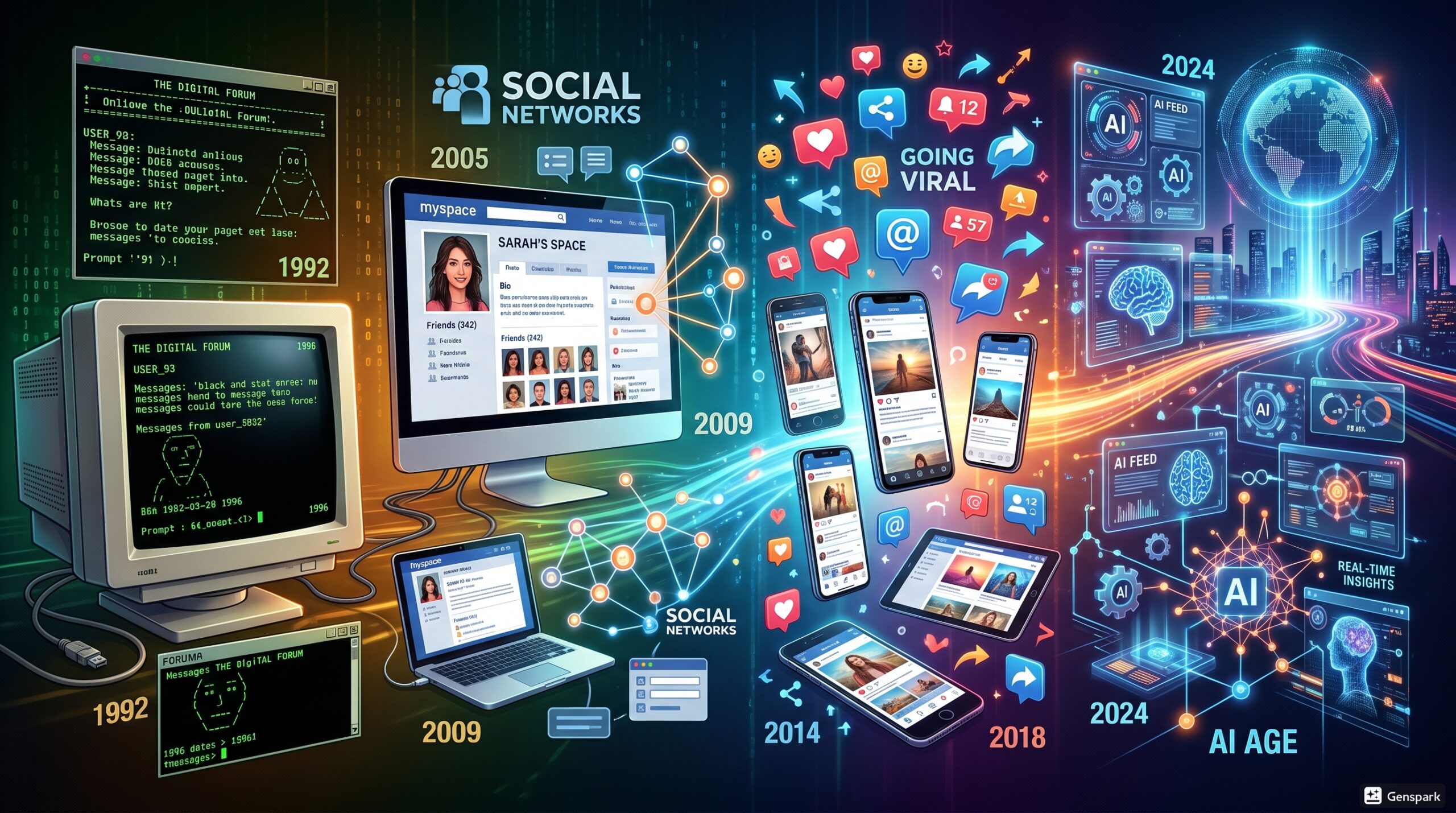
Few technological innovations have transformed human civilization as dramatically as social media. In just a few decades, the world moved from slow dial-up message boards and anonymous internet forums to hyper-connected digital ecosystems where billions of people communicate instantly through videos, livestreams, memes, stories, and artificial intelligence-powered content feeds.
Social media is no longer simply a tool for communication. It has become a global infrastructure that influences politics, culture, business, journalism, entertainment, education, and even human psychology. Governments use it to communicate with citizens. Businesses use it to market products. Activists organize movements through hashtags. Families stay connected across continents. Meanwhile, creators and influencers have turned social platforms into full-time careers and billion-dollar industries.
The evolution of social media is also the story of the internet itself — a journey from open digital communities to algorithm-driven platforms competing for human attention. Every era introduced new technologies, new behaviors, and new cultural shifts that changed how people interact online.
This article explores the complete evolution of social media, tracing its origins from primitive internet communities to today’s AI-powered content ecosystems and examining how these platforms reshaped modern society.
The Internet Before Social Networking
Before Facebook, Instagram, or TikTok existed, the internet was already beginning to connect people digitally. Early forms of online interaction appeared decades before modern social media platforms emerged.
In the late 1960s, the United States Department of Defense developed ARPANET, a computer networking project that became the foundation of the modern internet. While ARPANET was initially designed for research and military communication, it introduced the revolutionary concept of interconnected digital communication.
During the 1970s and 1980s, computer enthusiasts began building online communities through Bulletin Board Systems (BBS). Users connected using telephone lines and dial-up modems to exchange messages, upload files, and participate in discussions.
These early systems may appear primitive today, but they introduced several concepts that remain central to social media:
- Online identities
- Digital friendships
- Public discussion threads
- User-generated content
- Community moderation
As internet access expanded during the 1990s, online forums and chatrooms became increasingly popular. Platforms such as AOL, Yahoo Groups, and IRC (Internet Relay Chat) allowed users to engage in real-time conversations across the globe.
The internet was becoming social long before the term “social media” existed.
The Birth of Online Communities
Forums, Chatrooms, and Digital Identity
The 1990s marked the rise of digital communities organized around shared interests rather than geographic location.
Message boards and forums became gathering places for:
- Gamers
- Music fans
- Hobbyists
- Programmers
- Political groups
- Technology enthusiasts
Websites like GeoCities allowed users to create personalized web pages, often decorated with colorful backgrounds, animations, and personal diaries. These sites represented early forms of online self-expression.
At the same time, blogging platforms such as LiveJournal and Blogger gave users the ability to publish thoughts and experiences publicly. This period helped normalize the idea that ordinary individuals could become publishers and content creators.
These developments laid the psychological and cultural groundwork for modern social networking.
SixDegrees and the First Social Network
The Beginning of Modern Social Media
In 1997, a platform called SixDegrees introduced what many historians consider the first recognizable social networking website.
SixDegrees allowed users to:
- Create profiles
- Add friends
- Send messages
- Build visible social networks
The platform was based on the concept of “six degrees of separation,” the theory that all people are connected through short chains of relationships.
Although SixDegrees eventually failed due to limited internet adoption and technological constraints, it introduced the framework that nearly every modern social platform still follows today.
The idea that social relationships could be digitized permanently changed the internet.
Friendster and the Early Social Media Explosion
The First Mass Social Networking Craze
In 2002, Friendster became one of the first social networking platforms to achieve mainstream popularity.
Friendster allowed users to:
- Build personal profiles
- Connect with real-life friends
- Share photos
- Discover mutual connections
For many users, Friendster was their first experience managing a digital identity online.
The platform grew rapidly but struggled with technical problems and slow loading speeds as millions of users joined simultaneously. Despite its eventual decline, Friendster proved that social networking had enormous global potential.
Its success inspired the next generation of social platforms.
The MySpace Era
Personalization and Internet Culture
In 2003, MySpace emerged and quickly became the dominant social media platform of its era.
Unlike modern minimalist platforms, MySpace encouraged extreme personalization. Users customized their profiles using HTML, music playlists, flashing graphics, and colorful themes.
MySpace became deeply tied to youth culture and online identity formation.
It also revolutionized the music industry. Independent musicians used MySpace to:
- Share songs directly with fans
- Promote concerts
- Build audiences without record labels
Many artists gained fame through MySpace exposure, demonstrating the internet’s growing ability to bypass traditional media gatekeepers.
Why MySpace Succeeded
- Creative freedom
- Youth appeal
- Music integration
- Strong community culture
Why MySpace Declined
- Cluttered interface
- Poor user experience
- Weak mobile adaptation
- Rising competition from Facebook
Even after its decline, MySpace helped establish social media as a mainstream cultural force.
Facebook and the Social Networking Revolution
The Platform That Changed the World
In 2004, Facebook launched as a small networking site for Harvard students. Few could have predicted that it would eventually become one of the most influential companies in human history.
Facebook introduced a cleaner and more organized social networking experience than MySpace. Instead of chaotic customization, Facebook emphasized real identities and structured profiles.
Its most revolutionary feature was the News Feed, which centralized updates from friends into one continuously updating stream.
Facebook’s major innovations included:
- Real-name identities
- Photo tagging
- The Like button
- Groups and Pages
- Third-party applications
As Facebook expanded from universities to the general public, it rapidly became the dominant global social network.
By the 2010s, Facebook had fundamentally transformed:
- Online communication
- Advertising
- Journalism
- Political campaigning
- Digital marketing
The Rise of User-Generated Video
YouTube Changes Media Forever
In 2005, YouTube launched and transformed the internet into a video-driven environment.
Before YouTube, publishing videos online was technically difficult and expensive. YouTube simplified the process, allowing anyone to upload and share videos globally.
This innovation democratized media production.
YouTube created:
- Independent creators
- Video influencers
- Online educators
- Gaming streamers
- Vloggers
- Reaction channels
Traditional television networks were no longer the sole gatekeepers of entertainment.
The Rise of Viral Culture
YouTube introduced the concept of viral content on a massive scale. Videos could suddenly reach millions of viewers overnight, changing how entertainment spread online.
Monetization and the Creator Economy
YouTube’s partner program enabled creators to earn advertising revenue. This laid the foundation for the modern creator economy, where individuals could build careers through online content.
Twitter and the Age of Real-Time Information
Microblogging Changes Communication
Twitter launched in 2006 with a radically simple concept: short public posts shared instantly.
Initially limited to 140 characters, Twitter became a platform for:
- Breaking news
- Political commentary
- Celebrity interaction
- Public discourse
- Real-time event coverage
Twitter’s hashtag system transformed how information spread online. Users could organize conversations globally around specific topics and movements.
Twitter’s Role in World Events
Twitter played major roles in:
- The Arab Spring
- Protest movements
- Election discussions
- Crisis communication
- Citizen journalism
The platform became one of the internet’s most influential spaces for public conversation.
The Smartphone Revolution
Mobile Technology Reshapes Social Media
The launch of smartphones, especially the iPhone in 2007, changed social media permanently.
Social platforms were no longer limited to desktop computers. People could now:
- Upload photos instantly
- Share live updates anywhere
- Communicate continuously
- Consume content throughout the day
Mobile technology dramatically increased:
- User engagement
- Content creation
- Screen time
- Real-time interaction
This shift accelerated the growth of social media into an everyday necessity.
Instagram and the Visual Internet
The Rise of Image-Based Culture
Instagram launched in 2010 and helped transform social media into a highly visual experience.
The platform focused on:
- Mobile photography
- Filters
- Simplicity
- Lifestyle sharing
Instagram popularized “aesthetic culture,” where carefully curated images became central to online identity.
The Birth of Influencer Culture
Instagram gave rise to social media influencers — individuals who built large audiences through lifestyle content, fashion, travel, beauty, fitness, and entertainment.
Brands quickly realized influencers could market products more effectively than traditional advertising.
This created a new economy based on:
- Sponsored posts
- Brand collaborations
- Affiliate marketing
- Personal branding
Snapchat and Temporary Content
The Popularity of Ephemeral Communication
Snapchat introduced disappearing messages and temporary “Stories,” changing how users interacted online.
Unlike Facebook’s permanent digital archives, Snapchat emphasized casual and temporary communication.
This appealed especially to younger users seeking:
- Privacy
- Authenticity
- Informal interaction
Snapchat also pioneered augmented reality filters, introducing playful digital effects that later spread across nearly every major platform.
LinkedIn and Professional Social Networking
Social Media for Careers and Business
While entertainment-focused platforms dominated public attention, LinkedIn emerged as the leading professional networking platform.
LinkedIn transformed:
- Recruitment
- Business networking
- Corporate branding
- Online resumes
- Professional education
Companies increasingly used LinkedIn not only for hiring but also for thought leadership and marketing.
The platform demonstrated that social media could serve professional and economic purposes beyond entertainment.
TikTok and the Short-Form Video Revolution
The Platform That Changed Everything Again
TikTok became one of the fastest-growing social media platforms in history.
Unlike earlier social networks built around friend connections, TikTok focused primarily on algorithmic content discovery.
Its “For You” page analyzed user behavior to deliver highly personalized video feeds.
Why TikTok Became So Powerful
- Extremely addictive short videos
- Rapid trend cycles
- Personalized algorithms
- Easy video creation tools
- Viral discovery system
TikTok transformed internet culture by accelerating trends, memes, and music popularity at unprecedented speeds.
Songs could become global hits overnight due to viral dances or challenges.
The Evolution of Content Formats
From Text Posts to AI-Generated Media
Social media content evolved dramatically over time.
Timeline of Content Evolution
- Text posts
- Forums and blogs
- Photos
- Long-form video
- Stories
- Livestreams
- Short-form videos
- AI-generated content
Modern platforms increasingly prioritize video and interactive content over text-based communication.
Attention spans shortened while competition for engagement intensified.
The Rise of the Creator Economy
Social Media as a Career
One of social media’s most significant transformations is the emergence of the creator economy.
Millions of people now earn income through:
- YouTube channels
- TikTok videos
- Instagram sponsorships
- Livestream donations
- Paid subscriptions
- Affiliate marketing
Influencers evolved from hobbyists into full-scale businesses.
Entire industries now revolve around:
- Content production
- Creator management
- Influencer agencies
- Digital advertising
- Online merchandising
The creator economy is valued in the hundreds of billions globally.
Algorithms and the Attention Economy
The Shift From Social Connection to Engagement Optimization
Early social media focused on connecting people. Modern platforms increasingly focus on maximizing engagement.
Algorithms now determine:
- What users see
- How long they stay online
- Which content becomes viral
These systems analyze:
- Viewing behavior
- Watch time
- Click patterns
- Emotional reactions
- Search history
The Benefits of Algorithms
- Personalized recommendations
- Better content discovery
- Increased entertainment value
The Dangers
- Echo chambers
- Political polarization
- Addictive behavior
- Mental health concerns
- Misinformation spread
Social media companies now compete primarily for human attention.
Social Media and Mental Health
The Psychological Effects of Constant Connectivity
As social media usage increased, concerns about mental health also grew.
Researchers and psychologists have linked excessive social media use to:
- Anxiety
- Depression
- Loneliness
- Sleep disruption
- Low self-esteem
- Social comparison
Why Social Media Can Be Addictive
Platforms are designed to encourage repeated engagement through:
- Likes
- Notifications
- Infinite scrolling
- Viral trends
- Reward systems
These mechanisms activate dopamine responses in the brain, encouraging users to return repeatedly.
Social Media and Politics
Digital Platforms Become Political Battlegrounds
Social media transformed political communication worldwide.
Political leaders and campaigns now use platforms to:
- Reach voters directly
- Spread campaign messages
- Mobilize supporters
- Conduct targeted advertising
Major Political Concerns
- Fake news
- Election interference
- Bot networks
- Propaganda campaigns
- Disinformation
Social media’s role in democracy became one of the most debated issues of the modern internet era.
Business, Advertising, and Social Commerce
The Transformation of Marketing
Social media completely reshaped advertising and business communication.
Traditional advertising evolved into:
- Influencer marketing
- Viral campaigns
- Targeted ads
- Personalized recommendations
Social Commerce
Modern platforms increasingly integrate shopping directly into apps.
Users can now:
- Purchase products through livestreams
- Shop through creator recommendations
- Buy directly from social feeds
Social media has become a major driver of global e-commerce.
Regional Differences in Social Media
Different Platforms Around the World
Social media ecosystems vary significantly by region.
Western Platforms
- X
- TikTok
Asian Platforms
- LINE
- KakaoTalk
Government Regulation
Different governments regulate social media differently through:
- Content moderation laws
- Data privacy rules
- Platform restrictions
- Internet censorship
The future of social media increasingly depends on geopolitical and regulatory developments.
Failed Platforms and Lessons Learned
Why Some Social Networks Disappeared
Many once-popular platforms collapsed despite early success.
Friendster
- Failed to scale technologically
MySpace
- Could not compete with Facebook’s cleaner experience
Vine
- Failed monetization model
Google+
- Weak user engagement
Key Lessons
- User behavior changes quickly
- Innovation is temporary
- Mobile adaptation is essential
- Community trust matters
Artificial Intelligence and the Future of Social Media
The Next Phase of Digital Interaction
Artificial intelligence is rapidly reshaping social media.
Emerging AI Technologies
- AI-generated influencers
- Automated video creation
- Personalized AI assistants
- Synthetic voices
- Deepfake videos
Potential Benefits
- Improved accessibility
- Smarter recommendations
- Faster content creation
Serious Risks
- Authenticity crisis
- Misinformation
- Manipulated media
- Identity fraud
The challenge for future platforms will be balancing innovation with trust and ethics.
The Future of Social Media
Where Social Platforms Are Heading
Several major trends are shaping the future of social media:
Short-Form Video Dominance
Fast, highly engaging content continues to dominate user attention.
AI-Powered Personalization
Algorithms will become even more predictive and individualized.
Virtual and Augmented Reality
The rise of immersive digital spaces may redefine online interaction.
Decentralized Platforms
Some users are moving toward platforms emphasizing privacy and ownership.
Smaller Communities
Private groups and niche communities are becoming more important than mass public feeds.
Authenticity Over Perfection
Many users increasingly prefer raw and relatable content over heavily curated posts.
The Digital Evolution That Changed Humanity
The evolution of social media is one of the most significant technological and cultural transformations in modern history.
What began as simple digital message boards evolved into a global communication system influencing nearly every aspect of human life. Social media changed how people communicate, learn, shop, vote, work, entertain themselves, and perceive reality itself.
It created opportunities for creativity, entrepreneurship, education, and global connection. At the same time, it introduced new challenges involving privacy, misinformation, addiction, and mental health.
Today’s social media platforms are no longer merely communication tools. They are powerful algorithm-driven ecosystems shaping global culture in real time.
As artificial intelligence, virtual reality, and new technologies continue to evolve, the future of social media will likely become even more immersive, personalized, and influential.
The story of social media is still being written — and its next chapter may transform society even more profoundly than the last.