The Paradox of the Modern Workplace and The 4 Non-AI Skills That Will Make You Indispensable
We were promised that the automation age would grant us endless free time. Instead, it has triggered a quiet, collective panic.
Today, polished emails, flawless computer code, comprehensive market research, and complex data models can be generated in a matter of seconds by artificial intelligence. Tasks that used to take an entire workweek are now handled by a single, well-phrased prompt.
Yet, if you look closely at almost any modern organization, a fascinating paradox emerges: despite this sudden burst of pure efficiency, workplace friction is at an all-time high. Miscommunications run rampant, strategic initiatives stall due to internal politics, and many professionals feel a profound sense of disconnection.
This reveals a massive, hidden truth about the future of work: AI excels at recombination (mixing existing data), but it utterly fails at context and human agency.
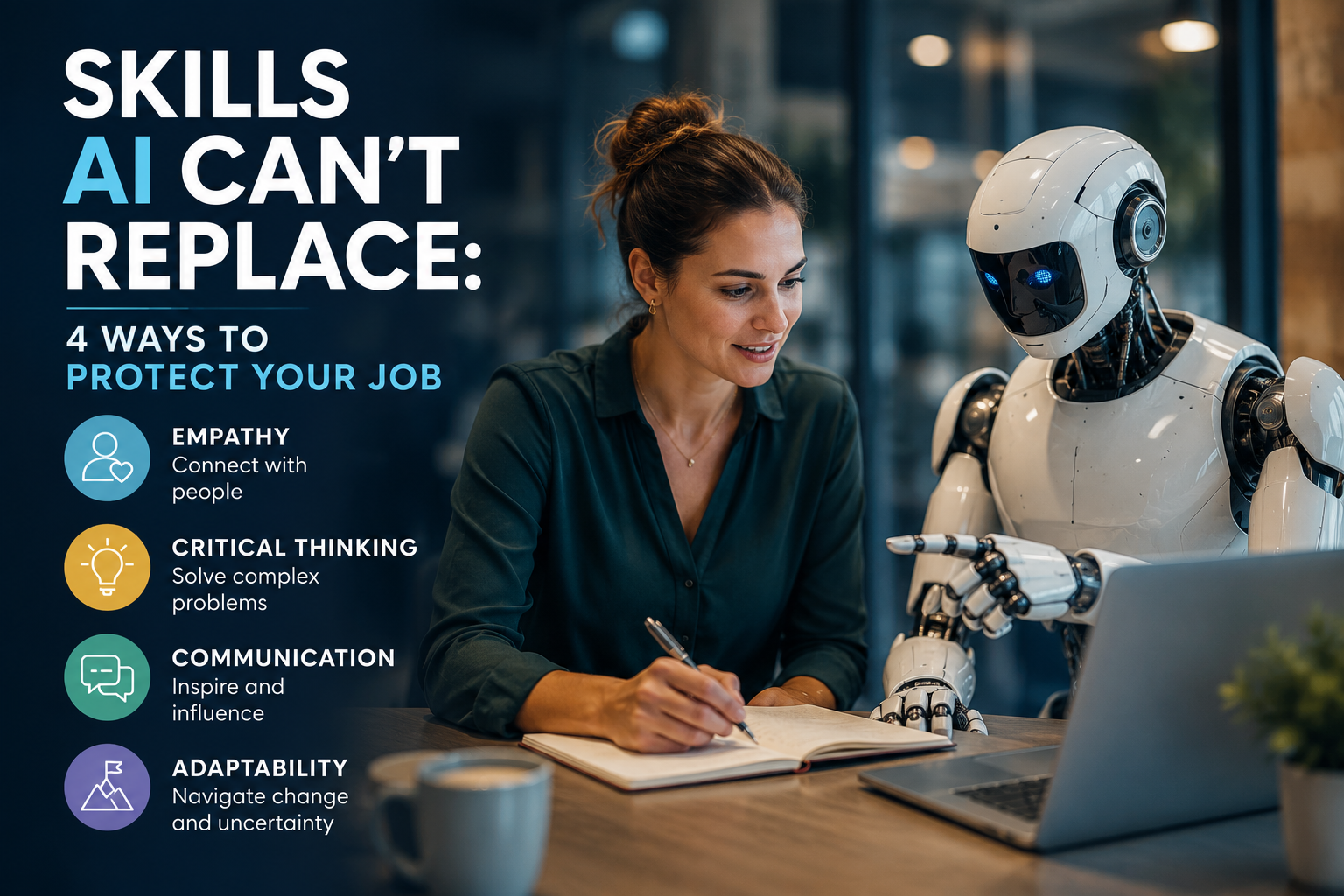
Your value in the workforce is no longer determined by what you can execute; it is determined by what you can decide, guide, and sense. The hard, technical skills that took decades to master are quickly becoming commoditized. To remain truly indispensable, you must shift your focus away from competing with algorithms. Instead, you need to master the four deeply human layers of work that software can never clone.
Skill 1: Contextual Intelligence & Judgment Under Uncertainty
AI operates on data and probabilities. Humans operate on nuance, stakes, and accountability.
The Core Concept
Contextual Intelligence is the ability to read between the lines of a situation. It is the rare skill of knowing when a strict corporate policy should actually be broken, how to read a room during a delicate negotiation, and how to make a high-stakes executive call when you only have 70% of the facts. It is the bridge between theoretical knowledge and real-world application.
Why AI Fails Here
Large Language Models (LLMs) operate in a vacuum of historical data. They can calculate the mathematical probability of a product launch failing based on past market trends, but they lack real-world stakes. AI does not understand human ego, regional cultural shifts, or the delicate internal politics of a shifting executive board. Most importantly, an algorithm cannot feel the weight of accountability. When an AI-generated decision fails, the software doesn’t lose its job or face a crisis of conscience—you do.
The Skill in Action
Imagine a fully booked boutique hotel. A software glitch causes an overbooking, and a high-profile VIP guest arrives at midnight only to find their presidential suite is occupied by a family celebrating their wedding anniversary.
An AI optimization system would look at the data and suggest a logical, rigid solution: bump the family to a nearby partner hotel and issue a partial refund based on contract terms.
A manager with high contextual intelligence, however, sees the invisible stakes. Moving the family ruins a milestone life event and risks a catastrophic public relations review. Evicting the VIP damages a multi-million dollar corporate partnership. The manager makes an on-the-spot human call: they upgrade the VIP to an executive boardroom converted into a temporary luxury suite, offer them complimentary private dining, and hand-deliver an artisanal gift to the celebrating family to thank them for their patience.
The software solved for data; the human solved for relationships.
Your Actionable Framework
- The Rule of Three: When faced with an ambiguous professional problem, never settle for your first instinct. Intentionally write down three distinct solutions from three completely separate perspectives:
- The Financial Lens: What makes the most mathematical sense?
- The Human Lens: How will this impact morale, loyalty, and trust?
- The Operational Lens: Is this sustainable for the team executing it?
- Conduct a Premortem Analysis: Before launching any initiative—especially those assisted by automated tools—gather your team and ask: “Assume it is six months from now and this project has completely failed. What unquantifiable human element did our data overlook?”
Skill 2: Advanced Emotional Intelligence (EQ) & Social Modeling
Efficiency is not the same thing as human connection. The more automated our workflows become, the more valuable trust becomes.
The Core Concept
Advanced Emotional Intelligence in the workplace goes far beyond “being nice” or possessing basic manners. True professional EQ is the ability to build psychological safety within a team, decode unvoiced anxieties, navigate complex organizational power dynamics, and motivate cross-functional groups who do not directly report to you. It is the ultimate glue of execution.
Why AI Fails Here
An AI can mimic empathy beautifully in a text response, but it cannot actually feel it. It cannot look at a colleague during a video call and notice that their smile didn’t reach their eyes. It cannot sense the subtle shift in a room’s atmosphere when a controversial metric is displayed on a slide. Trust is an entirely biological, shared human currency. It requires shared vulnerability, shared risks, and authentic presence—things lines of code simply do not possess.
The Skill in Action
Consider a project manager leading a software development team through an incredibly tight corporate deadline. The automated project management dashboard shows all “green” metrics—tasks are being completed on time, code is being pushed, and efficiency is high.
However, during a brief, casual sync, the manager notices that their lead engineer is uncharacteristically quiet, answering questions with short, clipped sentences.
Instead of trusting the glowing digital dashboard, the manager schedules an informal chat. They discover the engineer is experiencing severe burnout and family stress. The manager quietly restructures the upcoming sprint, pulling in support from an adjacent team before a catastrophic system failure or resignation occurs. The AI tracked the output; the human protected the engine.
Your Actionable Framework
- Practice Active Decoding: In your next five meetings, intentionally split your focus between what is being said and how it is being said. Look for micro-expressions, sudden changes in posture, defensive language, or conspicuous silences.
- Implement the “I’m Fine” Protocol: When a high-performing colleague gives a perfunctory “everything is fine” response during a stressful period, do not take it at face value. Follow up with a specific, low-pressure question: “Hey, I know we’ve been pushing incredibly hard on this launch. What is the single biggest bottleneck making your week harder right now that I can help remove?”

Skill 3: Complex Communication & Strategic Storytelling
AI can generate content. Only humans can command a room, align conflicting incentives, and create shared meaning.
The Core Concept
Complex communication is the art of translating raw, sterile data into compelling narratives that inspire action, change deep-seated mindsets, or settle fierce corporate disputes. It is the stark difference between emailing your team a dry, 50-page PDF report or delivering a 5-minute pitch that wins a million-dollar budget.
Why AI Fails Here
Because AI models are trained on the average of human writing across the internet, their default output is inherently generic, safe, and sterile. AI lacks personal taste, lived experiences, and the unique quirks of human personality. An AI can summarize your data, but it cannot weave in a personal story of failure, use tactical silence to emphasize a point, or tailor a message to the specific hidden fears of a highly skeptical C-suite executive.
The Skill in Action
A data analyst discovers a terrifying trend: customer churn is quietly accelerating in a specific demographic. They could use an AI to write a standard, bulleted corporate memo outlining the statistics and email it to the executive team, where it would likely sit unread in an inbox.
Instead, the analyst crafts a narrative. They open their presentation with the real-world story of a single, long-time customer who left the platform last week, detailing her exact frustrations. They layer the broad data trends over this personal story, showing that this single user represents a multi-million dollar flight risk. Finally, they present a clear, inspiring vision for how to fix it.
They used the data to inform themselves, but they used storytelling to move the leaders to action.
Your Actionable Framework
- Apply the “So What?” Filter: Never present an AI-generated summary, data point, or report without putting it through a human narrative filter. Force yourself to complete this three-part sentence before sharing it:“The data shows [X]. This matters because [Y human impact]. Therefore, we must do [Z action].”
- Map Stakeholder Incentives: Before entering a pivotal meeting or negotiation, take a blank sheet of paper and write down the hidden drivers of the key decision-makers. What are they judged on? What keeps them up at night? Tailor your narrative directly to those emotional levers, not just the logical facts.
Skill 4: Metacognition & Learning Agility
The ultimate ‘skill of skills’ is the ability to rapidly learn, unlearn, and reinvent your own value proposition.
The Core Concept
Metacognition is, quite simply, thinking about how you think. In a career context, it translates to learning agility—the professional humility to recognize when a skill you spent years mastering has become completely obsolete, combined with the psychological resilience to become a beginner all over again without letting your ego get in the way.
Why AI Fails Here
An artificial intelligence model cannot decide to reinvent itself. It is a fixed architecture that must be manually retrained, patched, or prompted by an external human agent. It has no intrinsic curiosity, no self-directed awareness of its own cognitive gaps, and no capacity to feel inspired to explore an entirely new discipline just for the joy of discovery.
The Skill in Action
Look at the evolution of graphic designers. When generative image tools burst onto the scene, many traditional illustrators panicked, digging their heels in and insisting that digital art tools were a passing fad or an existential enemy. They became obsolete.
The agile designers, however, utilized metacognition. They realized that their true value wasn’t the manual speed of their pen strokes; it was their eye for composition, color theory, storytelling, and branding. They immediately adopted AI tools to handle the heavy lifting of raw image generation, effectively transforming themselves into creative directors who could deliver ten times the conceptual variations to their clients in half the time. They didn’t lose their jobs; they multiplied their output.
Your Actionable Framework
- The Monthly Unlearning Audit: Set a recurring calendar reminder for the last Friday of every month. Ask yourself a blunt question: “What part of my daily routine has become the most repetitive and easy to automate?” Intentionally find an AI tool or system to handle that task, and dedicate the time you reclaim to learning a skill or strategy completely outside your comfort zone.
- Build a Sandbox Project: Choose a small, real-world project that you know absolutely nothing about (e.g., launching a basic newsletter, building a simple app, or designing a mock marketing campaign). Use AI tools to accelerate the process, but keep a journal documenting exactly where the AI failed and where your personal human judgment, taste, and critical thinking were required to save the project.
The Value Matrix: AI vs. Human Capabilities
To easily visualize where you should invest your energy, consider this breakdown of the modern corporate landscape:
| The Automatable Layer (Commoditised) | The Irreplaceable Human Layer (The Premium) |
| Data Processing & Synthesis: Generating summaries, writing basic code, compiling research. | Contextual Judgment: Making strategic calls when data is missing or conflicting. |
| Empathy Simulation: Writing a polite, polished, yet inherently generic email response. | Authentic Trust: Resolving interpersonal conflicts and building safe team cultures. |
| Mass Content Generation: Producing bulk text, generic marketing copy, or stock images. | Strategic Storytelling: Commanding a room and aligning conflicting human incentives. |
| Fixed System Capabilities: Operating strictly within the boundaries of existing programming. | Metacognition: Recognizing your own weaknesses and rapidly reinventing your skill set. |
The New Career Equation
Future-proofing your career is not about fighting technology, nor is it about blindly trying to learn every new coding language that emerges. The winning formula for the modern era is a simple multiplication:
Your Career Value = Human Skills (EQ + Judgment) x AI Literacy (Efficiency)
AI increases your velocity, but your human skills provide the direction and the steering wheel. Furthermore, technology brings an undeniable mandate of accountability: an AI can support a decision, but a human must always own the outcome. The professionals who step up to carry that responsibility are the ones who will always be protected from automation.
Stop treating your career like a race against the machine. Let the software handle the mundane, repetitive tasks so you can finally double down on what you were designed to do in the first place: be human. Reinvest your reclaimed time into deep relationships, high-stakes strategy, and original thought. That is how you become truly indispensable.