Introduction
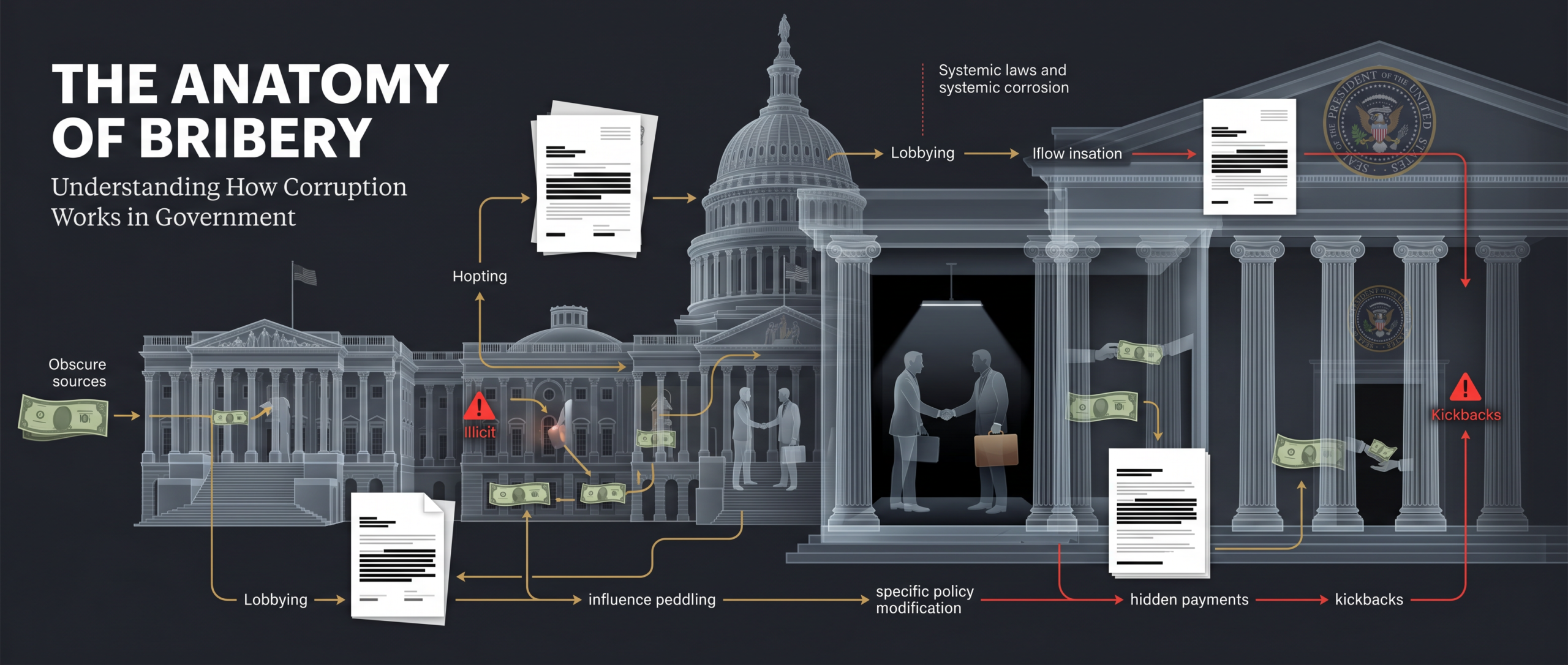
Bribery in government is one of the oldest and most damaging forms of corruption in the world. It happens when public officials use their position, authority, or influence in exchange for money, gifts, favors, protection, political support, or personal benefit. Instead of serving the people honestly, corrupt individuals use government power as a business opportunity.
In many countries, bribery is not always obvious to the public. It often happens quietly behind office doors, through secret meetings, coded conversations, middlemen, hidden bank accounts, fake companies, and manipulated government transactions. What people usually see are the final results: unfinished roads, overpriced projects, weak public services, poor disaster response, missing funds, and politicians who suddenly become extremely wealthy.
Bribery affects almost every part of society because government decisions influence hospitals, schools, transportation, taxes, infrastructure, public safety, and economic growth. When corruption spreads deeply into institutions, public trust slowly collapses.
This article explores how bribery systems work inside government offices, who participates in them, how public money is stolen or manipulated, and why corruption continues despite scandals and investigations.
I. Understanding the Foundation of Government Bribery
Why Bribery Exists in Government
Bribery grows in environments where power is concentrated and accountability is weak. When officials control large budgets, permits, contracts, or political influence without proper oversight, opportunities for corruption increase.
In many cases, bribery does not begin with one illegal transaction. It slowly develops into a system where corruption becomes normalized. Officials may eventually see bribery not as a crime, but as part of the culture of politics and governance.
Common reasons bribery happens:
- Greed and personal enrichment
- Expensive political campaigns
- Weak law enforcement
- Slow justice systems
- Lack of transparency
- Political dynasties and patronage
- Poverty and economic inequality
- Fear of losing power
Over time, corruption can become institutionalized, meaning it is no longer hidden by a few individuals but quietly accepted within entire networks of government offices and political groups.
The Hidden “Exchange System” of Corruption
Bribery is often built around exchange relationships. One side wants influence, approval, protection, or business opportunities. The other side wants money, loyalty, or political support.
Examples of common exchanges:
- A businessman pays officials to win a government contract.
- A company offers commissions in exchange for project approval.
- A politician receives campaign donations in return for future favors.
- A permit is released faster after an unofficial payment.
- Law enforcement ignores violations after receiving bribes.
This creates a hidden parallel system operating beside the official legal system.
II. The Main Players Inside a Corruption Network
Politicians and High-Ranking Officials
Elected officials often hold enormous power over:
- Budgets
- Infrastructure projects
- Appointments
- Procurement systems
- Legislative approvals
Because they influence public spending, they can become central figures in bribery operations.
Their possible roles may include:
- Directing contracts toward favored companies
- Influencing bidding results
- Protecting political allies
- Controlling access to government funds
- Assigning loyal individuals to key agencies
Some corruption networks operate almost like organized business structures, with clear hierarchies and financial arrangements.
Contractors and Business Interests
Businesses sometimes participate in bribery because government projects can generate massive profits.
In highly corrupt systems, companies may believe that:
- Paying bribes is necessary to survive
- Honest competitors cannot win fairly
- Political connections matter more than quality
Common methods businesses use:
- Secret commissions
- Inflated project costs
- Fake billing
- Lobbying through middlemen
- Funding political campaigns quietly
In some situations, businesses create shell companies specifically designed to receive government contracts.
Middlemen or “Fixers”
Middlemen play a major role in corruption because they reduce direct contact between officials and businessmen.
These individuals:
- Arrange meetings
- Deliver cash
- Negotiate percentages
- Handle secret communication
- Protect powerful figures from exposure
Fixers often know how government systems work and understand who must be paid to move transactions smoothly.
Without middlemen, many bribery operations would be far riskier.
Government Employees and Bureaucrats
Large corruption schemes usually require cooperation from multiple people inside agencies.
These may include:
- Procurement officers
- Engineers
- Auditors
- Accountants
- Budget officers
- Legal staff
Even a single infrastructure project may involve many signatures and approvals. Corruption often spreads when entire chains of employees cooperate or remain silent.
III. How Bribery Often Begins
Political Campaign Financing
Modern elections are extremely expensive. Candidates spend massive amounts on:
- Advertising
- Transportation
- Political rallies
- Social media campaigns
- Local machinery
- Vote mobilization
Many politicians depend on wealthy donors, contractors, or business groups for campaign funding.
After elections, some officials may feel pressured to “repay” political debts through:
- Government contracts
- Appointments
- Policy favors
- Budget insertions
This creates long-term corrupt relationships between politicians and private interests.
Public Infrastructure Projects
Infrastructure projects are among the most corruption-prone areas in government.
These projects involve:
- Large budgets
- Complex technical details
- Multiple contractors
- Difficult oversight
Examples include:
- Roads
- Bridges
- Airports
- Flood-control systems
- Public housing
- Railways
Because ordinary citizens may not fully understand engineering or procurement details, corrupt officials can manipulate costs more easily.
IV. The Mechanics of Kickbacks
What Is a Kickback?
A kickback is a secret payment given back to officials after contracts or favors are granted.
Example:
- Government approves a ₱500 million project.
- Contractor wins the project.
- Contractor secretly returns 15% to officials.
- Project costs are inflated to cover the loss.
Kickbacks are one of the most common forms of bribery worldwide.
How Corrupt Money Is Hidden
Bribery money is rarely transferred openly.
Officials may hide money through:
- Cash deliveries
- Fake consultancy agreements
- Offshore bank accounts
- Real estate investments
- Luxury items
- Relatives’ accounts
- Cryptocurrency
- Shell corporations
Money laundering helps disguise illegal wealth as legitimate income.
Why Cash Transactions Remain Common
Despite digital banking, cash remains popular in corruption because:
- It leaves fewer records
- It is difficult to trace
- It allows discreet movement
Many major scandals involve:
- Bags of money
- Cash-filled envelopes
- Secret withdrawals
- Hotel-room exchanges
Cash continues to be one of the safest tools for illegal transactions.
V. Manipulating Government Procurement
Rigged Public Bidding
Public bidding is supposed to create fair competition. However, corrupt systems can manipulate the process.
Common tactics include:
- Pre-selecting winners
- Creating fake competitors
- Writing contract specifications for one company only
- Disqualifying legitimate bidders unfairly
This allows corrupt officials to claim the process was “legal” while secretly controlling the outcome.
Overpricing Government Projects
One of the easiest ways to steal public money is through overpricing.
Example:
- A school building worth ₱20 million may be declared worth ₱45 million.
- The excess money is distributed among corrupt participants.
Overpricing often becomes difficult to detect because:
- Technical documents are complex
- Oversight is weak
- Audits may be manipulated
Citizens usually pay for corruption through higher taxes and poorer services.
Ghost Projects and Fake Deliveries
Some projects exist only on paper.
These are called:
- Ghost projects
- Fake procurement
- Phantom deliveries
Examples include:
- Medical supplies never delivered
- Roads partially constructed
- Nonexistent training programs
- Empty warehouses listed as full
Funds are released even when little or no work is completed.
VI. Political Protection and Corruption Networks
Loyalty and Mutual Protection
Corruption survives because powerful people protect each other.
This protection may involve:
- Political alliances
- Shared financial interests
- Family relationships
- Party loyalty
Once many officials benefit financially, silence becomes mutually beneficial.
Weaponizing Institutions
Some corrupt systems use government agencies selectively.
This may involve:
- Delaying investigations
- Harassing whistleblowers
- Protecting allies
- Destroying evidence
- Influencing prosecutors
Selective justice weakens democracy because laws appear unequal depending on political power.
Media and Information Control
Modern corruption battles increasingly involve media influence.
Corrupt groups may attempt to:
- Control narratives
- Spread disinformation
- Attack journalists
- Manipulate social media discussions
- Discredit witnesses
Public opinion often becomes another battlefield in political corruption scandals.
VII. Fear, Silence, and Whistleblowers
Why Many People Stay Silent
Corruption often survives because people fear retaliation.
Possible consequences include:
- Job loss
- Demotion
- Lawsuits
- Harassment
- Violence
- Political blacklisting
Many honest employees remain silent because exposing corruption can destroy careers and personal safety.
The Role of Whistleblowers
Whistleblowers expose wrongdoing from inside institutions.
They may provide:
- Documents
- Bank records
- Audio recordings
- Internal communications
- Testimonies
Whistleblowers are crucial in exposing corruption, but they are often attacked publicly to weaken their credibility.
VIII. The Human Cost of Bribery
Poor Infrastructure and Public Services
When public money is stolen:
- Roads deteriorate quickly
- Hospitals lack equipment
- Schools remain underfunded
- Flood-control systems fail
- Disaster response weakens
Corruption directly affects ordinary citizens.
Poverty and Economic Damage
Bribery increases project costs and discourages honest investment.
Long-term effects include:
- Slower economic growth
- Reduced investor confidence
- Increased public debt
- Higher taxes
- Wider inequality
The poor usually suffer the most because they rely heavily on public services.
Collapse of Public Trust
Perhaps the greatest damage caused by corruption is the destruction of trust.
Citizens may begin believing:
- Justice is only for the powerful
- Elections do not matter
- Government cannot be trusted
When trust collapses, democracy itself becomes unstable.
IX. Fighting Bribery and Corruption
Transparency and Open Governance
Transparency makes corruption harder to hide.
Important reforms include:
- Public budget tracking
- Digital procurement systems
- Open contracts
- Freedom of information laws
The more visible transactions become, the harder corruption becomes to conceal.
Independent Institutions
Anti-corruption efforts require:
- Honest courts
- Independent auditors
- Free media
- Strong watchdog agencies
Without independence, investigations may become politically manipulated.
Protecting Whistleblowers and Journalists
Individuals exposing corruption need:
- Legal protection
- Security
- Confidential reporting systems
Without protection, many witnesses will remain silent.
X. Why Corruption Continues Despite Public Scandals
Slow Justice Systems
Major corruption cases often take years or decades.
By the time verdicts arrive:
- Public attention has faded
- Witnesses disappear
- Political alliances change
Slow justice encourages impunity.
Adaptation of Corrupt Networks
Corruption evolves with technology.
Modern systems may use:
- Digital laundering
- Offshore finance
- Cryptocurrency
- International shell companies
Corrupt individuals constantly adapt to avoid detection.
Cultural Acceptance
In some places, bribery becomes normalized.
People may begin saying:
- “That’s just how politics works.”
- “Everyone does it.”
- “Nothing will change anyway.”
This normalization is extremely dangerous because it weakens resistance against corruption.
Conclusion
Bribery in government is far more than secret envelopes of money or isolated scandals. It is a complex system involving power, influence, fear, loyalty, money, and institutional weakness.
Every act of corruption has real human consequences:
- Families trapped in poverty
- Students in failing schools
- Patients in underfunded hospitals
- Communities destroyed by failed infrastructure
Understanding how bribery works is important because corruption survives best in silence and confusion. The more citizens understand the anatomy of corruption, the more difficult it becomes for corrupt systems to hide behind complexity, power, or political influence.
In the end, fighting bribery is not only about punishing criminals. It is about protecting democracy, rebuilding trust, and ensuring that public office truly serves the public.