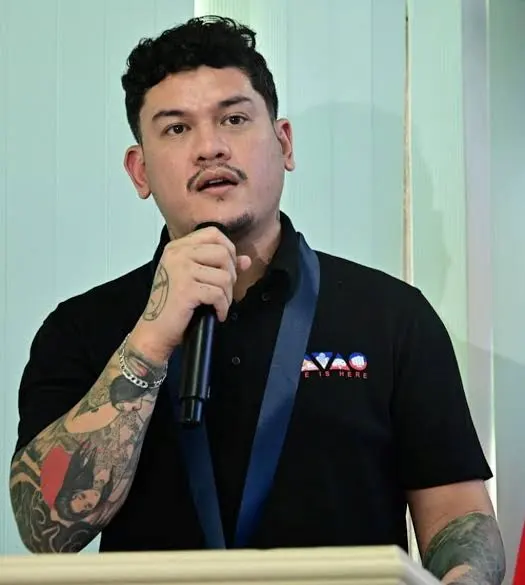
The recent appointment of Sebastian Duterte as president of PDP-Laban is more than an internal party reshuffle—it is a calculated political move that signals the consolidation of power within one of the Philippines’ most enduring political families. Coming at a time when Sara Duterte is widely viewed as a leading contender for the 2028 presidency, the development sharpens the contours of what could become a defining political narrative in the years ahead.
A Strategic Realignment
Sebastian “Baste” Duterte’s elevation to party president formalizes a role he had already been informally exercising, while placing him at the operational helm of a once-dominant political machinery . PDP-Laban, long associated with the Duterte brand, now appears firmly back under family control, with the younger Duterte tasked to “consolidate” and steer the الحزب’s direction .
This is not happening in isolation. The move coincides with Sara Duterte’s early declaration of her presidential bid for 2028—an announcement that effectively jumpstarts the next national campaign cycle years in advance . Together, these developments suggest a coordinated effort: one sibling builds the electoral machinery, while the other prepares to lead the national ticket.
The Meaning: Beyond Party Politics
At one level, this is about party leadership. At another, it is about political continuity. The Duterte family is not merely maintaining relevance—it is actively reconstructing a power base after the collapse of its alliance with the Marcos administration.
The appointment of Baste Duterte reinforces a familiar dynamic in Philippine politics: the centrality of political families. But it also reflects a more modern adaptation of that model—where roles are distributed strategically within a family to maximize influence. One handles governance and national visibility; another manages party infrastructure and coalition-building.
The emergence of broader alliances, such as the Duterte-backed coalition launched alongside his appointment, further underscores this intent to rebuild a nationwide network of support ahead of future elections .
The Implications: 2028 Begins Now
If there is one clear implication, it is this: the 2028 presidential race has effectively begun.
Sara Duterte enters the field as an early declarant and a strong political figure, buoyed by name recall and a loyal support base . However, her path is far from smooth. She continues to face political and legal challenges, including renewed impeachment efforts and lingering controversies .
In this context, Baste Duterte’s role becomes crucial. As party president, he is positioned to:
- Reorganize PDP-Laban at the grassroots level
- Build alliances with other political groups
- Shape the party’s national slate for upcoming elections
- Serve as a political anchor while Sara navigates national scrutiny
This division of labor reflects a long game—one that prioritizes structure, loyalty, and readiness.
The Dynamics: Power, Opposition, and Narrative
The Duterte camp is also operating within a shifting political landscape. The once-powerful Marcos-Duterte alliance has fractured, replaced by open political rivalry and competing narratives about governance and accountability.
In this environment, control of a political party is not just administrative—it is strategic. It determines access to candidates, funding networks, and grassroots mobilization. By placing Baste Duterte at the helm of PDP-Laban, the family ensures that these levers remain within their sphere of influence.
At the same time, the move invites scrutiny. Critics may view it as further entrenchment of dynastic politics, while supporters may see it as continuity of leadership and policy direction.
What Comes Next
The significance of this development lies not only in what it is, but in what it sets in motion.
The Duterte family is rebuilding—methodically, visibly, and early. The pairing of Sara Duterte as presidential aspirant and Baste Duterte as party leader creates a dual structure of influence that could prove formidable in the coming years.
But Philippine politics is rarely linear. Legal challenges, shifting alliances, public sentiment, and emerging პოლიტიკური figures will all shape the road to 2028.
For now, one thing is clear: this is not just a party appointment. It is a signal—a declaration that the Dutertes are not retreating from national politics, but preparing, once again, to dominate it.