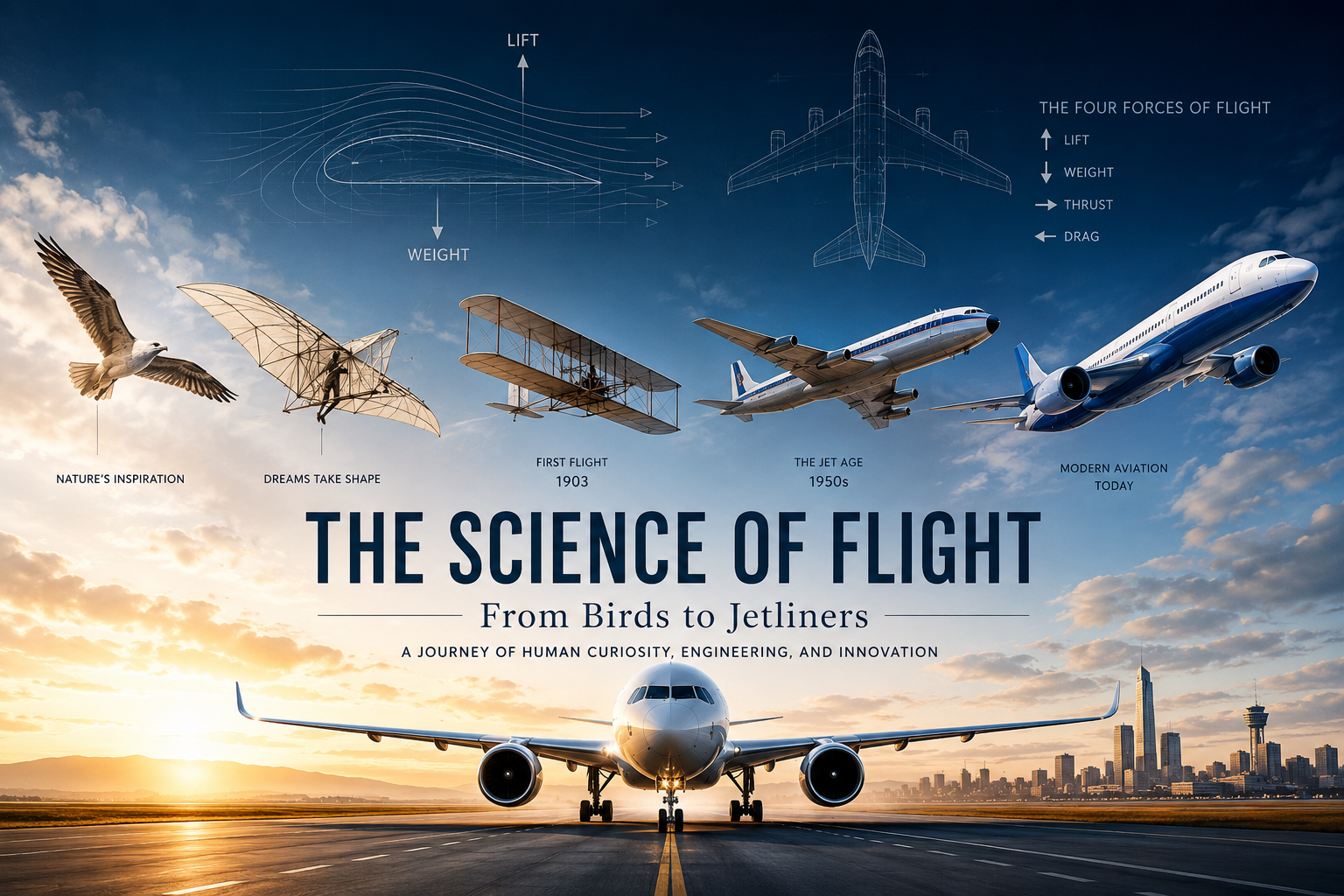
Humanity’s Long Obsession with the Sky
For most of human history, flight was a privilege of birds, clouds, and imagination. Ancient myths described humans soaring through the sky, but real flight remained out of reach until science began to decode the invisible forces of air.
Today, aircraft move millions of passengers across continents every day. Yet behind this routine miracle lies a set of physical principles that have remained unchanged since the first powered flight: the balance of four forces and the careful control of airflow over a wing.
Modern aviation, as defined by NASA and other aerodynamics authorities, is fundamentally the result of controlling lift, drag, thrust, and weight in a stable system of motion through air—a fluid medium that behaves in complex but predictable ways. (Aviatopia)
The Four Forces That Make Flight Possible
Every aircraft in the sky is governed by four invisible but constant forces:
- Lift – the upward force that counters gravity
- Weight – the pull of Earth acting on the aircraft
- Thrust – the forward force generated by engines or propellers
- Drag – the resistance of air against motion
When these forces are balanced, an aircraft flies steadily. When they are unbalanced, it climbs, descends, accelerates, or slows down.
According to NASA’s aerodynamics research, lift acts perpendicular to airflow and is primarily generated by the wings, while thrust is designed specifically to overcome drag and sustain forward motion. (NASA)
In simple terms:
Lift fights gravity. Thrust fights drag.
Lift: The Force That Defies Gravity
Lift is the most misunderstood element of flight—and also the most important.
Aircraft wings are shaped as airfoils, designed to manipulate airflow. As air moves over the curved upper surface and flatter lower surface, a pressure difference is created. This contributes to an upward force.
However, modern aerodynamics avoids overly simplistic explanations. NASA emphasizes that lift is the result of multiple interacting effects, including airflow deflection, pressure distribution, and the motion of air around the wing. (NASA)
A more complete way to understand it is this:
- The wing forces air downward
- The air responds by pushing the wing upward
- This reaction helps generate lift (Newton’s Third Law)
Thus, lift is not a trick of air “traveling faster,” but a consequence of how wings continuously redirect airflow and energy.
Drag: The Constant Opposing Force
As an aircraft moves forward, air resists that motion. This resistance is called drag.
Drag depends on:
- Aircraft shape
- Speed
- Air density
- Surface smoothness
NASA explains that drag always acts opposite to the direction of motion and increases significantly as speed rises. (NASA)
This is why aircraft design is obsessed with smooth surfaces, streamlined shapes, and aerodynamic efficiency. Every curve is engineered to reduce wasted energy.
Thrust: Overcoming Resistance
If drag is the enemy of motion, thrust is its counterforce.
In early aircraft, thrust came from propellers driven by piston engines. Today, it comes primarily from jet engines, which operate by expelling air backward at high speed, pushing the aircraft forward through reaction force.
The principle is rooted in Newton’s Third Law:
For every action, there is an equal and opposite reaction.
As NASA explains, thrust is essentially the forward reaction created when air is accelerated backward by engines or propellers. (NASA)
Weight: The Ever-Present Pull of Gravity
Weight is the simplest force in aviation—but also the one everything must overcome.
It is the downward force caused by gravity acting on the aircraft’s mass. Every design decision—from materials to fuel load—must consider how much weight must be lifted into the air.
No matter how advanced aircraft become, they still obey the same rule:
If lift does not exceed weight, flight is impossible.
The Early Breakthrough: The Wright Brothers and Controlled Flight


The 3 images used above are all taken from Google search| All rights remain with the owners
The turning point in aviation came in 1903, when Orville Wright and Wilbur Wright achieved the first controlled, powered, heavier-than-air flight.
Their achievement was not simply building an aircraft—it was solving control.
They introduced:
- Three-axis control (pitch, roll, yaw)
- Wing warping for stability
- A system that allowed sustained, controlled flight rather than brief jumps
NASA historical analyses emphasize that their aircraft design succeeded because it balanced lift, drag, thrust, and weight in a controllable system rather than relying on brute force alone. (NASA)
The Rapid Evolution of Aviation
World War Era: Engineering Under Pressure
Aircraft development accelerated dramatically during the World Wars:
- Stronger engines
- Metal airframes replacing wood and fabric
- Improved aerodynamics
- Early high-speed experimentation
The Jet Age: Speed Becomes the Priority
The introduction of jet engines transformed aviation entirely.
Aircraft such as those developed by Boeing made commercial air travel faster, more reliable, and accessible to the public.
Jets allowed aircraft to:
- Fly higher above weather systems
- Travel longer distances efficiently
- Reach previously impossible speeds
This era turned aviation into a global transportation network rather than an experimental technology.
Modern Aviation: The Age of Precision and Computers

Image taken from the Google search| All rights remain with the owner
Today’s aircraft are not just mechanical systems—they are highly intelligent flying machines.
Modern jets built by companies like Airbus use:
- Fly-by-wire systems (computer-controlled flight surfaces)
- Lightweight composite materials
- Highly efficient turbofan engines
- Real-time aerodynamic adjustments
Instead of relying solely on pilot muscle and mechanical linkage, modern aircraft continuously compute and adjust flight behavior thousands of times per second.
This makes aviation safer, more efficient, and more stable than ever before.
A Science That Keeps Evolving
Flight is not magic—it is controlled physics.
From the Wright brothers’ fragile wooden aircraft to today’s intercontinental jetliners, the principle has remained unchanged:
- Manage lift to counter weight
- Generate thrust to overcome drag
- Use control systems to stabilize motion
What has changed is the precision with which humans can manipulate these forces.
As research in aerodynamics continues—especially in electric propulsion, sustainable fuels, and autonomous flight—the science of aviation is still evolving. But its foundation remains the same sky that has always challenged humanity: a fluid we learned not just to cross, but to master.