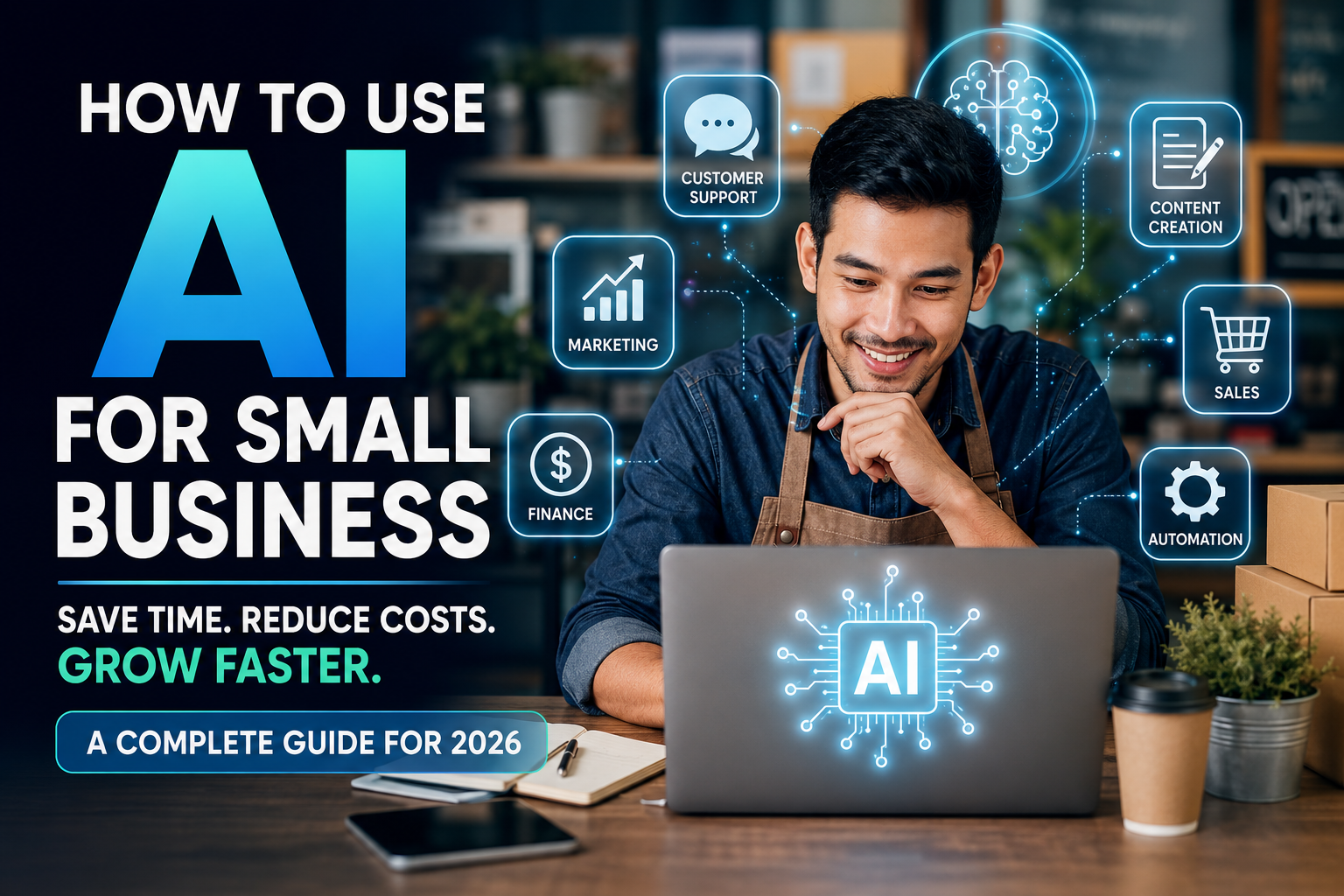
How Small Businesses Can Use AI
Artificial intelligence, commonly called AI, is no longer a technology reserved only for giant corporations and tech companies. In 2026, AI has become one of the most useful and affordable tools available for small businesses, freelancers, online sellers, startups, and local entrepreneurs. From writing marketing content to answering customer questions and managing business tasks, AI can help business owners save time, reduce costs, and improve productivity.
Many small business owners often think AI is too technical, expensive, or difficult to use. The truth is that modern AI tools are designed to be simple and beginner-friendly. Most of them work through easy chat interfaces or drag-and-drop systems that require little to no technical knowledge. Even a small local business can now use AI to compete with larger companies by improving customer service, marketing, and daily operations.
This guide will explain how small businesses can use AI effectively. You will learn where AI can help the most, which tools are useful for beginners, how to start using AI safely, and how to avoid common mistakes. Whether you run an online store, a restaurant, a service business, or a small agency, AI can become a valuable assistant that helps your business grow smarter and faster.
What Is Artificial Intelligence (AI)?
Understanding AI in Simple Terms
Artificial intelligence is a type of technology that allows computers and software to perform tasks that normally require human thinking. AI can analyze information, answer questions, create content, recognize patterns, and even make suggestions based on data. In simple terms, AI acts like a smart digital assistant that helps people complete tasks more efficiently.
For small businesses, AI is mainly used to automate repetitive work and improve decision-making. Instead of spending hours writing emails, organizing schedules, or responding to common customer questions, business owners can use AI tools to handle these tasks faster. This gives owners and employees more time to focus on important work such as improving products, serving customers, and growing the business.
It is also important to understand that AI does not completely replace humans. AI works best when it supports human creativity and decision-making. A business owner still needs to review content, manage customer relationships, and make final decisions. AI simply makes these tasks easier and more efficient.
Common Types of AI Used by Small Businesses
One of the most common forms of AI is chatbots. These tools automatically answer customer questions through websites, Facebook pages, or messaging apps. They can provide instant responses even outside business hours, improving customer satisfaction.
AI writing tools are also becoming extremely popular. These tools help create blog articles, social media posts, product descriptions, email campaigns, and advertising copy. Small businesses that struggle with content creation can save a huge amount of time by using AI writing assistants.
AI image generators help businesses create graphics, marketing images, and advertisements without hiring expensive designers. Meanwhile, AI accounting assistants can organize expenses, generate reports, and simplify bookkeeping tasks.
There are also AI-powered marketing platforms that analyze customer behavior, recommend advertising strategies, and help businesses improve online visibility. As AI continues to improve, more affordable tools are becoming available specifically for small businesses.

Why Small Businesses Should Start Using AI
Save Time on Repetitive Tasks
One of the biggest benefits of AI is time savings. Many small business owners spend hours every week handling repetitive tasks such as replying to emails, creating reports, scheduling appointments, or posting on social media. These tasks are necessary, but they can consume valuable time that could be used for growing the business.
AI tools can automate many of these repetitive activities. For example, AI scheduling assistants can organize meetings automatically, while AI chatbots can answer common customer questions instantly. Instead of manually writing social media captions every day, AI can generate ideas and drafts in seconds.
Saving time allows business owners to focus on more important responsibilities like customer relationships, business strategy, and product improvement. In many cases, AI can perform certain tasks in minutes that would normally take hours.
Reduce Operating Costs
Hiring employees for every task can become expensive for small businesses, especially startups with limited budgets. AI can reduce some operational costs by handling simple administrative or marketing tasks without requiring additional staff.
For example, instead of hiring a full-time customer support team, a business may use an AI chatbot to answer basic questions. Instead of paying large amounts for marketing content, AI writing tools can assist in creating blog posts and advertisements.
This does not mean businesses should replace employees entirely. Rather, AI can help smaller teams accomplish more work with fewer resources. Businesses can use their budgets more efficiently while still maintaining productivity.
Improve Customer Experience
Modern customers expect fast responses and smooth service. AI helps businesses provide better customer experiences by improving communication and support.
AI chatbots can answer questions 24 hours a day, even when the business is closed. AI recommendation systems can suggest products that match customer preferences. AI-powered email systems can personalize promotions based on previous purchases or customer interests.
When customers receive quick and helpful responses, they are more likely to trust the business and make repeat purchases. Good customer experience is one of the most important factors for business success, and AI can help improve it significantly.
Increase Productivity
AI helps employees and business owners work faster by simplifying complex tasks. Instead of spending hours researching, organizing data, or creating reports, AI can assist with these processes quickly.
For example, AI can summarize long documents, generate marketing ideas, analyze sales trends, and organize business information automatically. Employees become more productive because they spend less time on repetitive manual work.
This increased efficiency can lead to better business performance, faster growth, and improved profitability over time.
The Best Areas Where Small Businesses Can Use AI
AI for Customer Service
Customer service is one of the easiest and most effective areas where small businesses can use AI. AI chatbots can instantly answer common questions such as business hours, pricing, delivery information, or appointment availability.
These chatbots work through websites, Facebook Messenger, WhatsApp, and other messaging platforms. Customers appreciate quick responses, especially when they need immediate information. AI also allows businesses to provide support outside normal working hours.
AI email assistants can help businesses reply to customer inquiries professionally and quickly. Instead of manually typing every email, business owners can use AI to draft responses that can be reviewed and edited before sending.
AI for Marketing
Marketing is one of the most powerful uses of AI for small businesses. AI tools can help create blog articles, social media content, newsletters, advertising copy, and product descriptions.
Many small businesses struggle to maintain consistent online content because writing and designing materials takes time. AI tools simplify this process by generating ideas, outlines, and draft content within seconds.
AI also helps businesses improve search engine optimization or SEO. AI SEO tools can identify trending keywords, analyze competitors, and suggest improvements that help websites rank higher on Google.
Social media management becomes easier with AI scheduling tools that recommend posting times, generate captions, and track engagement performance. Businesses can maintain active social media pages without spending excessive time online.
AI for Sales
AI can help increase sales by improving lead generation and customer follow-up. AI-powered customer relationship management systems can organize leads, track customer interactions, and send automated reminders for follow-ups.
Online stores can use AI recommendation systems to suggest products based on customer behavior. For example, if a customer purchases running shoes, the system may recommend sports socks or fitness accessories.
These personalized recommendations improve customer experience while increasing the chances of additional sales.
AI for Finance and Accounting
Accounting tasks can be stressful and time-consuming for many small businesses. AI bookkeeping tools can automatically track expenses, organize receipts, generate invoices, and prepare financial summaries.
Some AI systems can even predict future cash flow trends based on past financial data. This helps business owners make smarter financial decisions and avoid cash shortages.
AI also improves fraud detection by identifying unusual transactions or suspicious activity. While AI should not completely replace professional accountants, it can simplify financial management significantly.
AI for Operations and Productivity
AI tools can improve internal business operations by automating workflows and organizing tasks. AI project management systems help teams track deadlines, assign responsibilities, and monitor progress more efficiently.
Inventory management systems powered by AI can predict stock needs based on sales patterns. This reduces overstocking and prevents inventory shortages.
Businesses that improve operations become more organized, productive, and prepared for growth.
Best AI Tools for Small Businesses in 2026
Several AI tools are especially useful for beginners and small businesses. AI writing assistants like ChatGPT, Claude, and Gemini help create marketing content, answer questions, and improve productivity.
Design tools such as Canva AI and Adobe Firefly allow businesses to create graphics, advertisements, and social media images quickly. Video creation platforms like CapCut AI and Synthesia simplify video editing and marketing content production.
Marketing platforms like Jasper and Copy.ai focus specifically on advertising and content generation. Customer support tools like Zendesk AI and Intercom help automate communication and improve customer satisfaction.
For productivity and organization, tools such as Notion AI and Microsoft Copilot assist with note-taking, planning, and document management. Accounting tools like QuickBooks AI and Xero AI simplify financial management for small businesses.
The best approach is to start with one or two tools that solve the biggest business problems instead of trying to use too many platforms at once.
How to Start Using AI in Your Small Business
Step 1: Identify Your Biggest Business Problems
Before using AI, business owners should first identify which tasks consume the most time or create the most frustration. Common problems may include slow customer response times, inconsistent marketing, poor organization, or repetitive administrative work.
Understanding these challenges helps businesses choose the right AI tools instead of wasting money on unnecessary software.
Step 2: Choose One AI Tool First
Many beginners make the mistake of trying multiple AI tools at the same time. This often creates confusion and overwhelm. It is usually better to start with one simple tool that solves a specific problem.
For example, a small business struggling with social media may begin with an AI content generator. A business receiving many customer inquiries may start with a chatbot.
Starting small makes learning easier and allows the business to gradually build confidence with AI technology.
Step 3: Train Your Team
Employees should understand how to use AI tools properly. Businesses should encourage staff to experiment with AI while also teaching them the importance of reviewing AI-generated content carefully.
AI works best when combined with human judgment and creativity. Proper training ensures employees use AI responsibly and effectively.
Step 4: Create AI Workflows
Businesses should integrate AI into their existing processes rather than using it randomly. For example, a company may create a workflow where AI generates social media captions, employees review them, and then posts are scheduled automatically.
Well-organized workflows improve consistency and maximize productivity.
Step 5: Measure Results
Business owners should monitor how AI affects productivity, sales, customer satisfaction, and time savings. Measuring results helps determine whether AI tools are providing real value.
Tracking performance also helps businesses decide which AI systems deserve further investment.
Common Mistakes Small Businesses Make With AI
One common mistake is trying too many AI tools at once. Businesses sometimes subscribe to several platforms without fully learning any of them. This can waste money and create confusion.
Another mistake is depending entirely on AI without human review. AI-generated content may sometimes contain errors, outdated information, or unnatural wording. Human oversight remains extremely important.
Businesses should also avoid ignoring data privacy. Sensitive customer information should only be handled using trusted and secure AI platforms. Protecting customer trust must remain a priority.
Poor prompting is another issue. AI performs better when instructions are detailed and specific. Businesses that learn how to give clear prompts usually receive better results.
How to Write Effective AI Prompts
An AI prompt is simply the instruction or question given to an AI tool. The quality of the prompt strongly affects the quality of the response.
Good prompts are specific and detailed. Instead of asking AI to “write a post,” a better prompt would be: “Write a friendly Facebook post promoting a weekend sale for a local coffee shop targeting young professionals.”
Providing context improves AI performance. Businesses should include information about their audience, goals, tone, and preferred style.
Businesses can also ask AI to generate multiple versions of content or rewrite material in different styles. Learning prompt writing is one of the most valuable AI skills for modern businesses.
Real Examples of Small Businesses Using AI Successfully
Local restaurants use AI to create social media promotions, answer online inquiries, and automate reservations. This allows restaurant owners to focus more on food quality and customer service.
Online stores use AI recommendation systems and customer support chatbots to improve shopping experiences. Personalized product suggestions often increase sales and customer satisfaction.
Freelancers and agencies use AI to speed up content creation, research, and project organization. This helps them handle more clients without sacrificing quality.
Service businesses such as salons, repair shops, and clinics use AI scheduling tools and automated reminders to reduce missed appointments and improve communication.
These examples show that AI is practical and useful even for small local businesses with limited budgets.
The Future of AI for Small Businesses
AI technology will continue becoming more affordable and accessible. In the future, even very small businesses will have access to advanced AI tools that were previously available only to large companies.
AI will also become more personalized. Businesses will be able to understand customer preferences more accurately and deliver highly customized experiences.
Despite rapid AI growth, human creativity and relationships will remain important. Customers still value trust, empathy, and authentic communication. AI should support human work rather than replace it completely.
The businesses that adapt early and learn how to use AI effectively will likely gain a major advantage in the coming years.
Frequently Asked Questions About AI for Small Businesses
Is AI expensive for small businesses?
Many AI tools are surprisingly affordable. Some even offer free versions for beginners. Small businesses can start with basic plans and upgrade only when necessary.
Can AI replace employees?
AI can automate certain repetitive tasks, but it cannot fully replace human creativity, emotional understanding, and decision-making. AI works best as a support tool for employees.
Is AI difficult to learn?
Most modern AI tools are designed for beginners and do not require technical skills. Learning basic AI usage is easier today than ever before.
What is the best AI tool for beginners?
ChatGPT is one of the easiest and most versatile AI tools for beginners because it can assist with writing, brainstorming, research, and customer communication.
Is AI safe for customer data?
AI can be safe when businesses use trusted platforms and follow proper data privacy practices. Businesses should avoid sharing sensitive customer information carelessly.
Can AI help increase sales?
Yes. AI can improve marketing, customer service, personalization, and lead generation, all of which can contribute to higher sales and better customer retention.
Last Words about AI for Small Businesses
Artificial intelligence is transforming the way small businesses operate. What once seemed like advanced technology reserved for large corporations is now accessible to almost anyone with a computer or smartphone. Small businesses can use AI to save time, improve productivity, reduce costs, and provide better customer experiences.
The best way to begin is by starting small. Choose one AI tool that solves a real business problem and learn how to use it effectively. Over time, businesses can expand their AI usage gradually while maintaining human creativity and customer relationships.
AI is not just a temporary trend. It is becoming an important part of modern business growth. Small businesses that learn how to use AI wisely today may have a significant advantage in the future.