Introduction
Most people think of seasons as something permanent and predictable. Spring brings new growth, summer delivers warmth, autumn signals change, and winter introduces colder conditions. Because humans experience these patterns year after year, it is easy to assume Earth’s seasons have always worked the same way.
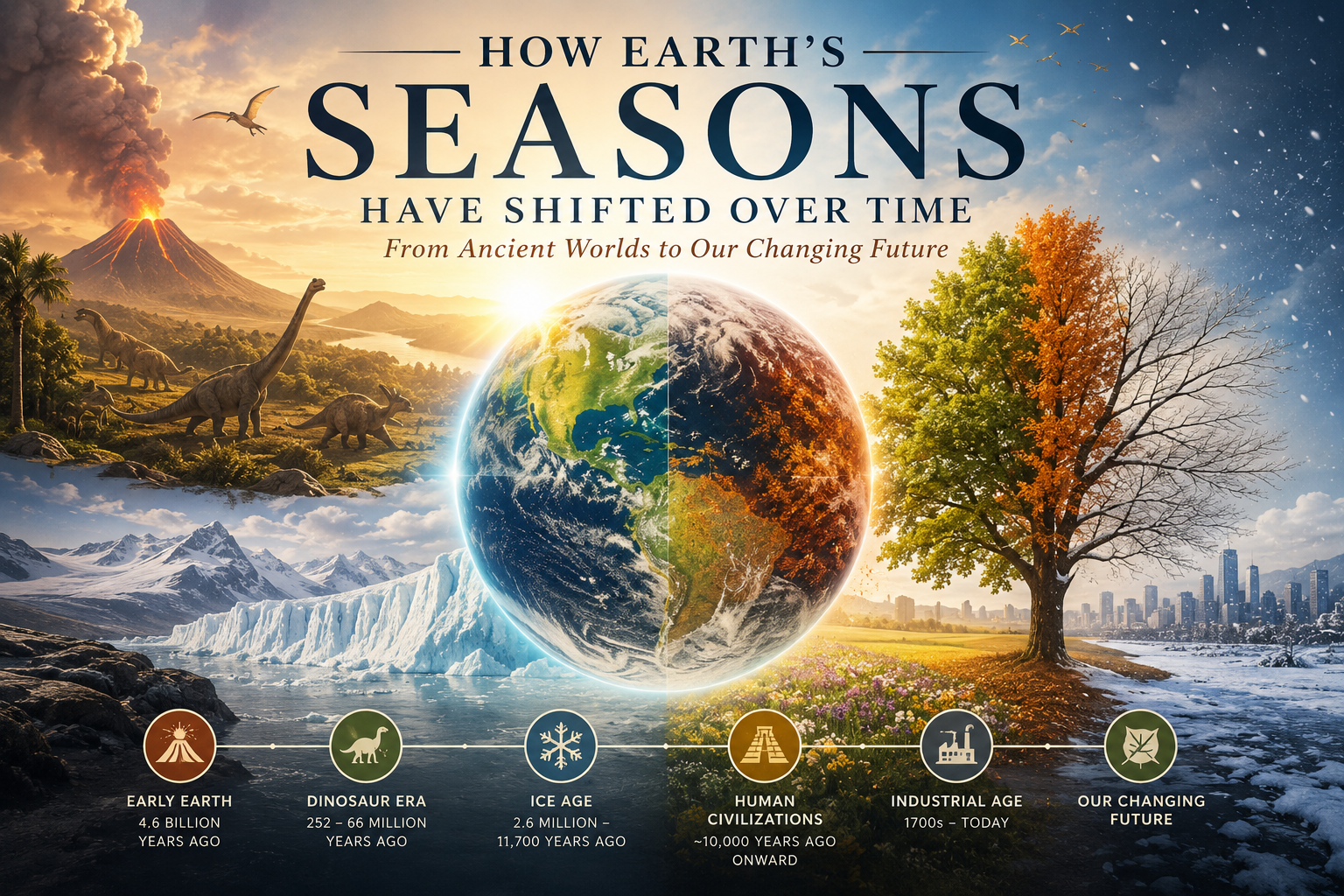
The truth is far more fascinating. Earth’s seasons have never been fixed. Across billions of years, our planet experienced dramatic shifts—from volcanic worlds with almost no recognizable seasons, to frozen “Snowball Earth” periods, to dinosaur-age greenhouse climates, and eventually to the modern world where human activity itself may now be altering seasonal rhythms.
Understanding Earth’s changing seasons requires looking beyond yearly weather patterns and exploring “deep seasons”—vast climate rhythms unfolding over thousands or millions of years. These long cycles reveal that Earth has repeatedly transformed itself.
Today scientists are discovering that humanity may be witnessing another major seasonal transition.
What Creates Seasons on Earth?
Earth’s seasons are primarily caused by the tilt of its axis rather than changes in distance from the Sun.
Earth is tilted approximately 23.5 degrees. As the planet travels around the Sun, different regions receive varying amounts of sunlight.
When one hemisphere tilts toward the Sun, it experiences summer. When tilted away, it experiences winter.
This explains why seasons in the Northern and Southern Hemispheres are opposite.
Contrary to a common belief, Earth is actually slightly closer to the Sun during Northern Hemisphere winter. Distance is not the key factor.
Instead, seasons depend on:
- Sun angle
- Day length
- Solar energy distribution
- Atmospheric circulation
- Ocean currents
Small differences in sunlight become amplified by weather systems and oceans.
Before Modern Seasons: Earth’s Earliest Climate Worlds
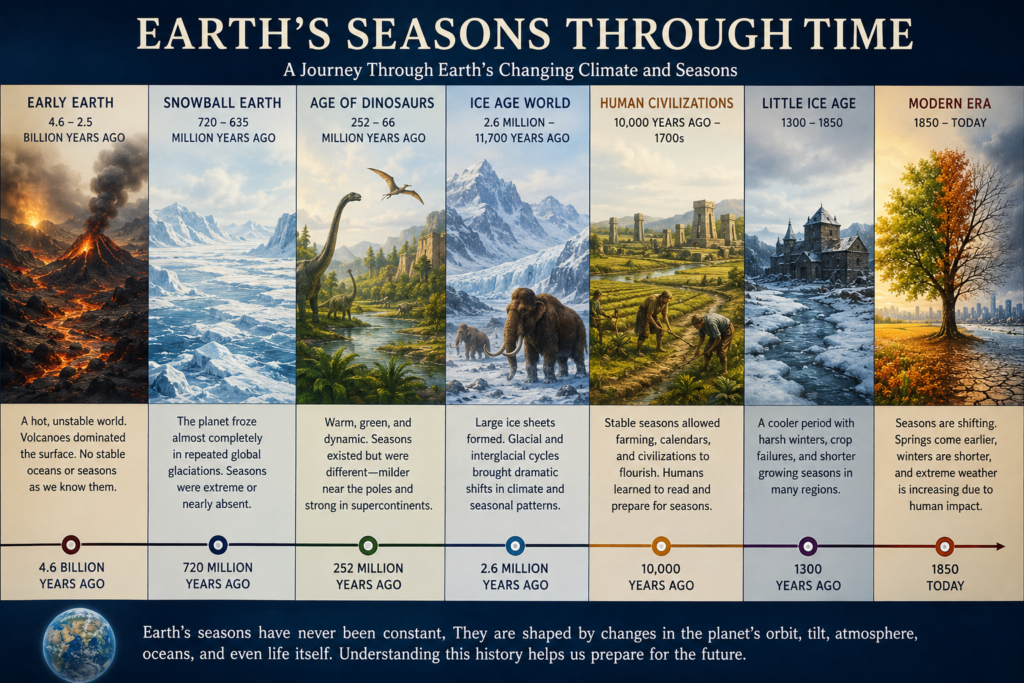
The Hadean Earth: 4.6–4 Billion Years Ago
Earth began as an extremely hostile place.
Shortly after formation, the young planet experienced constant impacts from asteroids and intense volcanic activity. Much of the surface existed as molten rock.
No stable oceans existed. No continents resembled modern landmasses.
Under these conditions, recognizable seasons probably did not exist.
The planet’s climate was chaotic and unstable.
The Archean Earth: 4–2.5 Billion Years Ago
As Earth cooled, oceans formed and primitive continents emerged.
Yet another mystery appeared: the Sun was significantly dimmer than today.
Scientists call this the “Faint Young Sun Paradox.” Despite receiving less solar energy, Earth still maintained liquid water.
The likely explanation is a greenhouse atmosphere rich in methane and carbon dioxide.
Primitive seasons may have developed, but they likely differed greatly from modern seasonal cycles.
Earth rotated faster during this period. Days may have lasted only around 18 hours.
A faster-spinning world could have produced very different winds, storms, and heat circulation patterns.
Snowball Earth: When Seasons Nearly Disappeared
One of the most dramatic periods in Earth history occurred between roughly 720 and 635 million years ago.
Scientists call this period Snowball Earth.
Evidence suggests glaciers reached regions near the equator.
Imagine oceans covered with ice, continents buried under frozen landscapes, and sunlight reflecting back into space.
Under such conditions, seasonal contrasts may have become greatly reduced.
Ice reflects sunlight efficiently. More ice meant lower temperatures, which created even more ice.
Scientists discovered evidence from:
- Tropical glacial deposits
- Ancient sediments
- Isotope chemistry
- Rock formations
Eventually volcanoes may have rescued Earth.
Volcanic eruptions continued releasing carbon dioxide. Over millions of years the gas accumulated because weathering processes slowed beneath ice.
Eventually greenhouse warming became powerful enough to melt the frozen world.
Earth shifted from extreme cold toward extreme warmth.
Seasons During the Age of Dinosaurs
The Triassic World
Around 252 million years ago Earth looked very different.
Most land was joined into one giant supercontinent called Pangaea.
Massive continental interiors were far from oceans.
Without ocean moderation, temperature differences became severe.
Many regions experienced:
- Long dry seasons
- Intense heat
- Powerful storms
- Large seasonal swings
The Jurassic Climate
During later dinosaur eras climates became warmer and wetter.
Polar regions contained less permanent ice.
Forests extended farther toward the poles.
Scientists believe some dinosaurs inhabited regions that experienced months of darkness during winter.
Evidence suggests certain species may have migrated while others adapted to seasonal darkness.
Fossils help reconstruct ancient seasons through:
- Tree rings
- Growth patterns
- Sedimentary layers
- Oxygen isotope analysis
Ancient trees recorded wet and dry years much like modern trees do today.
The Rise and Fall of Ice Ages
Earth later entered repeated cycles of colder and warmer climates.
These were not single ice ages but repeated advances and retreats of ice sheets.
Scientists discovered these cycles are influenced by changes in Earth’s orbit.
The Serbian mathematician Milutin Milankovitch proposed that small orbital changes alter solar energy reaching Earth.
These include:
Eccentricity
Earth’s orbit changes shape over approximately 100,000 years.
Obliquity
Earth’s tilt shifts over approximately 41,000 years.
Precession
Earth wobbles over approximately 23,000 years.
These subtle changes create long-term climate rhythms.
Over thousands of years they influence glacial growth and retreat.
Deep seasons operate on enormous timescales far beyond human lifetimes.
The Seasons of Human Civilization
Roughly 11,700 years ago Earth entered the current geological period known as the Holocene.
Climate became relatively stable.
This stability helped agriculture emerge.
Humans learned to predict seasonal patterns.
Ancient civilizations depended heavily upon seasonal timing.
Farmers tracked:
- River flooding
- Solstices
- Lunar cycles
- Star positions
Ancient Egyptians watched the Nile.
The Maya developed sophisticated calendars.
Romans built agricultural systems around recurring seasons.
Predictable seasons became foundations for civilization itself.
The Little Ice Age
Between approximately 1300 and 1850, many regions experienced cooler temperatures.
Scientists refer to this as the Little Ice Age.
Effects included:
- Longer winters
- Frozen rivers
- Crop failures
- famine
- social disruption
In Europe some rivers froze regularly.
Paintings from the era show winter festivals occurring atop ice-covered waterways.
Scientists suspect multiple causes:
- Lower solar activity
- Major volcanic eruptions
- Ocean circulation changes
The event illustrates how relatively small climate shifts can dramatically alter seasonal life.
The Modern Era: Seasons Begin Changing Again
Today researchers observe measurable shifts in seasonal timing.
Spring arrives earlier in many locations.
Summer lasts longer.
Winters in numerous regions have shortened.
Changes include:
- Earlier flowering
- Earlier snowmelt
- altered rainfall
- stronger heat waves
The Arctic is warming especially rapidly.
Meanwhile wet and dry seasons are shifting in tropical regions.
Monsoon systems also show signs of changing behavior.
Unlike orbital cycles, modern changes are occurring over decades rather than thousands of years.
How Plants and Animals Are Responding
Nature evolved according to long-established seasonal patterns.
When those patterns shift quickly, ecosystems can become disrupted.
Bird migrations may become mistimed.
Flowers may bloom before pollinators emerge.
Some species adapt.
Others struggle.
Scientists call this ecological mismatch.
Examples include:
- Birds arriving after insect peaks
- Plants flowering earlier than pollinators emerge
- Breeding seasons shifting
Even small timing changes can ripple throughout food webs.
Are Humans Creating a New Seasonal Era?
Many researchers discuss the possibility that humanity has entered a new planetary stage often called the Anthropocene.
Human activities now influence:
- greenhouse gases
- land use
- biodiversity
- atmospheric chemistry
Some regions now experience recognizable modern “seasons” such as:
- wildfire season
- heatwave season
- severe storm season
These emerging patterns raise profound questions.
Can humans override natural climate rhythms?
Natural cycles continue operating, but human-driven warming now adds another force.
The Future of Seasons
Future projections suggest seasonal patterns could continue shifting.
Scientists expect:
- longer heat periods
- altered rainfall
- stronger weather extremes
- changing growing seasons
Natural orbital cycles indicate another ice age might eventually occur thousands of years into the future.
Yet human influence complicates predictions.
Earth’s future seasons may depend increasingly upon choices made today.
Conclusion
Earth’s seasons have never been permanent.
Across billions of years our world transformed repeatedly—from molten beginnings, to frozen Snowball Earth, to dinosaur greenhouse climates, to Ice Age cycles and human civilization.
What seems ordinary today is actually a temporary chapter in a much larger planetary story.
The seasons outside our windows are not fixed features of nature.
They are part of an evolving rhythm written across the entire history of Earth.