
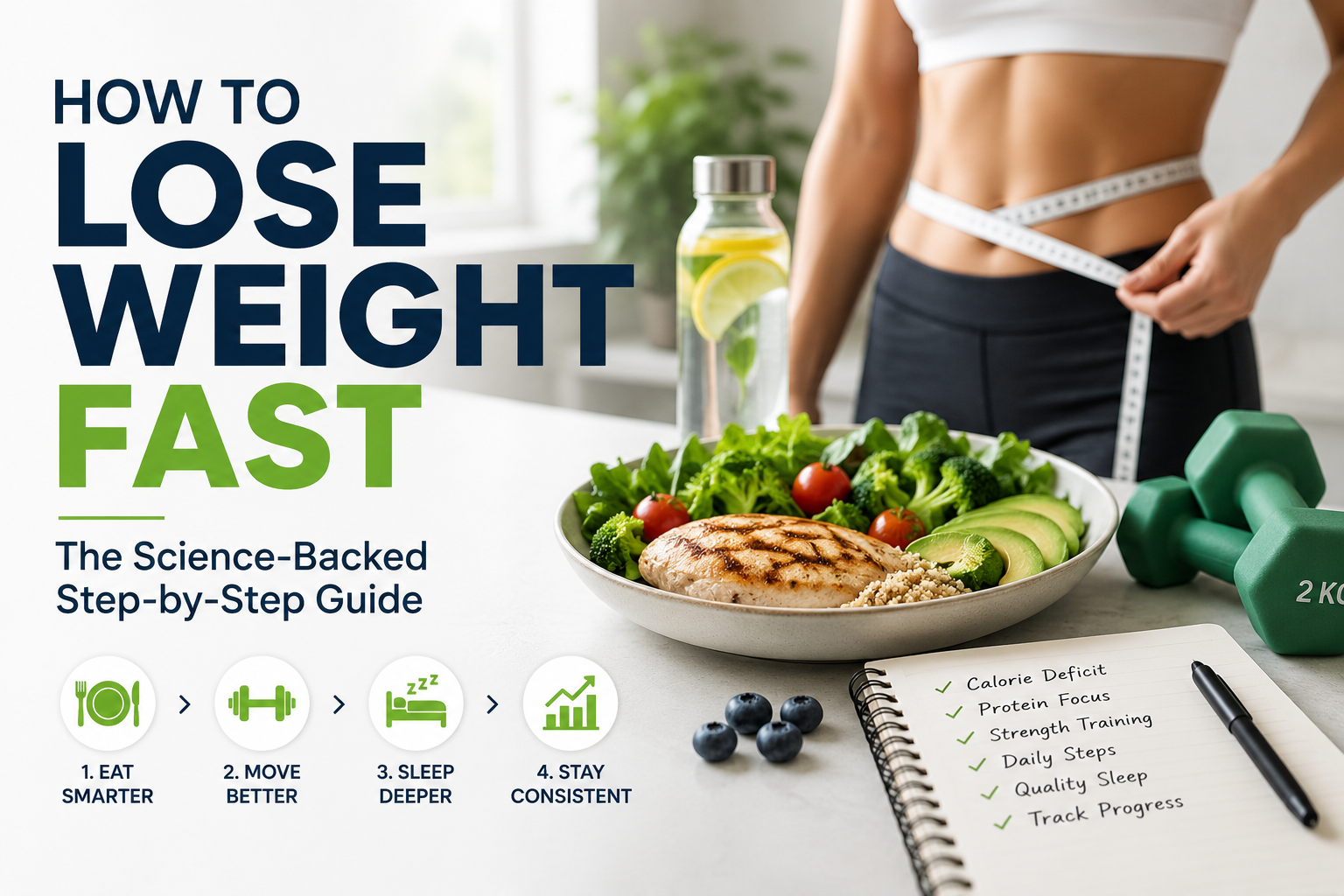
We live in a culture driven by the desire for speed. When we want to lose weight, we want it done yesterday. This natural human impatience creates a massive conflict with human biology, which has evolved over millions of years to survive famine, not to shed fat quickly for a vacation.
Because of this conflict, the internet is flooded with crash diets promising instant transformations. But here is the plain, scientific truth: an energy deficit—eating fewer calories than your body burns—is the absolute foundation of all weight loss. However, if you push that deficit too hard or too fast without a strategy, your body will fight back by lowering your metabolism and burning your muscle for fuel.
True “fast” weight loss is not about starving yourself on a juice cleanse. It is a precise optimization problem: how to maximize fat loss while fiercely protecting your lean muscle and keeping your metabolism from crashing.
How Fast Can You Safely Lose Weight? Medical Guidelines
Before changing what you eat, you need to understand the biological speed limit of fat tissue. Drop weight too slowly, and you lose motivation. Drop it too fast, and you lose health.
- The Clinical Gold Standard: Major medical institutions (like the American Heart Association) establish the ideal rate of weight loss at 1 to 2 pounds (0.5 to 1 kg) per week. Another highly accurate benchmark is aiming to lose roughly 0.7% of your total body weight per week. Staying within this window ensures that the weight leaving your body is actual fat, not water and muscle tissue.
- The Daily Deficit Formula: To hit this safe upper limit, you need to create a daily energy deficit of 500 to 750 calories. This is best achieved through a combination of eating slightly less and moving a bit more.
- The Extreme Option (Under Medical Supervision Only): There is a clinical protocol known as a Very Low-Calorie Diet (VLCD), which restricts intake to under 800 calories a day. While this produces rapid weight loss, medical guidelines state it is only safe for severe medical necessity, must be limited to a few weeks, and requires strict medical oversight to prevent severe nutrient deficiencies and gallstones.
Diet Architecture: What to Eat for Accelerated Fat Loss
To lose fat quickly without starving your body of vital components, your diet needs structure. You cannot simply eat smaller portions of junk food and expect high-quality results.
The Primacy of Protein
When you are in a calorie deficit, your body looks for energy wherever it can find it. If your protein intake is low, it will actively break down your skeletal muscle. Eating a high-protein diet acts as a structural anchor. It forces your body to protect your muscles and target fat stores instead. Aim for 0.8 to 1.2 grams of protein per kilogram of ideal body weight daily.
High-protein meal frameworks preserve lean tissue during a caloric deficit. Source: Vital Earth Minerals
Low-Carb vs. Low-Fat
Clinical data shows that over an 8-to-12-week period, low-carb and low-fat diets yield almost identical weight loss results. The “best” diet is simply the one you can stick to without miserable cravings. However, extreme low-fat diets should be avoided; cutting fat too low can harm your cholesterol profiles (lowering good HDL and raising triglycerides) and disrupt hormone production.
Focus on High-Fiber Whole Foods
Prioritizing a Mediterranean-style eating pattern rich in lean proteins, vegetables, and high-fiber whole foods does two things: it provides extreme volume to keep your stomach physically full, and it combats the low-grade chronic inflammation associated with carrying excess weight.
The Meal Replacement Strategy
If you struggle with portion control or decision fatigue, clinical evidence shows that utilizing structured meal replacements (like high-quality protein shakes) for one or two meals a day gives people a distinct advantage, often resulting in several pounds of additional initial weight loss simply by eliminating human guessing errors.
The Hidden Danger of “Low-Quality” Weight Loss
When you step on a scale, that single number tracks everything: fat, muscle, water, bone, and organs. A massive mistake people make on “fast” diets is celebrating low-quality weight loss.
If you starve yourself without exercising, a significant portion of the weight you drop will come from skeletal muscle mass.
Losing muscle is catastrophic for your health and long-term appearance. Muscle is highly metabolic tissue. When you lose it, your body’s peak oxygen consumption (VO2) decreases, your physical strength plummets, and your “metabolic flexibility”—your body’s ability to efficiently switch between burning carbs and burning fat—is severely damaged. You might look smaller, but you will have a higher body fat percentage relative to your weight, a condition colloquially known as “skinny fat.”
Outsmarting the Metabolic Backlash
When you reduce your food intake, your brain perceives a potential famine. It responds with a mechanism called metabolic adaptation (or adaptive thermogenesis). This is a biological defense system where your body lowers its resting metabolism, makes you subconsciously move less throughout the day, and spikes your hunger hormones to force you to eat.
A famous study on contestants from The Biggest Loser television show revealed that extreme, continuous calorie deprivation caused their metabolisms to plummet by 275 to 500 calories per day. Worse yet, this metabolic slowdown persisted for years after the diet ended, making weight regain almost inevitable.
The Solution: Intermittent Diet Breaks
To bypass this metabolic trap, modern science highly recommends Intermittent Energy Restriction. Instead of dieting relentlessly for months, you insert planned, temporary breaks.
Strategic diet breaks help maintain a higher metabolic rate compared to continuous calorie restriction. Source: Georgia Radley Nutrition
For example, you might diet aggressively for 4 weeks, and then spend 1 week eating at your exact “maintenance” calories (bringing your carbohydrates back up). Data shows that people who use structured diet breaks preserve significantly more of their resting energy expenditure, dropping their metabolic rate by only about 85 calories compared to the 180-calorie drop seen in continuous dieters.
The Non-Negotiable Exercise Strategy
If you want to lose weight fast and safely, exercise is not optional—but its purpose is often misunderstood.
                       [ EXERCISE STRATEGY ]
                                 |
        +------------------------+------------------------+
        |                                                 |
[ RESISTANCE TRAINING ]                                [ CARDIO ]
        |                                                 |
• Lift weights 3-4x/week                       • 150 mins moderate cardio
• Signal to preserve muscle                     • Expands daily energy deficit
• Maintains metabolic rate                     • Enhances cardiovascular health
Do not lift weights to “burn calories.” Lift weights to send a survival signal to your body. Progressive resistance training (weightlifting, bodyweight training, or resistance bands) 3 to 4 times a week tells your nervous system that your muscle tissue is vital for survival. This forces the body to keep the muscle and pull energy exclusively from fat cells.
Pair this resistance training with 150 minutes of moderate cardiovascular exercise per week. The cardio acts as an auxiliary booster to expand your calorie deficit and protect your heart, but remember: you cannot out-exercise a bad diet. Cardio should support your dietary structure, not try to erase a high-calorie binge.
Habits, Systems, and Avoiding the Rebound
The statistics surrounding weight loss are notoriously grim: 50% of people regain their lost weight within two years, and a staggering 80% regain it within five years. This happens because people treat a diet like a temporary prison sentence. Once they reach their goal, they return to the exact habits that caused the weight gain in the first place.
To beat these odds, you must implement behavioral systems:
- Professional Accountability: Data proves that frequent contact with a healthcare professional, dietitian, or coach heavily predicts whether you will successfully maintain your weight loss.
- Digital Tools: The modern landscape of digital health—including food tracking apps, wearable smart devices, and telehealth coaching—makes getting consistent support incredibly easy and highly effective at preventing relapse.
- Behavioral Identity Shifts: True maintenance requires shifting away from emotional eating and intentionally building an environment where whole foods are accessible and physical movement is built directly into your daily routine.
The Modern Medical Paradigm: Anti-Obesity Medications
It is impossible to discuss fast weight loss today without addressing the massive shift in modern medicine: GLP-1 receptor agonists (such as semaglutide) and dual incretins (such as tirzepatide).
These medications work by mimicking natural gut hormones to delay stomach emptying and signal profound fullness directly to the brain. For individuals struggling with severe metabolic hurdles, these tools have completely revolutionized weight management.
However, these medications make the strategies outlined in this article more critical than ever. Because these pharmaceuticals suppress appetite so drastically, patients often experience sudden, extreme drops in calorie intake. Without an intentional focus on a high-protein diet and dedicated resistance training, a massive portion of the weight lost on these medications can come directly from lean muscle tissue, leaving the individual physically weaker and metabolically compromised.
The Master Blueprint
To achieve the fastest possible weight loss without destroying your body, adhere to this clinical checklist:
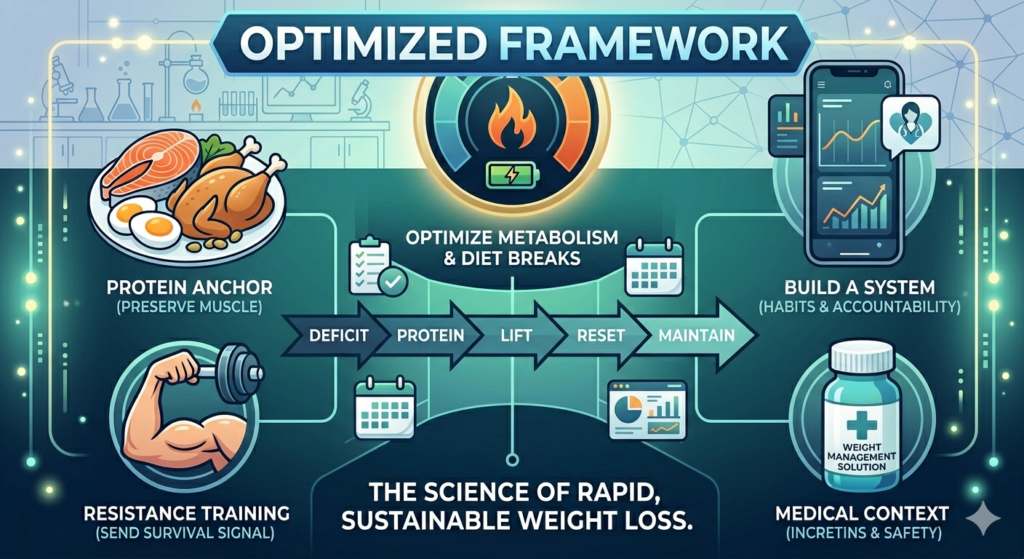
- Set a target deficit: Eat 500 to 750 calories below your maintenance level.
- Anchor your protein: Consume 0.8 to 1.2 grams of protein per kilogram of ideal body weight daily.
- Lift weights: Perform resistance training 3 to 4 times a week to guard your muscle.
- Take diet breaks: Every 4 to 6 weeks, bring your calories back to maintenance for a week to reset your metabolism.
- Build a system: Use apps, accountability partners, or medical professionals to bridge the gap between a temporary diet and a permanent lifestyle change.
The pursuit of rapid weight loss does not have to be a dangerous gamble with your health. When you look past the clickbait and anchor your strategy in strict biological realities, “fast” simply means “optimized.”
By treating your calorie deficit as a temporary lever, your protein intake as an uncompromised shield, and resistance training as a non-negotiable demand for survival, you effectively outsmart the metabolic traps that cause millions of people to fail.
Remember, the true measure of a successful weight loss phase is not how much weight you can drop in thirty days—it is how much muscle, strength, and metabolic health you keep intact for the next thirty years. Stop starving your body to get smaller, and start fueling your biology to become stronger. The scale will follow.
Here is something extra and a bonus for all weight watchers.
How to Calculate Maintenance Calories, Deficits, and Protein
Calculating your personal numbers takes the guesswork out of weight loss. By setting up your targets using validated physiological formulas, you ensure your deficit is aggressive enough to see rapid results, but structured enough to protect your metabolism and muscle tissue.
Here is the exact step-by-step mathematical framework to calculate your maintenance calories, weight loss deficit, and daily protein targets.
Step 1: Calculate Your Total Daily Energy Expenditure (TDEE)
Your TDEE (or “maintenance calories”) is the total number of calories your body burns in a 24-hour period. To find this, we first calculate your Basal Metabolic Rate (BMR) using the clinically validated Mifflin-St Jeor Equation, and then multiply it by an activity factor.
Part A: Find Your BMR
Choose the formula that matches your biological sex:
- For Men: BMR=(10×weight in kg)+(6.25×height in cm)−(5×age in years)+5
- For Women: BMR=(10×weight in kg)+(6.25×height in cm)−(5×age in years)−161
Note: To convert pounds to kilograms, divide your weight by 2.2. To convert inches to centimeters, multiply your height by 2.54.
Part B: Multiply by Your Activity Factor
Multiply your BMR by the number below that best matches your actual weekly movement:
- Sedentary (Desk job, little to no intentional exercise): BMR×1.2
- Lightly Active (Light exercise or sports 1–3 days/week): BMR×1.375
- Moderately Active (Intentional exercise or lifting 3–5 days/week): BMR×1.55
- Very Active (Hard exercise or heavy physical job 6–7 days/week): BMR×1.725
The Result: This final number is your Maintenance Calories. Eating this amount will keep your weight exactly the same.
Step 2: Establish Your Accelerated Weight Loss Deficit
To trigger safe but rapid fat loss, you need to subtract an energy deficit from your maintenance calories. Clinical guidelines recommend a daily deficit of 500 to 750 calories to optimize the rate of fat loss without causing severe metabolic slowdown.
The Math:
Weight Loss Calorie Target=TDEE−Deficit
- For a moderate approach: Subtract 500 calories from your TDEE.
- For an accelerated approach: Subtract 750 calories from your TDEE.
Safety Floor Warning: To prevent muscle wasting, severe nutrient deficiencies, and metabolic crashes, daily calorie intake should generally not drop below 1,200 calories for biological women or 1,500 calories for biological men, unless under direct medical supervision.
Step 3: Determine Your Daily Protein Target
When you are in a caloric deficit, your protein requirement goes up to protect your lean skeletal muscle mass from being broken down for fuel. Clinical standards for preserving muscle mass during active weight loss call for a target of 0.8 to 1.2 grams of protein per kilogram of ideal body weight daily.
The Math:
- Determine your ideal or target body weight in kilograms (Target Weight in lbs ÷ 2.2).
- Choose your multiplier based on your exercise habits:
- Sedentary / Light Cardio: Use 0.8g per kg.
- Lifting weights / High-Intensity training: Use 1.2g per kg (or higher, up to 2.0g per kg if training aggressively).
- Multiply your target weight in kg by your chosen multiplier to get your daily protein grams.
Step 4: Putting It All Together (A Real-World Example)
Let’s calculate the targets for a 35-year-old male who weighs 200 lbs (90.9 kg), is 5’10” (177.8 cm) tall, lifts weights 3 times a week (Moderately Active), and has a target weight of 175 lbs (79.5 kg).
1. Find Maintenance (TDEE)
- BMR Calculation: (10×90.9)+(6.25×177.8)−(5×35)+5=1,850 calories
- TDEE Calculation: 1,850×1.55 (Moderately Active)=2,867 maintenance calories
2. Apply the Deficit
- To lose weight at an accelerated pace, we subtract a 750-calorie deficit:
- 2,867−750=2,117 daily calories
3. Calculate Protein
- Target weight is 175 lbs, which equals 79.5 kg.
- Because he lifts weights, we use a higher structural muscle-retention multiplier of 1.2g per kg (or higher for resistance training, but sticking strictly to the foundational baseline):
- 79.5 kg×1.2g=95 to 100 grams of protein minimum per day (Note: For active weightlifters looking to maximize lean mass preservation, this can safely scale up to 1.6g–2.2g per kg of target body weight).
By tracking these exact metrics (2,117 calories and ~100+ grams of protein daily) while maintaining a baseline resistance training routine, you create the mathematically optimized environment for high-quality, rapid fat loss.













[…] that derail debt payoff plans. Build it first, even if it takes a couple months. Then redirect that energy to your […]