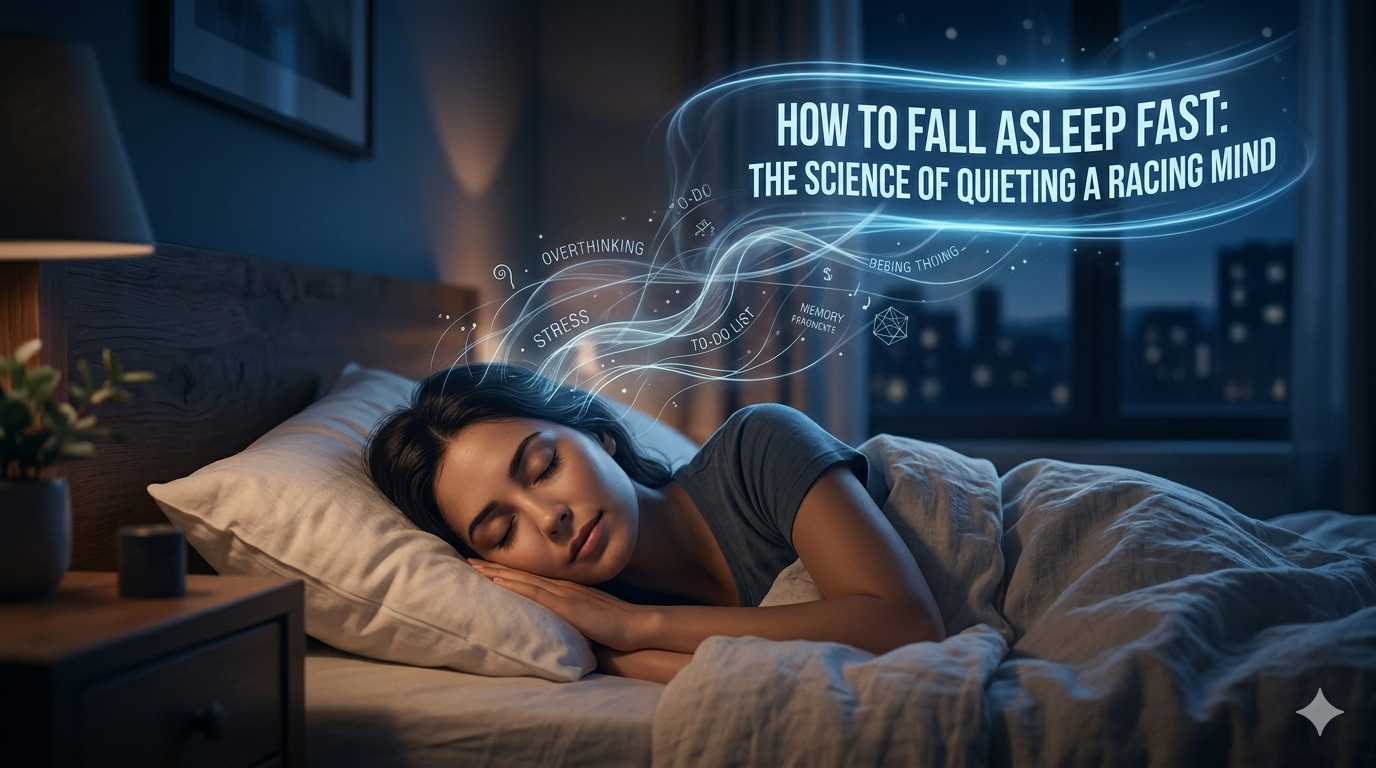
We’ve all been trapped in that distinct brand of midnight misery. You’re exhausted. Your eyes burn. But the second your head hits the pillow, your brain decides it’s the perfect time to review a minor awkward conversation from 2017, worry about a project deadline, or contemplate the terrifying vastness of the universe.
You look at the clock: 12:15 AM. You do the math on how many hours of sleep you’ll get if you fall asleep right now. Then you look again: 1:10 AM.
The cruelest paradox of human biology is that the harder you try to force yourself to sleep, the more elusive it becomes. That’s because trying is an act of effort. Effort releases cortisol and adrenaline—the exact chemical markers of stress. You are essentially screaming at your nervous system to calm down, which only panics it further.
Falling asleep quickly isn’t a battle of willpower. It’s about understanding the physiological switches that turn your body from “fight-or-flight” mode over to “rest-and-digest” mode, and then systematically flipping them. Here is how to actually stop wrestling with your blankets and effortlessly fade out.
How to Fall Asleep Fast: 3 Quick Techniques to Try Right Now
If you are reading this in the dark right now, you don’t care about lifestyle shifts you should have made this morning. You need an exit ramp from your own thoughts. Use these three tactical overrides to trick your nervous system into compliance.
The Military Method (The Full-Body Scan)
Originally developed by the U.S. Navy Pre-Flight School to help pilots pass out in two minutes or less—even under the stress of simulated gunfire—this technique is pure biomechanics. It operates on a simple premise: a completely paralyzed muscle cannot send stress signals to the brain.
- The Face: Close your eyes and consciously relax your forehead. Let your tongue drop away from the roof of your mouth. Relax the tiny muscles around your eyes and your jaw. If your face is tense, the rest of your body stays on guard.
- The Upper Body: Drop your shoulders as low as they will go, letting the tension drain out of your neck. Let your hands and fingers go completely limp by your sides.
- The Core and Legs: Exhale deeply, relaxing your chest. Move down to your thighs, calves, and ankles. Imagine your limbs turning into heavy, wet sand sinking into the mattress.
- The Cognitive Brake: Once your body is a dead weight, your mind will try to start talking again. To block it, visualize something totally static and dark—like lying in a pitch-black room on a velvet couch, or looking up at a dark sky. If a thought pops up, don’t fight it; just repeat the words “Don’t think, don’t think, don’t think” to yourself for ten seconds.
The 4-7-8 Breathing Blueprint
When you are anxious about not sleeping, your breathing becomes shallow. This keeps your heart rate elevated. The 4-7-8 technique, popularized by Dr. Andrew Weil, acts as a manual brake pedal for your heart.
- Inhale through your nose quietly for a count of 4 seconds.
- Hold your breath at the top for a count of 7 seconds. (This forces your blood to maximize oxygen absorption, which stabilizes the heart rhythm).
- Exhale completely through your mouth, making a soft “whoosh” sound, for a count of 8 seconds.
By making your exhalation twice as long as your inhalation, you deliberately trigger the vagus nerve, forcing your heart rate to drop and sending a chemical memo to your brain that says, “We are safe. You can turn off now.”
Cognitive Shuffling
Counting sheep doesn’t work because it’s too predictable; your brain easily runs background anxious thoughts right alongside the counting. Instead, try cognitive shuffling, a trick designed by cognitive scientists to mimic the random, chaotic thoughts that happen right before we drift into dreams.
Pick a word—say, “BEDTIME.”
- Start with the letter B. Think of as many random words as you can that start with B (Boy, Blanket, Banana, Boston) until you run out or get bored. Move slowly, visualizing each object for a second.
- Move to E (Egg, Elephant, Engine).
- Move to D, and so on.
Because these words have no emotional weight and no narrative connection to each other, your brain recognizes this nonsensical drift as a sign that it is safe to transition into sleep. Most people rarely make it past the third or fourth letter.

Setting the Biological Stage
Your biology is incredibly sensitive to environmental cues. If the cave you are sleeping in isn’t right, your primitive survival brain will keep you in a state of hyper-vigilance.
The Thermal Drop
Your body cannot initiate deep sleep unless its core temperature drops by roughly two degrees Fahrenheit. This is why it’s incredibly difficult to sleep in a hot, stuffy room.
The smartest way to hack this is to take a hot bath or shower about 90 minutes before bed. It sounds counterintuitive, but the hot water forces your blood vessels to dilate and brings all your internal heat to the surface of your skin. The moment you step out of the shower, that heat rapidly evaporates into the room, causing your core temperature to plummet. This sudden drop is a massive biological trigger for melatonin production.
Keep your bedroom thermostat set between 65°F and 68°F (18°C to 20°C). It should feel slightly chilly when you first crawl under the sheets; your blankets are meant to keep your skin comfortable while your lungs breathe in cool air to lower your core.
The Sensory Cleanse
Your brain processes sound even when you are asleep. If your room is dead silent, a sudden minor noise—a car outside, a floorboard creaking—will spike your adrenaline.
Instead of stark silence, introduce a steady, low-frequency sound mask. While “white noise” (like a harsh fan or static) works for some, brown noise is far better for a racing mind. Brown noise emphasizes deeper, rumbling frequencies—think of a low waterfall or distant thunder. These heavy frequencies mask sudden environmental noises far better and mimic the acoustic environment of the womb, which naturally coaxes the human brain into alpha and theta wave states.
The Daytime Setup (Winning the Night at 8:00 AM)
Insomnia at 11:00 PM is almost always a lagging indicator of choices you made throughout the day. You have to build up what scientists call sleep pressure—the literal chemical desire to sleep.
Every hour you are awake, a molecule called adenosine builds up in your brain like an internal exhaust system. The more adenosine you accumulate, the heavier your eyelids feel by nightfall.
[ Awake Time Increases ] ---> [ Adenosine Accumulates in Brain ] ---> [ High Sleep Pressure (Deep Sleep) ]
Two major things disrupt this beautiful, natural system:
- The Caffeine Trap: Caffeine doesn’t actually give you energy; it is an adenosine impostor. It parks itself inside your brain’s adenosine receptors, blocking the sleep-pressure signals from getting through. Because caffeine has a half-life of about five to six hours, that 4:00 PM iced coffee is still floating around your brain at midnight. The Rule: Cut off all caffeine intake at least 10 hours before your target bedtime.
- The Light Reset: To know when to sleep, your body needs to know exactly when the day started. Within 30 minutes of waking up, step outside and get direct sunlight into your eyes for 10 to 15 minutes (don’t stare at the sun, just look around). This sharp dose of morning light halts melatonin production instantly and sets an internal clock that triggers a massive wave of natural melatonin exactly 16 hours later.
The Nighttime Buffer Zone
You cannot expect your brain to go from 100 mph to a dead stop instantly. A sports car needs a braking distance, and so do your thoughts. Give yourself a dedicated 45-to-60-minute “buffer zone” before your head hits the pillow.
The Real Danger of Screens
We’ve all heard that the blue light from phones suppresses melatonin. While true, the much bigger villain is cognitive arousal.
When you scroll through social media, read a news article, or check a work email right before bed, you are feeding your brain a chaotic cocktail of tiny dopamine spikes, micro-frustrations, and problems that need solving. Your brain perceives this incoming data stream as an active crisis or an exciting hunt. It stays awake to process it. Put the phone on the other side of the room an hour before bed. Read a physical fiction book instead—fiction transports your mind to a narrative world that doesn’t require you to take action, allowing your cognitive gears to slow down.
The Mental Dump
If you find yourself lying awake planning tomorrow or stressing over things you forgot to do, keep a physical pad of paper and a pen on your nightstand.
Before you turn out the lights, do a literal “mental dump.” Write down every single task you need to complete tomorrow, along with any nagging worries. There is a profound psychological release in physically transferring thoughts out of your working memory and onto a piece of paper. You are essentially telling your brain: “It is recorded. It is safe. We can deal with this tomorrow.”
Aggressive Troubleshooting: The 20-Minute Eviction Rule
What happens when you’ve done the breathing, the room is cold, your phone is away, and you are still wide awake after half an hour?
Get out of bed.
This is where most people get tripped up. They stay in bed, tossing, turning, and getting increasingly angry. The problem is that your brain is an incredibly powerful associative machine. If you spend hours lying awake frustrated, your brain rewires its association with your bed from “this is where I sleep” to “this is the place where I stress out and struggle.”
The 20-Minute Rule: If you are not asleep after roughly 20 or 30 minutes, get up. Do not turn on bright overhead lights. Move to a different room or a comfortable chair.
Engage in a low-stimulation, analog activity in dim lighting:
- Read a boring magazine or book.
- Fold some laundry.
- Do a mindless chore.
Do not open your laptop or phone. Stay there until your body experiences a genuine wave of physical tiredness—heavy eyelids, yawning, a sinking feeling in your chest. The moment that wave hits, walk back to the bedroom and get into bed. You want your bed to be a sanctuary reserved exclusively for sleep and intimacy, not a battleground.
A Final Note on Lowering the Stakes
The ultimate secret to falling asleep fast is realizing that one bad night of sleep will not ruin your life.
Much of the panic that keeps insomniacs awake is the catastrophic thinking that starts around 3:00 AM: “If I don’t sleep right now, I’m going to ruin my presentation tomorrow, get fired, and ruin my career.”
Humans are remarkably resilient. You have survived days on poor sleep before, and you will do it again if you have to. The human body is designed to catch up on deep sleep sleep-cycles efficiently the following night anyway.
Let go of the need to control the clock. Drop your shoulders, stretch out your breath, accept whatever rest your body gives you tonight, and let your ancient biological machinery do the rest.