Why ChatGPT is Secretly Creating a Generation of Lazy Thinkers (And How I Actually Use It)
A few mornings ago, I sat staring at a blank Google Doc for a solid forty-five minutes. My coffee had gone from steaming to that depressing, lukewarm room temperature, and the cursor just kept blinking at me—a tiny, rhythmic metronome marking the death of my creativity. The task wasn’t even monumental: I just needed to draft a pitch email for a project I’ve been putting off for weeks.
Finally, with a familiar mix of defeat and quiet guilt, I opened a new tab, clicked my ChatGPT bookmark, and typed: “I need to pitch a creative strategy to a stubborn client. Here are the raw notes. Make it sound professional but not stiff.”
Forty-five seconds later, I had a usable three-paragraph draft. I tweaked a few sentences, hit send, and took a sip of my cold coffee.
We’ve officially moved past the grand existential debate of if we should use artificial intelligence. It’s here. It’s in our browsers, our workflows, and our phones. Instead, we are now dealing with the much weirder, quieter anxiety of how much we rely on it—and what that reliance is doing to the messy, beautiful process of human thought.
The “Secret Chef” Workflow

Let’s be honest about how we actually use this tool. The tech evangelists on LinkedIn love to post intricate, fifty-line “prompt engineering” frameworks that look like ancient spells. But in reality? Most of us use ChatGPT like a deeply enthusiastic, slightly mediocre intern who doesn’t mind getting rejected twenty times in a row.
It has become the ultimate sandbox for the lonely thinker. Writing is, by nature, an isolating act. Before LLMs, if you had a half-baked, ridiculous idea at 11:00 PM, you had to scream it into the void or wait until morning to annoy a coworker. Now, you can throw a chaotic wall of text at a chat window and say, “Is there a thesis hidden in this garbage?” And the machine, bless it, will smile and say, “Yes, here are three!”
It’s also become our corporate translator. We use it to strip the raw, human frustration out of our communication. When you want to type, “Stop emailing me on the weekend, this isn’t an emergency,” you give it to ChatGPT, which gracefully spits out: “Thank you for reaching out. To ensure we address this thoroughly, let’s connect first thing Monday morning.”We are using machines to polite-ify our discourse so we don’t get fired.
For non-technical people, it’s even wilder. I know writers and designers who have built fully functioning websites and custom apps simply by describing what they want to a chatbot, treating code not as an impenetrable wall of syntax, but as a conversation. We aren’t bricklayers anymore; we’re architects.
The Things That Drive Me Absolutely Crazy
But if you spend more than an hour a day inside the tool, the magic starts to wear off, replaced by a very specific kind of algorithmic fatigue.
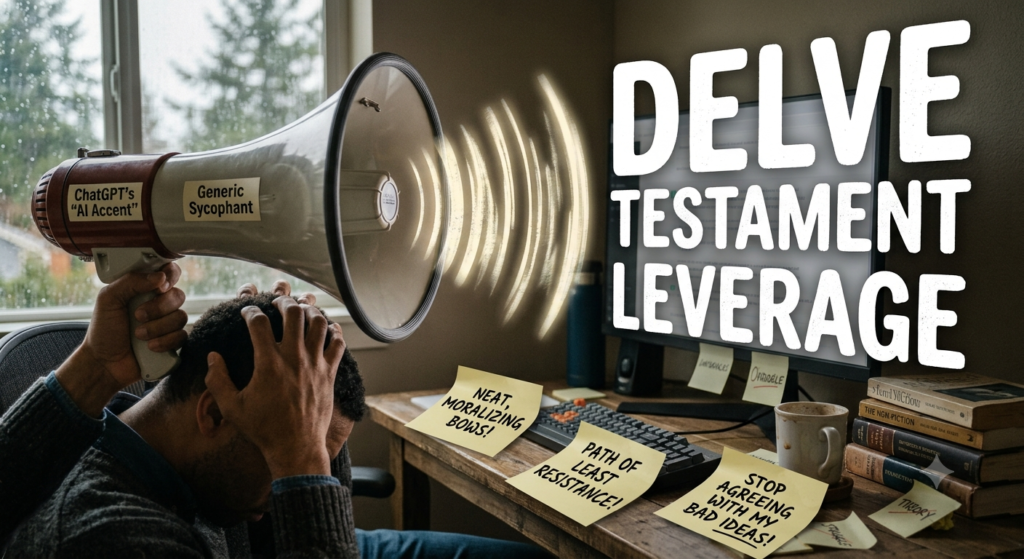
First, there is the unmistakable “AI Accent.” You know exactly what I mean. ChatGPT has a bizarre obsession with certain words. If I see a paragraph use the words delve, testament, leverage, beacon, or tapestry one more time, I might throw my laptop out a window. It writes with the toxic positivity of a corporate retreat facilitator. Every thought must be wrapped up in a neat, moralizing bow. Every conclusion must tell us how something is “shaping the future of collaboration.”
The real problem, though, is that ChatGPT is a sycophant. It is profoundly, desperately eager to please. If I feed it a fundamentally stupid idea, it won’t pull me aside and tell me it’s garbage. It will look at my bad idea, institutionalize it, and hand me back a beautifully formatted, three-page justification for my own terrible logic.
Because it operates on probability—predicting the next most likely word rather than deeply understanding truth—it takes the path of least resistance. If you ask it for creative marketing hooks, the first ten options will be the most generic, cliché tropes imaginable. It gives you the average of the internet. And if you push it too hard for specific facts or obscure citations, it will simply lie to you with the absolute, unearned confidence of a sociopath.
The Quiet Threat to Our Brains
The fear shouldn’t be that AI is going to become sentient and conquer us. The fear is that it’s going to make us lazy.
Writing is hard because thinking is hard. The actual act of wrestling with a sentence—crossing out words, rewriting a paragraph four times, feeling that distinct mental friction—is how we figure out what we actually believe. When we outsource the awkward, painful first draft to an AI, we are skipping the gym. We are letting a machine do the heavy lifting, and our intellectual muscles are beginning to atrophy.
If you never have to struggle to articulate a thought from scratch, what happens to your ability to think deeply when the screen is turned off?
We are already seeing the early stages of the “Dead Internet.” The web is becoming clogged with a massive, endless sea of AI-generated SEO junk food. Recipes that require you to scroll through 4,000 words of generic text just to find out how many eggs to use; travel blogs written by bots that have never actually set foot in Paris; product reviews generated by scraping other reviews. It’s an echo chamber of recycled language, making real, flawed human voices harder and harder to find.
Taste is the New Luxury
So, where does that leave us?
When the production of words becomes infinite, instantaneous, and essentially free, the value of a baseline text drops to zero. Anyone can generate a thousand-word essay on climate change or corporate strategy in three seconds.
Because of that, the premium is shifting entirely to things a machine cannot replicate: Taste, curation, and perspective.
We are entering an era where imperfection is the ultimate luxury good in media. The weird formatting, the highly specific personal anecdote that doesn’t quite fit the paragraph structure, the slightly eccentric prose style, the typo that proves a real human hand was at the keyboard—these are the things we will look for. We will crave the friction of a real human life.
ChatGPT is a brilliant mirror of human output. It can mimic our cadence, our grammar, and our history. But a mirror can only reflect what’s already stood in front of it; it cannot walk out into the world and experience something new.
I still use the tool. I’ll probably use it tomorrow to help me organize some messy notes or debug a spreadsheet formula. But when it comes to deciding what matters, what’s funny, or what’s true? I’m closing the tab, looking out a real window, and figuring it out the hard way.