
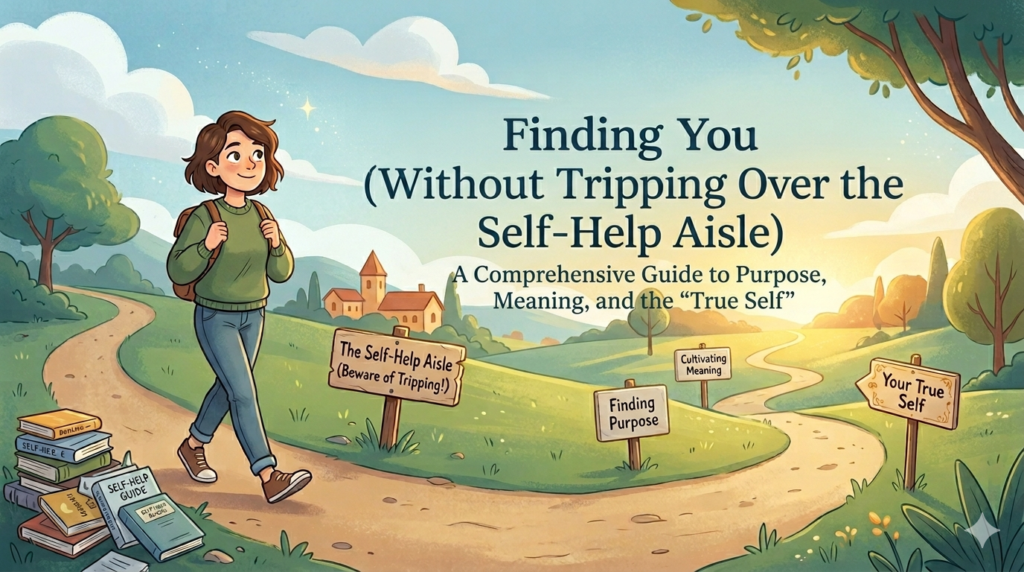
A Comprehensive Guide to Purpose, Meaning, and the “True Self”
The “Is This It?” Moment
There’s this thing that happens, usually late at night, usually when you’re exhausted but can’t actually sleep. You’re lying there and out of nowhere this thought shows up — not loud, just sort of… present. Is this it?
And the annoying part is, things are fine. Maybe even good. You’ve got the job, or close enough to one. Maybe a place to live that’s yours. You’ve done the things you were supposed to do, more or less, and you don’t have a specific complaint. But that question still comes. Is this it?
I’ve been there. Most people I know have been there. And I think the reason it’s so unsettling isn’t because something’s wrong with your life — it’s because something’s off between your life and you. There’s a gap, and you feel it even when you can’t name it.
We’re meaning-hungry creatures. Not just comfort-seeking, not just pleasure-chasing — we need things to meansomething. And when they don’t, or when we’ve been running so fast ticking boxes that we never stopped to check if we even wanted those boxes — that’s when the ceiling-staring begins.
This isn’t a self-help piece with a neat five-step system. I don’t have one of those, and honestly, I’d be suspicious of anyone who does. What I do think is worth talking about is the messier, slower, more honest process of figuring out who you actually are under all the layers — and why that question, uncomfortable as it is, might be the most useful one you ever sit with.
Who Are You When Nobody’s Looking?
Here’s something that took me a while to really absorb: there’s a difference between who you are in public and who you actually are. And I don’t mean that in a dark, double-life kind of way. I mean it in the way that most of us don’t even notice how much we’re performing until we stop.
Your social self is the curated version. The one who knows how to read a room, what to post, when to laugh, which opinions are safe and which ones need to stay quiet. It’s not fake exactly — it’s just… edited. Constantly edited, in real time, based on whoever’s watching.
Your actual self is harder to find because it’s underneath all that editing. It’s the stuff you’d do if no one was grading you. The things that matter to you that aren’t impressive. The opinions you hold in your head but rarely say out loud. The parts of you that haven’t been optimized for an audience.
The tricky thing is that a lot of us got handed our identity kind of like getting handed a pre-packed bag for a trip. Family expectations, cultural defaults, social media feeding us an idea of what a good life looks like, all of it adding up to a version of ourselves that is, honestly, mostly inherited. The career path that made sense to everyone else. The relationship style that’s expected. The hobbies that photograph well.
There’s a question I think is worth asking, and it’s deceptively simple: Do I actually want this, or did I want to want it?
There’s a difference. And once you start noticing it, you can’t really stop.
One concrete thing: write down your values — the ones you’d say out loud if someone asked. Then look at how you’ve actually spent the last month. Your time, your money, your attention. Where’s the gap? Because that gap is telling you something.
Jung had this concept — the Shadow Self — which is basically all the parts of yourself you’ve shoved in the basement because you decided they were unacceptable. Anger, jealousy, the weird obsessions, the contradictions. The issue with locking that stuff away is it doesn’t go dormant. It leaks. It shows up sideways in your behavior, your reactions, the things that make you disproportionately upset. The move isn’t to become those things — it’s just to stop pretending they’re not there. Acknowledge them. They’re part of you too.
Why Happiness Is Kind of a Useless Goal
I know that sounds wrong. But hear me out.
Happiness is an emotion. It comes and goes. It’s weather-dependent, sleep-dependent, blood-sugar-dependent. You can be doing everything “right” and still wake up on a random Wednesday feeling inexplicably flat. Trying to maintain happiness as a constant state is like trying to keep a fire burning at exactly the same intensity for forty years. It’s not a goal, it’s a setup.
What people actually seem to want — what I think we’re all reaching for when we say “I just want to be happy” — is meaning. And meaning is different. It holds up better. People endure genuinely brutal things when they have a sense that it matters somehow. They drag themselves through grief and failure and long stretches of nothing-working when there’s a thread of purpose running through it. Meaning is more like an anchor than a feeling.
So what actually creates it? There are a few things that seem to consistently matter, based on people who actually study this:
Belonging. And not the fake kind — not the belonging of performing well enough that people keep you around. The real kind, where someone knows the unedited version of you and still shows up. Where you don’t have to pre-edit your sentences before you speak.
Purpose. Having a reason that points outward. Toward other people, toward a craft, toward something that would exist or matter even if you weren’t getting credit for it.
The story you tell yourself. This one’s underrated. The facts of your life stay the same, but the narrative you build around them changes everything. Are you the person things happened to, or the person working through difficult chapters? Same events, completely different experience.
Transcendence. This sounds fancier than it is. It’s just those moments where you stop tracking yourself — where you’re so absorbed in something that the self-conscious chatter goes quiet. A long run. Making something with your hands. A conversation that actually goes somewhere. These moments are worth paying attention to and worth chasing, because they’re telling you something about where you actually belong.
None of this is about feeling good all the time. All of it is about feeling like you’re actually here.
Finding Purpose (It Doesn’t Arrive Like a Lightning Bolt, FYI)
Can we please retire the idea that purpose is this singular, cosmic, once-in-a-lifetime revelation that you either find or miss forever?
It puts too much pressure on a single moment that doesn’t really work that way. Nobody I’ve ever met had a flash of divine clarity that solved the whole question permanently. What actually seems to happen is slower and less dramatic — a gradual noticing, a direction that becomes clearer over time, a pulling toward certain things and away from others.
Purpose also shifts. What drives you at 24 is probably not what’s going to drive you at 45. That’s not a failure of character — that’s just time doing what time does.
The Ikigai framework is one of the more useful tools I’ve come across. It’s Japanese in origin, and it asks four questions: What do you love? What are you actually good at? What does the world need? What could you get paid for? Your purpose tends to live somewhere in the overlap — not necessarily all four at once, but where they start to converge. It’s a useful map.
But also — and maybe more practically — just pay attention to your envy. I’m serious. Envy is an awful emotion to sit in, but it’s a shockingly honest one. When you feel that specific sting watching someone else’s life or work or path, it’s almost always because some part of you wants that. Don’t shame the feeling. Follow it. What’s it pointing at?
And pay attention to where time disappears. What are you doing when you forget to eat, forget your phone, look up and realize it’s been three hours? That absorption is meaningful data. It’s your brain telling you this is where it works best.
Purpose doesn’t usually announce itself. It mostly just hums quietly while you’re doing something else.
The Obstacles (Because There Are Always Obstacles)
Knowing you want to figure this out and actually doing it are two completely different things. Here’s what tends to get in the way.
Paralysis from overthinking. The fear of making the wrong call is so loud that you make no call, and stay exactly where you are for years, doing something you’re quietly checked out of. Here’s the thing about that: you can course-correct from a decision you’ve made. You cannot course-correct from staying still. Movement creates information in a way that waiting never does. Pick something. You can adjust.
That voice that says “who do you think you are.” Imposter syndrome, basically. The internal critic that shows up specifically when you try to do something new or reach for something bigger. It is going to be there. Everyone has it. The people who get through it aren’t the ones who silenced it — they’re the ones who kept going while it was talking. You don’t have to feel confident. You have to move anyway.
Being afraid of letting people down. This one runs deep. Living differently from the version of yourself people are used to creates friction. Family members get weird. Friends get defensive. Some people interpret your changing as a comment on their choices. None of that is really about you — but you’re the one who has to deal with it. What I can say is: living a life built around not making other people uncomfortable will eventually hollow you out. Their comfort or your authenticity. You don’t get both forever.
Practical Stuff That Actually Helps
You don’t have to sell everything and move to rural Portugal to start living more like yourself. (Though I’m not here to talk you out of it.)
Small things, done consistently, accumulate.
Look at your calendar. Genuinely look at where your time went last week. Not where you meant for it to go — where it actually went. Then ask if that reflects what you say matters to you. Most people are surprised by the gap. That surprise is useful. It’s not about guilt, it’s about honesty.
Do one thing per week that is purely yours. Not for your resume, not for anyone’s Instagram, not because it makes you look interesting. Just because it’s you. A small class, a project, a conversation, a hobby that has no audience. Over time, these things matter more than you’d expect.
Practice not needing approval. Start small. Say the thing you were going to soften. Make the choice you actually want instead of the one that looks best. Decline the thing you didn’t want to do anyway. Every time you do this and survive it — and you will survive it — you build up a little more tolerance for being yourself in public. It’s a muscle. Genuinely. It gets easier with use.
This Doesn’t End
Here’s the last honest thing I’ll say: there’s no arrival point.
You don’t figure yourself out and then coast. The self keeps shifting, the context keeps changing, the questions come back in new forms. That’s not a failure of the process — that’s just what it means to be a person living a life. The goal isn’t to solve the question. The goal is to keep asking it, keep adjusting, keep being honest with yourself even when it’s uncomfortable.
Being a work in progress isn’t a phase before you become finished. It’s the whole thing. It’s what being alive looks like from the inside.
And if you’ve read this far — if something in here was worth your time — you’re already doing the thing. You’re asking the question. A lot of people don’t. They just keep scrolling, keep going through the motions, keep waiting for something to tell them what it all means.
You don’t need permission to start. You just need to take the next small step in a direction that feels true.
The map comes later. Start walking first.
And yeah, try not to take the self-help aisle too seriously. Including this. Use what’s useful, leave the rest.