More Than a Tournament
There are very few things left in this world that can stop everything — not a natural disaster, not a market crash, not even a papal conclave. But every four years, a football tournament does exactly that. Streets empty. Offices go quiet. Grown men weep openly in public, and nobody thinks it’s strange.
The FIFA World Cup is the closest thing humanity has to a shared religion, and it doesn’t require translation.
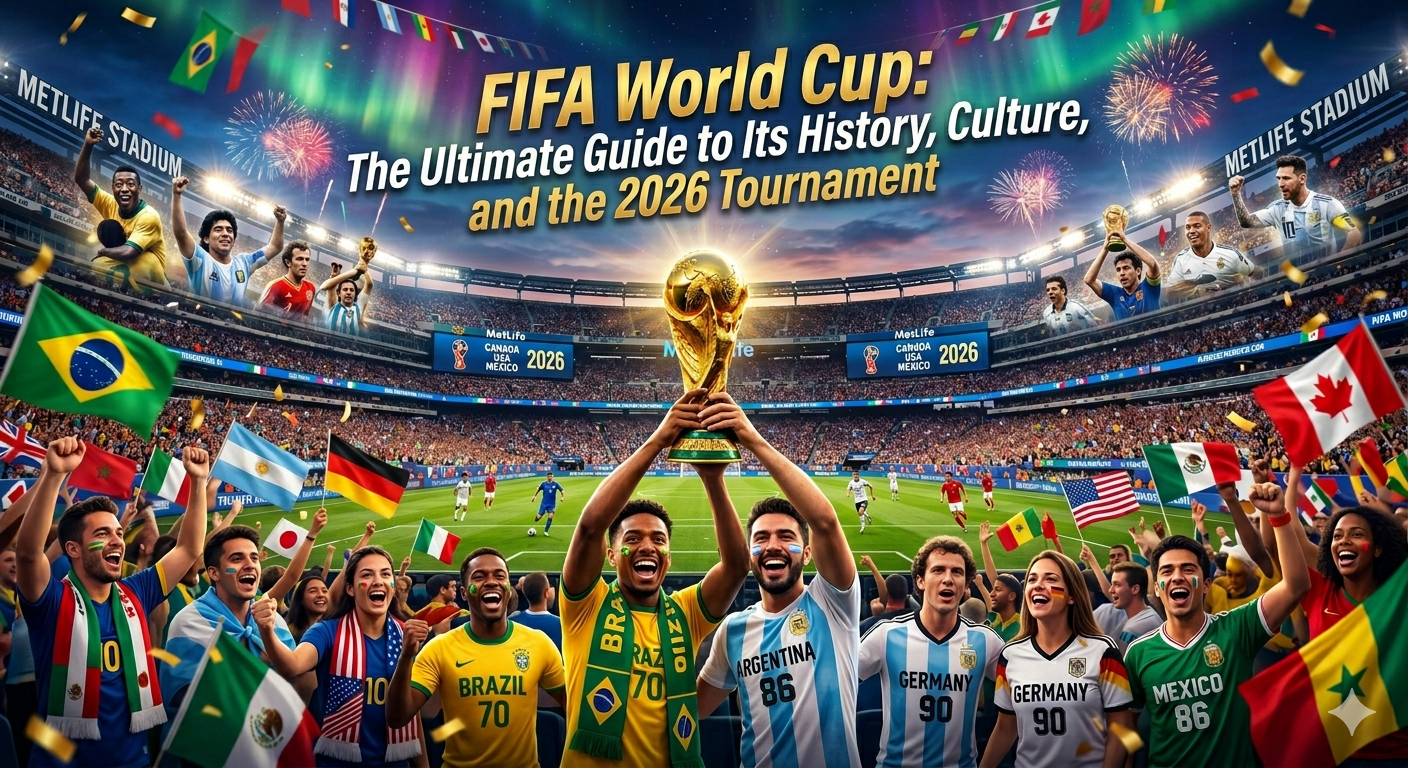
In its modern form, the tournament has grown into something almost too large to fully grasp. The 2026 edition — spread across the United States, Mexico, and Canada — will feature 48 teams, 16 host cities, and an estimated global audience that will, at certain moments, account for more than half the living human beings on this planet watching the same thing at the same time. No summit, no concert, no other event comes close.
But to think of the World Cup as simply the biggest sports event in the world is to miss what it actually is. It is a quadrennial mirror held up to civilization itself — reflecting wherever we are politically, economically, culturally, and athletically. The tournament has crowned champions during wartime recoveries, been hijacked by authoritarian regimes, survived financial scandals that would have buried any lesser institution, and still, after nearly a century, produces moments of such raw drama and beauty that they stay embedded in collective memory for generations.
This is the story of how all of that happened, and what it means.
The Genesis: How a Dream Became Global Reality (1930–1954)
Jules Rimet’s Vision
The man who made the World Cup happen was not some visionary billionaire or powerful government minister. He was a French lawyer named Jules Rimet, who became president of FIFA in 1921 and spent the better part of the following decade convincing a skeptical world that international football deserved its own global stage.
The idea wasn’t immediately popular. European clubs, who paid the wages of the players being asked to travel, were deeply resistant. The logistics of organizing a tournament across continents in an era before commercial aviation seemed, to many, genuinely absurd. And yet Rimet persisted, threading together coalitions, making concessions, and slowly building enough institutional momentum that by 1930, the first World Cup was held in Uruguay.
The host nation was chosen for reasons both symbolic and pragmatic. Uruguay had won back-to-back Olympic gold medals in football in 1924 and 1928, making them the unofficial world champions of the amateur game. They also offered to cover all travel and accommodation costs for visiting teams — a significant incentive, given that the tournament had almost no commercial revenue. Even so, only 13 teams showed up, with European representation limited to just four nations, most of them there largely out of diplomatic obligation.
The tournament itself was raw and fiercely contested. Uruguay beat Argentina 4-2 in the final before a crowd estimated at over 90,000 in Montevideo. The rivalry between the two South American neighbors had the intensity of something far older than a football match, and it set a tone for the tournament that has never entirely faded.
The Wartime Hiatus and Healing
The 1930s were formative in darker ways too. The 1934 tournament in Italy and the 1938 edition in France proceeded under the gathering shadow of European fascism. Benito Mussolini used the 1934 tournament as a propaganda stage in ways that were obvious enough to embarrass even some of his allies, and the pressure placed on referees during Italy’s matches became a subject of historical controversy that still gets revisited today.
Then the war came, and with it, a 12-year gap in the tournament’s history.
When football returned in 1950, it returned to Brazil, and to the Maracanã — a stadium in Rio de Janeiro built to hold nearly 200,000 people, which remains to this day the largest football venue ever constructed. Brazil went into the final group stage match needing only a draw against Uruguay to win the championship, playing in front of what is believed to be the largest crowd ever to watch a football match in history.
Uruguay won 2-1.
What followed — known ever since as the Maracanazo — became one of the defining traumas in Brazilian cultural history. The journalist Nelson Rodrigues later described it as “our Hiroshima.” Several spectators reportedly died of heart attacks in the stadium. The goalkeeper, Moacir Barbosa, was blamed by the Brazilian public for the rest of his life and allegedly refused entry into the national team training ground as late as 1994 because, as a staff member reportedly told him, “you cannot enter — you are the man who made Brazil cry.” He died in 2000, largely broken by the weight of a single afternoon.
The Miracle of Bern (1954)
Four years later, in Switzerland, the World Cup produced something quite different — one of the most emotionally significant results in European football history.
Hungary’s team of the early 1950s was, by most assessments, the greatest international side that never won a World Cup. They had gone four years without a defeat. They featured Ferenc Puskás, one of the most gifted footballers who had ever played the game, and a tactical sophistication that was years ahead of its time. In the group stage of the 1954 tournament, they demolished West Germany 8-3.
The final, played in driving rain in Bern, ended with West Germany winning 3-2 after coming back from two goals down. The result shook the football world. But its significance extended well beyond sport. West Germany was still a nation rebuilding its identity in the aftermath of the Third Reich, its people living under the weight of what their country had done. The World Cup victory — celebrated deliriously at home — became a moment of national permission, a signal that West Germany could take pride in something again. Historians of the period point to the Miracle of Bern as one of the catalysts for what became known as the Wirtschaftswunder, the economic miracle that rebuilt the country in the following decade.
Football, it turns out, can do that.
The Golden Eras: Legends, Dynasties, and Cultural Shifts (1958–1998)
The Pelé Era and the Birth of Global Icons
Before 1958, international football was largely a regional affair — followed passionately within continents, but without the global circulation of images and stories that would eventually make the tournament’s stars into something approaching universal figures.
Then a 17-year-old Brazilian named Edson Arantes do Nascimento arrived in Sweden, and everything changed.
Pelé — the nickname had been with him since childhood, the etymology of which he himself claimed never to fully understand — scored six goals in four matches in the knockout stages, including two in the final against the host nation. He wept when Brazil won. Television cameras, increasingly present at the tournament, caught everything, and those images moved around the world in a way that photographs from previous tournaments simply had not.
What followed over the next 12 years was a sustained period in which Brazil, playing with a freedom and invention that the football world had no real vocabulary to describe, became the sport’s dominant force. The 1970 team — Pelé, Jairzinho, Tostão, Rivelino, Gérson — won in Mexico with a style so expressive that the tournament’s global television broadcast allowed hundreds of millions of people to watch it happen. The phrase Joga Bonito — “play beautifully” — became shorthand for everything that made the Brazilian approach distinct.
Pelé retired from international football after that tournament having played in four World Cups and won three of them. No other player has matched that record.
Maradona, 1986, and the Hand of God
If Pelé represented football at its most joyful, Diego Maradona in 1986 represented it at its most complicated — and, for that reason, perhaps its most honest.
Argentina played England in the quarterfinals of that tournament in Mexico City, and the match carried a weight of geopolitical history that had nothing to do with football. The Falklands War had ended just four years earlier, and the emotions on the Argentine side were openly acknowledged. Maradona later admitted he felt he was playing not against a football team but against an entire political and military adversary.
In the 51st minute, Maradona punched the ball into the net with his left hand. The referee didn’t see it. The goal stood. After the match, Maradona described it as “a little with the head of Maradona, and a little with the hand of God.” The phrase entered the language.
Four minutes later, the same man picked up the ball near his own half, turned away from an English midfielder, and ran — 60 meters, past five outfield players and the goalkeeper, in 11 seconds — to score one of the most breathtaking goals in the history of the sport. The contrast was almost deliberately theatrical: one goal that represented football at its most cynical, and one that represented it at its most divine, scored within minutes of each other by the same player.
Argentina won the tournament. Maradona was its heart, its villain, its hero, and its author, all at once.
Tactical Revolutions
The tournament’s history is also the history of how football itself evolved as a tactical art.
Italy’s catenaccio — a deeply disciplined defensive system built around a libero, or sweeper, who cleaned up behind a rigid back line — dominated much of European football in the 1960s and into the 1970s. It was effective, sometimes brilliant, and consistently controversial. Critics argued it reduced the game to a strangled, joyless exercise. Its proponents pointed to the trophies.
The Dutch response, in 1974, was Total Football — a system in which players were expected to be interchangeable, capable of filling any position on the pitch, creating a fluid, shape-shifting attacking structure that confused opponents who had prepared for static roles. Johan Cruyff was its emblem: elegant, cerebral, possessed of a spatial awareness that made him seem to be playing the game on a slightly different plane from everyone else. The Netherlands lost the 1974 final to a West German side that was perhaps less beautiful but more clinical. They lost again four years later in Argentina.
They never won the tournament. But their influence on how football is taught and played — from Barcelona’s tiki-taka philosophy to the modern pressing systems that now dominate elite club football — is arguably greater than that of most champions.
The Modern Expansion
The tournament’s expansion has been deliberate and, for most of its history, quietly political.
Going from 16 teams in 1978 to 24 in 1982 opened the door to more African and Asian nations, reflecting both the growth of FIFA’s membership in the developing world and the commercial logic of a wider audience. Expanding to 32 teams in 1998 further diluted the Euro-South American duopoly and allowed for upsets of a kind that the old format had tended to suppress.
The Mechanics: How the Modern World Cup Works (Updated for 2026)
For most of its history, the World Cup operated as a 32-team tournament — a format that was compact enough to feel coherent but wide enough to include the majority of the football-playing world’s serious contenders. That changes in 2026.
The 48-Team Format
The expansion to 48 teams represents the most significant structural shift in the tournament since 1930. FIFA’s rationale was partly commercial — more teams means more countries with genuine skin in the game, more broadcast deals, more sponsorship interest — and partly ideological, reflecting a genuine desire to make the tournament more globally representative.
The structure breaks down into 12 groups of four teams each, labeled Groups A through L, producing a 72-match group stage that runs for nearly three weeks before the knockout rounds begin.
This is where the format gets genuinely interesting. Unlike previous editions, where only the top two teams in each group advanced, the 2026 format allows the eight best third-placed teams across all 12 groups to also progress. It means a team can finish third in their group — technically not even the best team in a group of four — and still survive to the knockout rounds, provided they performed well enough relative to third-placed teams in other groups.
The math of this creates an unusual drama toward the end of the group stage. A team finishing third needs to not only beat or draw their remaining opponents, but simultaneously track results in other groups to understand whether third place will be enough. It’s the kind of complexity that sounds exhausting in theory and produces genuinely gripping television in practice.
The New Knockout Gauntlet
Once the group stage concludes, the surviving 32 teams enter the Round of 32 — a proper knockout bracket that eventually narrows to a champion. To lift the trophy at MetLife Stadium in New Jersey, a team will need to win eight matches across roughly five weeks of football.
In previous editions, a World Cup winner played seven matches. That extra game, against teams who have already survived one knockout round, is not a trivial addition.
The Anatomy of a Matchday: Fan Culture and Rituals
The Traveling Circus
The sociological phenomenon of the World Cup fan is unlike anything else in sport. Each major football nation sends a contingent that carries with it a complete set of cultural signifiers — the Dutch sea of orange, the synchronized chanting of South American supporters who treat the terraces as a percussion section, the South Korean drums that can be heard from outside a stadium before the gates open.
Perhaps the most remarked-upon example in recent memory is the Japanese supporters. For decades now, Japanese fans have remained behind after matches to collect rubbish from the stands — not just their own section, but the entire stadium. At the 2022 tournament in Qatar, the Japanese team also left their dressing room spotless after each match, with a handwritten note in Arabic that read “thank you.” The gesture generated its own wave of international news coverage.
Football is, among other things, an opportunity for national self-presentation, and different countries approach that opportunity in very different ways.
The Power of Ritual
The tournament has accumulated its own liturgy over the decades — official songs that range from genuinely beloved (Shakira’s Waka Waka for South Africa 2010 remains one of the most recognized pieces of sports music ever recorded) to quickly forgotten; mascots that sometimes charm and sometimes baffle; match balls that have evolved from heavy, water-absorbent leather spheres to aerodynamic structures that goalkeepers have spent years complaining about.
The anthem played before each match — whether the competing nations’ own national songs or the tournament’s official theme — creates a ritual pause, a moment of stillness before the noise, that gives the occasion a weight it would otherwise lack. Players have described those minutes as among the most emotionally intense of their careers, regardless of what follows.
The Domestic Impact
What happens inside the host country’s borders during the tournament is a subject that deserves its own documentation. Productivity metrics fall. Traffic patterns shift. In countries whose national teams are still in the competition, the scheduling of important business meetings around match times becomes a matter of professional courtesy rather than personal preference.
When a major footballing nation exits — particularly in the knockout rounds — the collective mood of the country shifts in ways that are measurable and real. Psychologists have documented the phenomenon. Economists have found evidence of it in productivity data. It is not metaphor: tens of millions of people are genuinely, profoundly affected.
Shadow Over the Beautiful Game: Money, Politics, and Controversy
Sportswashing and Geopolitics
The World Cup has never been politically neutral, and pretending otherwise has never really been possible. Mussolini’s manipulation of the 1934 tournament is the most egregious historical example, but it is far from the only one.
The 1978 tournament in Argentina was held while the country’s military junta was conducting what it called the “Dirty War” — the systematic disappearance and murder of political opponents, the full scale of which the world was only beginning to understand. The decision to go ahead with the tournament there remains contested. Journalists and activists were arrested during the event. The stadiums provided cover.
The 2022 Qatar tournament brought these questions into contemporary focus, raising sustained debate about the kafala labor system that governed the migrant workers who built the infrastructure, and about what it means for a global sporting body to award its flagship event to a state with a particular approach to human rights.
FIFA, to its credit, has responded to at least some of these pressures by introducing formal human rights requirements into its bidding process. Whether those requirements have sufficient enforcement mechanisms remains genuinely disputed.
The FIFA Machine
The economics of hosting the World Cup have become almost surreally large. The 16 cities across the United States, Mexico, and Canada that will host 2026 matches have invested collectively in billions of dollars of infrastructure — stadium renovations, transport upgrades, security systems, hospitality capacity.
The “white elephant” problem — the tendency for host nations to build purpose-specific infrastructure that has no viable post-tournament use — has been a recurring criticism since at least 1998. Brazil’s 2014 tournament left several stadiums in cities with small football cultures that have struggled to fill them since.
The 2026 edition largely sidesteps this issue by using existing venues, many of them already among the largest in the world.
The 2015 Arrests and Reform
In May 2015, Swiss authorities arrested seven FIFA officials at a Zurich hotel at the request of the U.S. Department of Justice, which had been investigating bribery and corruption in the awarding of tournament hosting rights stretching back decades. The investigation eventually implicated dozens of officials and revealed a culture of systematic corruption that had operated in plain sight for years.
The scandal forced genuine institutional change. Gianni Infantino, elected FIFA president in 2016, has overseen a series of governance reforms, though critics argue the institution remains structurally resistant to transparency. What is undeniable is that the 2015 arrests shattered the fiction that FIFA was primarily a sporting body rather than a major commercial and political enterprise.
The Technological Revolution: Changing How We Watch and Referee
Broadcasting Milestones
The relationship between the World Cup and broadcasting technology is essentially a parallel history of the 20th century.
Radio made the 1930 tournament internationally audible in real time. Television — in black and white — brought the 1954 tournament to European living rooms in a way that immediately transformed how the event was experienced. When the 1970 edition in Mexico became the first World Cup broadcast in color, it revealed the game in a new dimension; the yellow of Brazil’s shirts against green grass was an aesthetic statement as much as anything else.
The satellite era extended global reach. The internet and streaming era has made it theoretically possible to watch every match of a World Cup from anywhere with a connection. The 2026 tournament will be the first in which the full 104-match schedule is routinely expected to reach audiences across every inhabited continent simultaneously, in real time, at broadcast quality.
VAR and the Offside Line
The introduction of the Video Assistant Referee — VAR — at the 2018 World Cup in Russia was one of the most genuinely controversial changes to the tournament’s on-field rules since the format was first standardized.
In principle, VAR uses video footage to review four categories of match-changing decisions: goals (and the build-up to them), penalty decisions, direct red cards, and cases of mistaken identity. In practice, it has produced some of the most agonizing moments in recent tournament history, as celebrating players and fans are asked to wait for technology reviews that can take two minutes or more.
The offside application has been particularly contentious. Semi-automated technology, introduced at the 2022 World Cup, uses a system of cameras and player tracking data to draw lines with sub-centimeter precision — ruling out goals for infringements that a human linesman’s eye could not have caught. The resulting images, showing a goal disallowed because a player’s shoulder was fractionally past the last defender, have generated widespread debate about whether the technology is measuring something that matters to the spirit of the game.
The counterargument is straightforward: the rules are what they are, and accuracy in applying them is objectively preferable to inaccuracy. The debate, which is essentially a debate about what football is for, has not been resolved and probably cannot be.
The Record Books: Defining World Cup Greatness
The Countries That Have Won It
Five nations — Brazil, Germany, Italy, Argentina, and France — have won the tournament between them 22 times across 22 editions. Brazil leads with five titles and is the only nation to have participated in every single tournament since 1930. Germany and Italy each have four. Argentina and France have three and two respectively.
This concentration of success reflects the alignment of financial resources, institutional infrastructure, and footballing culture in those countries. But it obscures how competitive the tournament actually is: of the 22 World Cups played, 13 different nations have at minimum reached the final.
The Individual Records
Miroslav Klose and holds the record for most World Cup goals in history: 16, accumulated across four tournaments with Germany between 2002 and 2014. He surpassed Ronaldo’s record — 15 goals — in the 2014 semifinal against Brazil, which Germany won 7-1 in what may be the most shocking result in the tournament’s history.
That record is now under active pressure from two players who define the contemporary game. Lionel Messi won the 2022 World Cup with Argentina, finally completing the one achievement that had eluded him in a career otherwise adorned with almost every available honor. He finished that tournament as its best player and top scorer, and brought his all-time World Cup goal tally to 13. Kylian Mbappé, who won the tournament in 2018 at 19 and reached two consecutive finals, has 12.
Both men will be in 2026. Both will be chasing Klose’s record, assuming they remain fit and their countries qualify — which, for France and Argentina, would require something close to a catastrophe to prevent.
Messi and Cristiano Ronaldo both played at the 2022 tournament, making them the first players to compete in six World Cups. The milestone reflects extraordinary longevity as much as quality, and it is unlikely to be matched in the near future.
Update: Leonel Messi currently ties with Klose for the 16 goal record but currently Messi is still competing and has the possibility of breaking the 16 goals record in the current Word Cup.
The Giant-Killings
The moments that most people reach for when they want to explain what the World Cup means are rarely the victories of the favorites.
They are Cameroon defeating Argentina in the opening match of 1990 — defending champions, no less — with Roger Milla coming off the bench to score and then performing his corner flag dance, which became one of the most replicated goal celebrations in football history.
They are South Korea, co-hosting the 2002 tournament, somehow eliminating Spain and Germany on the way to a semifinal — a run that remains almost impossible to explain and that generated controversy about refereeing decisions that South Korean fans and non-South Korean fans still relitigate in fundamentally different directions.
They are Morocco in 2022, becoming the first African or Arab nation to reach a World Cup semifinal, beating Portugal and Spain along the way, and doing it with a defensive organization and collective spirit that forced even the most skeptical tactical observers to reassess their assumptions.
The 48-team 2026 format, by admitting more teams and extending the knockout stage, should create more conditions for these upsets. History suggests they will come from somewhere nobody predicted, which is, in the end, the whole point.
The Perpetual Cycle
When the final whistle blows at MetLife Stadium after the 2026 World Cup final, the winning players will lift a trophy that has existed in its current form since 1974, made of 18-carat gold and malachite, depicting two human figures holding up the Earth.
And within approximately 48 hours, football journalists will have already begun their first tentative discussions about 2030 — which is set to be the tournament’s centenary edition, with matches planned across three continents, including several in South America in tribute to Uruguay 1930.
That is perhaps the strangest thing about the World Cup: its conclusion contains, already embedded within it, the beginning of the next one. The four-year cycle creates not just anticipation but a kind of organized longing — a structured absence that the sport fills with qualifying campaigns, club seasons, and a ceaseless accumulation of stories and statistics and records that build toward the next moment when everything stops and the world watches.
The tournament has been used as propaganda and as healing. It has been the platform for the greatest individual performances in sport and the stage for its most profound collective heartbreaks. It has survived corruption scandals that would have destroyed a less essential institution, and it has grown from 13 teams in Montevideo to 48 across a continent, without ever quite losing the thing that Rimet imagined when he first started making phone calls and writing letters to skeptical administrators a century ago.
The idea that football, played between nations, means something. That competition at the highest level reveals something true about the people and cultures involved. That a goal scored in the right moment, in the right match, in front of the right audience, can become one of those points in collective memory that a culture carries forward and passes down.
It’s more than a tournament. It always has been.
The 2026 FIFA World Cup takes place across the United States, Mexico, and Canada from June to July 2026, featuring 48 nations across 16 host cities in the tournament’s largest edition to date.