The Most Expensive Shoes in the World (And Why Almost None of Them Have Actually Sold)
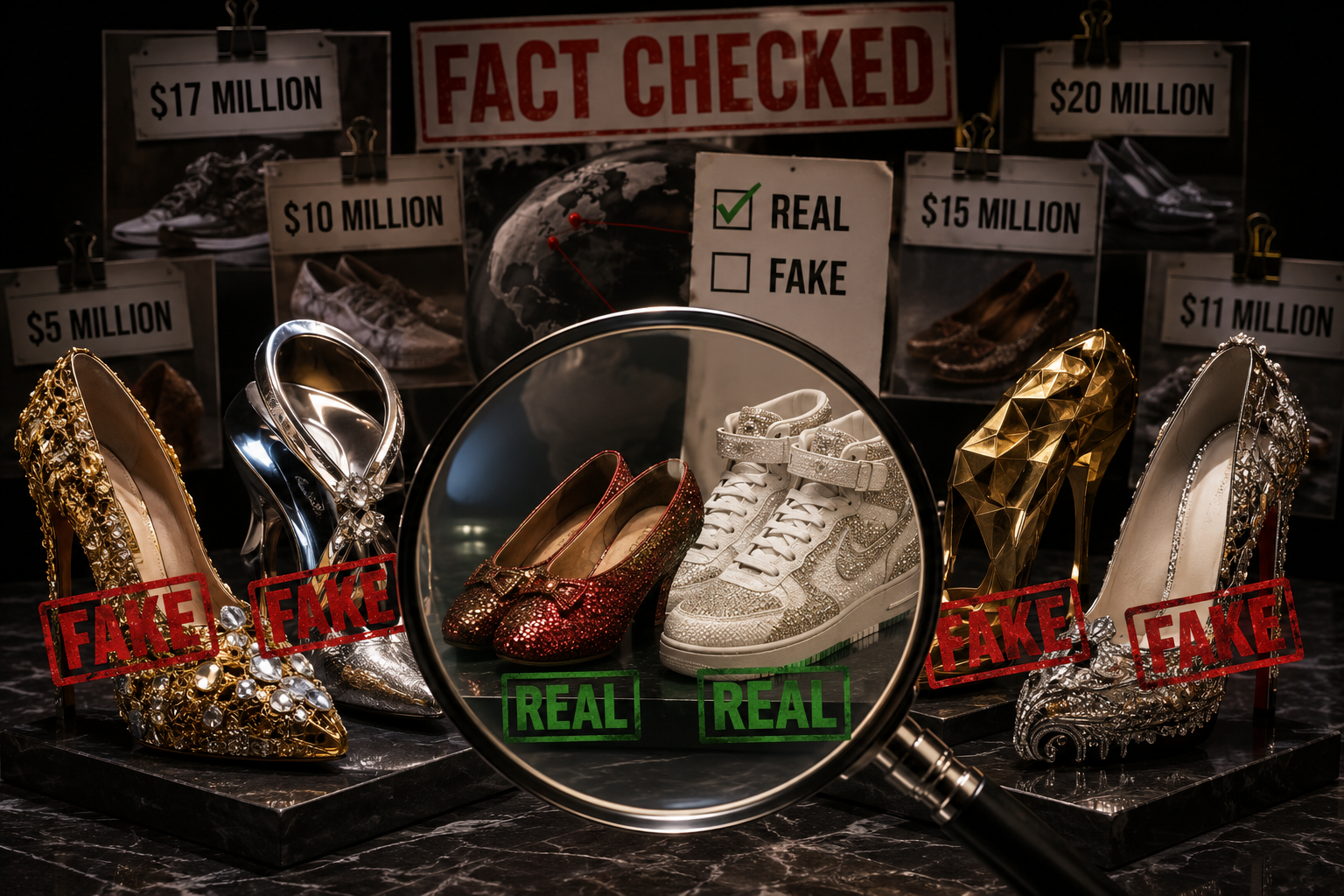
Here’s a fun fact that’s going to ruin every “top 10 most expensive shoes” list you’ve ever read: almost none of the shoes on those lists have ever actually been sold for the price everyone quotes.
Most of them are PR stunts. A designer builds one insane pair of heels, slaps a headline-grabbing number on it, sends out a press release, and boom — every blog on the internet repeats “$19.9 million” forever, even though nobody has ever handed over a check for that amount.
There are exactly two shoes on this earth that have a real, verified, someone-actually-paid-this price tag. Everything else is a beautiful, diamond-covered rumor.
So let’s do this properly. First, the real ones. Then, the legends.
Part One: Shoes That Actually Sold
1. Dorothy’s Ruby Slippers — $32.5 million
Yes, those ruby slippers. The ones Judy Garland wore in The Wizard of Oz back in 1939.
Here’s the wild part: these specific slippers were stolen from the Judy Garland Museum in Grand Rapids, Minnesota, back in 2005, by a mobster who apparently thought the “rubies” were real gemstones. (They’re sequins. He robbed a museum for sequins.) The shoes vanished for 13 years until the FBI recovered them in 2018.
Fast forward to December 2024: Heritage Auctions puts them up for sale with a modest estimate of $3 million. Bidding opens at $1.55 million and within minutes it turns into an all-out war. Final price, with buyer’s premium: $32.5 million — making them the most expensive piece of Hollywood memorabilia ever sold, by a mile. The previous record holder wasn’t even close (Marilyn Monroe’s dress from The Seven Year Itch went for $5.5 million).
The buyer stayed anonymous. Honestly, fair — if you just paid $32 million for a pair of shoes, you probably don’t want your name in the paper either.
2. Michael Jordan’s Game-Worn Air Jordan 13s — $2.2 million
These are the actual sneakers Jordan wore during Game 2 of the 1998 NBA Finals — his last championship with the Bulls. Sotheby’s auctioned them off and they went for $2.2 million.
No diamonds, no gold, no meteorite fragments. Just sweat, history, and the fact that sports memorabilia collectors have absolutely lost their minds over game-worn Jordan gear in the last few years.
That’s it. That’s the whole “verified” list. Everything below this line is a shoe that has never been sold to anyone, ever — but that doesn’t make the stories any less ridiculous.
Part Two: The Legends (Never Sold, Never Will Be)
These shoes are real. The materials are real. The price tags are… let’s say “designer-suggested.” Think of these less as sale prices and more like a jeweler standing next to their creation saying “this is basically worth $15 million” and every outlet on earth just writing that down as fact.
The Moon Star Shoes — “$19.9 million”
Italian designer Antonio Vietri unveiled these on a yacht in Dubai in 2019, as part of a fashion week with the excellent acronym MIDE (Made in Italy, Designed in Emirates). The shoes are solid gold, shaped like the Burj Khalifa, covered in 30 carats of diamonds, and — this is not a typo — inlaid with a piece of a meteorite that landed in Argentina in 1576.
It’s an incredible piece of craftsmanship. It has also never been sold to a single human being. The $19.9 million figure is Vietri’s own valuation, announced at the unveiling, and every article since has just copy-pasted it.
Debbie Wingham High Heels — “$15.1 million”
British designer Debbie Wingham built these out of gold, rare pink and blue diamonds, and over a thousand smaller stones. Wingham is also known for making a $64 million diamond-encrusted cake, so you get a sense of the general vibe of her business model: build something absurd, announce a jaw-dropping number, let the internet do the rest.
Same deal as the Moon Star Shoes — no sale, no buyer, just a very confident press release.
The Passion Diamond Shoes — “$15–17 million”
A collaboration between Jada Dubai and Passion Jewellers: 238 diamonds, 15 carats total, nine months to build, unveiled at the Burj Al Arab. Even the sources can’t agree on the exact price — you’ll see $15 million in some places and $17 million in others, which is usually a good sign nobody’s actually citing a real transaction.
Harry Winston’s Ruby Slippers — “$3 million”
Not to be confused with the real ruby slippers from part one — these are a tribute pair. In 1989, jeweler Ronald Winston built a replica to mark The Wizard of Oz‘s 50th anniversary, using 4,600 real rubies and 50 carats of diamonds. They’ve spent most of their life touring for children’s charities like Make-A-Wish rather than sitting in anyone’s closet. Lovely story. Still never sold.
Stuart Weitzman’s Red-Carpet Heels — “$1–3 million” (a whole shelf of them)
Stuart Weitzman has basically made a decades-long hobby out of strapping absurd jewelry to shoes and sending them down the Oscars red carpet:
- Rita Hayworth Heels (~$3 million) — built around a pair of Rita Hayworth’s actual earrings. Owned by her daughter, Princess Yasmin Aga Khan. Not for sale, never has been.
- Cinderella Slippers (~$2 million) — 565 diamonds set in platinum, because apparently glass wasn’t extravagant enough.
- Ruby Stilettos (~$1.6 million) — 642 Burmese rubies inspired by, you guessed it, Dorothy again. This entire industry cannot get over The Wizard of Oz.
Fun footnote: one of Weitzman’s earlier Oscar creations — Laura Harring’s diamond heels from 2002 — actually did go to Christie’s and sold for around $1 million. So somewhere in the Weitzman shoe empire there might be a third genuinely verified sale. Worth a deeper dig if you want to chase it down, but it’s a different pair than the famous Rita Hayworth ones.
So Why Do People Keep Believing the Big Numbers?
Because it’s a great story, and nobody checks the receipts. A designer says “$20 million,” a fashion blog repeats it, then fifty more blogs repeat that blog, and five years later it’s “common knowledge” that a pair of shoes made of gold and space rock is worth more than most people’s houses — even though it’s sitting in a display case, not a bank vault.
The real lesson here isn’t about shoes. It’s that “most expensive [X] in the world” headlines are almost always PR valuations dressed up as market prices. The moment actual money changes hands — like it did for the ruby slippers — the number becomes real, verifiable, and honestly way more interesting than the marketing version.
Rare, expensive, and sold are three very different things. Only two shoes on this whole list can claim all three.