The 15 Archaeological Discoveries That Changed How We See Ourselves
Ask ten archaeologists to rank the greatest discoveries of all time and you’ll get eleven different lists, at least two shouting matches, and one person who insists you can’t rank these things at all. They’re not wrong, exactly. Comparing a decoded stone to a decoded skeleton to a buried army is a bit like ranking your favorite organ — they all do wildly different jobs.
But I think the exercise is worth doing anyway, because it forces you to ask a sharper question than “what’s impressive.” It forces you to ask: what actually changed because of this? Some finds are jaw-dropping in photographs but didn’t really move the needle on what we know. Others look like a corroded lump of bronze and turn out to be a functioning ancient computer that rewrites the timeline of human engineering.
My criteria, for what it’s worth: I weighted these toward discoveries that either (a) overturned a widely-held assumption, (b) unlocked a huge amount of other knowledge that was previously inaccessible, or (c) gave us direct, physical contact with a specific person or moment rather than just an abstraction. Pure spectacle counted for less than I expected it to going in — sorry, Nazca Lines, you’re gorgeous but you’re here on mystery value more than proof of anything.
Here’s the list, the case for each one, and — because I think ranked lists that don’t argue with themselves are boring — the case against.
Quick Comparison
| # | Discovery | Year Found | Location | Age of Find | Why It Matters Most |
|---|---|---|---|---|---|
| 1 | Rosetta Stone | 1799 | Egypt | ~2,200 years old | Unlocked Egyptian hieroglyphs for translation |
| 2 | Tutankhamun’s Tomb | 1922 | Egypt | ~3,300 years old | Only intact royal Egyptian tomb ever found |
| 3 | Terracotta Army | 1974 | China | ~2,200 years old | Revealed the scale of imperial Qin-era power |
| 4 | Pompeii & Herculaneum | Excavated from 1738 | Italy | ~1,950 years old | Complete snapshot of daily Roman life |
| 5 | Dead Sea Scrolls | 1947 | West Bank | ~2,000–2,200 years old | Oldest surviving Hebrew Bible manuscripts |
| 6 | Machu Picchu | Documented 1911 | Peru | ~580 years old | Showcased advanced Inca engineering |
| 7 | Lucy | 1974 | Ethiopia | ~3.2 million years old | Proved bipedalism preceded large brains |
| 8 | Göbekli Tepe | Excavated from 1990s | Turkey | ~11,600 years old | Monumental architecture predating farming |
| 9 | Ötzi the Iceman | 1991 | Italy/Austria border | ~5,300 years old | Best-preserved Copper Age human ever found |
| 10 | Troy | 1870s | Turkey | ~3,200+ years old | Proved myth could map to real geography |
| 11 | Sutton Hoo | 1939 | England | ~1,400 years old | Overturned the “Dark Ages” poverty myth |
| 12 | Nazca Lines | Documented 1920s–30s | Peru | ~1,500–2,500 years old | Massive geoglyphs of unresolved purpose |
| 13 | Antikythera Mechanism | 1901 | Greece (shipwreck) | ~2,100 years old | Ancient analog astronomical computer |
| 14 | Skara Brae | 1850 | Scotland | ~5,000 years old | Best-preserved Neolithic domestic village |
| 15 | Angkor Wat | Documented 1860s | Cambodia | ~900 years old | Largest religious monument on Earth |

1. The Rosetta Stone (1799) — The Key That Opened Everything
The case for: Before 1799, Egyptian hieroglyphs were decorative noise to Western scholars — nobody alive could read a word of them, despite temple walls covered in the stuff. The Rosetta Stone, carved with the same decree in hieroglyphic, Demotic, and Greek, gave linguists the parallel text they needed to eventually crack the code. It took Jean-François Champollion another 23 years to finish the job, but once he did, an entire civilization’s written record came back online at once.
The case against: It’s a decree about tax exemptions for priests. Genuinely one of the least glamorous texts ever to become world-famous. The stone isn’t the discovery — the decipherment is, and that took two decades of other people’s grinding work.
My take: Doesn’t matter. This is #1 because it’s not really “a discovery,” it’s a master key. Everything else on this list involving Egyptian writing exists downstream of this rock.
2. Tutankhamun’s Tomb (1922) — The One That Made Archaeology Famous
The case for: The only nearly intact royal Egyptian tomb ever found — over 5,000 objects, untouched for 3,000 years, discovered by Howard Carter after years of fruitless digging funded by a patron who was about to walk away. It single-handedly created the public image of archaeology as adventure rather than academia.
The case against: Tutankhamun himself was a minor, teenage pharaoh who mattered very little historically. If his tomb had been robbed like every other pharaoh’s tomb — which is the normal outcome — nobody outside Egyptology would know his name. The discovery is spectacular; the person it belongs to is almost incidental to why we care.
My take: That irony is exactly why it earns its spot. It’s proof that preservation, not political importance, is what actually determines who gets remembered.
3. The Terracotta Army (1974) — An Emperor’s Army for the Afterlife
The case for: Roughly 8,000 individually-faced soldiers, built to guard China’s first emperor in the afterlife, found by farmers digging a well. The scale alone reframes what we thought Bronze/Iron Age states were capable of organizing and funding.
The case against: We still haven’t opened the actual tomb it’s guarding — the emperor himself remains sealed away, partly out of respect, partly because current conservation tech can’t guarantee the contents survive exposure. So in a sense, this “discovery” is still incomplete. We found the outer defense system and stopped there.
My take: That unfinished quality is part of what makes it thrilling rather than a knock against it. There’s a very real chance the biggest archaeological reveal of the next fifty years is sitting under a mound in Shaanxi Province, waiting for better tools.
4. Pompeii and Herculaneum — A City Caught Mid-Breath
The case for: Nothing else on Earth gives you a three-dimensional, ordinary-day snapshot of ancient life at this resolution — bread still in ovens, graffiti still legible, and the haunting plaster casts of people frozen in their final moments. Herculaneum’s carbonized scrolls, now being read via CT scanning and AI without ever physically unrolling them, are still yielding new texts today, in 2026.
The case against: It’s also, bluntly, a mass casualty site turned tourist attraction, and it’s worth sitting with that discomfort. The “snapshot” we’re so fascinated by is thousands of people’s final, terrified moments.
My take: I think that tension is exactly why it belongs here rather than despite it. Good archaeology doesn’t let you look away from the human cost of the thing you’re marveling at.
5. The Dead Sea Scrolls (1947) — Found by a Wandering Goat
The case for: The oldest known copies of the Hebrew Bible, roughly a thousand years older than anything scholars had before, plus a trove of sectarian texts that gave historians real context for Judaism and early Christianity around the time of Jesus. Discovered, famously, when a shepherd threw a rock into a cave looking for a lost goat and heard something shatter.
The case against: The scrolls’ discovery and subsequent decades-long publication saga is honestly a case study in how not to handle a major find — access was restricted to a small circle of scholars for nearly 50 years, slowing research to a crawl and fueling a genuinely absurd number of conspiracy theories in the meantime.
My take: The messy custody battle doesn’t diminish the content. It’s a good cautionary tale for how institutions should handle the next big find, though.
6. Machu Picchu (1911) — The City in the Clouds
The case for: 15th-century Inca stonework so precise that walls fit together without mortar, on a mountain ridge nearly 8,000 feet up, engineered to survive earthquakes that would flatten rigid European construction of the same era. A serious corrective to colonial narratives that dismissed pre-Columbian civilizations as unsophisticated.
The case against: Calling this a “discovery” at all is contested and, frankly, a little colonial itself — local Quechua communities knew exactly where it was. Hiram Bingham didn’t find a lost city; he introduced an already-known site to a Western audience that hadn’t been paying attention.
My take: Worth saying explicitly rather than glossing over. I’m keeping it on the list for its engineering significance, but “rediscovery” is the more honest word, and it’s one I’d push back on if I saw a site describe it otherwise.
7. Lucy (1974) — Meeting Our Ancestor Face to Face
The case for: A 3.2-million-year-old hominin skeleton, roughly 40% complete, that settled a real scientific debate: did upright walking or big brains come first in human evolution? Lucy walked on two legs with a brain barely bigger than a chimpanzee’s, proving bipedalism came first.
The case against: Later finds — like Ardipithecus ramidus, dated even earlier — have complicated the tidy “Lucy as the missing link” narrative that made her so famous. She’s not quite the singular ancestor she was marketed as in the ’70s and ’80s.
My take: Science moving past her doesn’t diminish what she did at the time. Lucy is the reason the bipedalism-first question got settled at all; the fact that we’ve since built on her is the whole point of good science.
8. Göbekli Tepe (1990s) — The Temple That Predates Farming
The case for: Massive carved stone pillars in Turkey, dated to roughly 11,600 years ago — older than Stonehenge by 6,000 years, older than agriculture, older than pottery. It suggests monumental communal building might have driven the shift to settled farming life, rather than following it, upending a textbook assumption that had stood for decades.
The case against: It’s still a single site, and “predates agriculture” claims have been getting slightly walked back as excavation continues and dating gets refined. Some researchers argue it’s being used to support a bigger revolution-in-thinking than the evidence alone can fully carry yet.
My take: Even with that caveat, this is my personal pick for most important entry on the list. Not the flashiest, not the one you’d put on a postcard, but the one that made archaeologists actually rewrite a chapter rather than just add a footnote.
9. Ötzi the Iceman (1991) — A Body That Talks
The case for: A 5,300-year-old man, preserved so well by alpine ice that scientists reconstructed his last meal, mapped his tattoos, traced his geographic origin through his teeth, and determined he was likely killed in a violent confrontation — an arrowhead in his shoulder, defensive wounds on his hands.
The case against: None, really. If anything Ötzi is under-discussed relative to how much data he’s given us. He’s not as photogenic as gold and temples, so he gets less pop-culture attention than he deserves.
My take: Most underrated entry on this list, full stop.
10. Troy (1870s) — When Myth Became Map
The case for: Heinrich Schliemann’s excavation at Hisarlik turned Homer’s legendary city from pure poetry into an actual, physical place, opening the door for archaeologists to take oral tradition seriously as a genuine historical lead rather than dismissing it as fantasy.
The case against: Schliemann’s methods were, by any modern standard, an act of vandalism. He blasted through archaeological layers with dynamite hunting for treasure, likely destroying evidence of the actual Trojan War-era city in the process, and his prized “Priam’s Treasure” turned out to predate the war by centuries anyway.
My take: This is my most controversial pick — I nearly cut it. It stays on the list for its influence on the field, not because Schliemann was good at his job. He wasn’t. He was closer to a looter with a classics degree, and it’s worth being honest about that rather than romanticizing him the way older textbooks tend to.
11. Sutton Hoo (1939) — Rewriting the “Dark Ages”
The case for: An Anglo-Saxon ship burial in England, loaded with gold, Byzantine silver, and an iconic iron helmet, that demolished the old assumption that early medieval Britain was an impoverished cultural backwater after Rome’s fall.
The case against: It’s a genuinely quiet discovery next to the rest of this list — no mummies, no lost cities, just a very good burial mound. It rewards people who already care about early medieval history more than it grabs a casual audience.
My take: Undersold precisely because it’s understated. This is the discovery I’d hand to someone who thinks archaeology is only about pyramids and gold masks.
12. The Nazca Lines — Art You Can Only See From the Sky
The case for: Hundreds of massive geoglyphs across the Peruvian desert, some stretching hundreds of feet, created without any known means of aerial viewing to check the work. The mystery of why has kept researchers arguing for decades.
The case against: Compared to everything else here, we genuinely don’t know much more about the Nazca Lines’ purpose than we did fifty years ago. It’s a discovery that’s stayed a mystery rather than one that’s unlocked new knowledge — more spectacle than substance, by my own criteria above.
My take: Lowest-ranked entry for a reason. Gorgeous, endlessly interesting, but this list is supposed to reward discoveries that taught us something, and the honest answer here is “not as much as you’d think.”
13. The Antikythera Mechanism (1901) — Ancient Greece’s Impossible Computer
The case for: A corroded bronze lump pulled from a shipwreck, later revealed to be an intricate mechanical device from around 100 BCE capable of predicting eclipses and tracking the Olympic calendar — nothing of comparable complexity shows up again in the historical record for over a thousand years.
The case against: It sat in a museum drawer for decades before anyone realized what it was, which says less about the object and more about how easy it is for a major discovery to be missed entirely without the right expert looking at the right time.
My take: That near-miss is what makes it fascinating to me. Makes you wonder how many other “corroded lumps” are sitting in museum storage right now.
14. Skara Brae (1850) — A Neolithic Village Preserved by a Storm
The case for: A 5,000-year-old Neolithic village in Scotland — older than Stonehenge and the Great Pyramid — exposed by a violent storm, complete with stone furniture still in place. Unlike almost everything else on this list, it shows how ordinary people lived, not kings or priests.
The case against: It’s easy to overlook next to Egypt and China simply because it’s domestic rather than monumental. No gold, no army, no temple — just houses.
My take: That’s exactly its value. Every other entry here is about power. Skara Brae is about daily life, and we don’t have nearly enough of that kind of evidence from this period.
15. Angkor Wat (19th century documentation) — A Forest Reclaimed
The case for: The largest religious monument on Earth, and modern LiDAR surveys in the 2010s revealed the Khmer Empire’s urban footprint was even bigger than assumed — possibly supporting close to a million people at its peak, making it one of the largest pre-industrial cities anywhere.
The case against: Like Machu Picchu, calling this a Western “discovery” undersells the local communities who never lost track of it. French explorers documented and popularized it for European audiences; they didn’t find a secret.
My take: Included for the same reason as Machu Picchu — genuine engineering and urban-planning significance — with the same caveat that “documented” is more accurate than “discovered.”
What These Discoveries Actually Have in Common
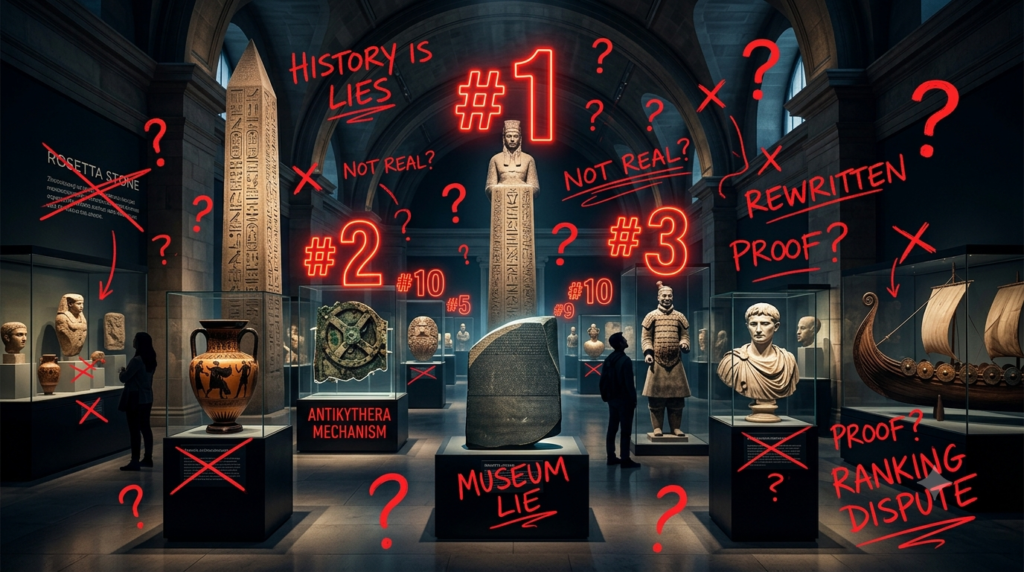
Here’s the pattern that struck me putting this together: almost none of these came from a perfectly planned expedition. A soldier stumbled on a slab of rock. A shepherd’s goat wandered off. Farmers hit something hard digging a well. Hikers mistook a 5,000-year-old man for a lost mountaineer. A storm stripped away a sand dune.
Rigorous methodology matters enormously once a site is found — that’s where the real science happens. But the findingitself still runs on a surprising amount of luck, curiosity, and someone being willing to stop and look closer instead of walking away. Which is a genuinely optimistic thought: there are almost certainly more Göbekli Tepes out there, still buried, waiting on the right accident.
Frequently Asked Questions
What is considered the greatest archaeological discovery of all time? There’s no single consensus answer, but the Rosetta Stone is frequently cited as the most consequential, since it didn’t just reveal one site — it gave scholars the tool to read an entire civilization’s surviving texts.
What is the oldest archaeological discovery on this list? Lucy, the Australopithecus afarensis skeleton found in Ethiopia in 1974, dates back roughly 3.2 million years, making her by far the oldest find here. Among built structures, Göbekli Tepe in Turkey is the oldest, at around 11,600 years old.
Why isn’t Stonehenge on this list? Stonehenge is remarkable, but it doesn’t quite meet the “changed our understanding” bar the way Göbekli Tepe does — it confirmed what researchers already suspected about Neolithic ritual architecture rather than overturning it. It’s a strong honorable mention rather than a top-15 pick.
Are archaeologists still finding sites like these today? Yes. LiDAR and satellite imaging in particular have driven a wave of new discoveries in the last decade, including hidden structures at Angkor and previously unknown Maya cities in Central America, suggesting there’s a lot still buried.
Is it true Google penalizes AI-generated content? No — Google has stated it doesn’t penalize content based on how it was produced, only based on whether it’s genuinely useful, original, and well-researched versus low-effort or created purely to manipulate rankings.