Most of the death tolls on this list weren’t decided by how powerful the storm was or how big the earthquake registered. They were decided by what happened before and after — ignored warnings, unenforced building codes, and governments too slow to respond. Nine disasters, ranked from least to most deadly, and what each one should have taught us before the next one hit.
A note on the numbers: several of these figures are disputed by hundreds of thousands of people, either because record-keeping was primitive at the time or because the death toll became politically sensitive. Where sources disagree, we’ve given the full range rather than picking one number to sound authoritative.
9. 2004 Indian Ocean Tsunami — ~230,000 dead
What happened: On December 26, 2004, a 9.1 magnitude earthquake off the coast of Sumatra triggered a tsunami that struck 14 countries across the Indian Ocean, from Indonesia to Somalia. Waves reached heights of up to 30 meters in some areas.
Observation: The Pacific Ocean had a functioning tsunami warning system at the time. The Indian Ocean did not. Some coastal communities had hours between the earthquake and the wave’s arrival — and no way to use that time.
What to avoid next time: Infrastructure gaps get closed only after the body count forces the issue. The Indian Ocean Tsunami Warning System was built in direct response to this disaster. It shouldn’t take 230,000 deaths to justify a warning system for an ocean with a known seismic history.
8. 2010 Haiti Earthquake — 46,000–316,000 dead (disputed)
What happened: A magnitude 7.0 earthquake struck near Port-au-Prince in January 2010, one of the most densely populated areas in the Western Hemisphere.
Observation: The death toll itself is contested territory. The Haitian government’s official figure is 316,000. Independent reviews, including assessments commissioned by USAID, put the number as low as 46,000–100,000. That gap is the real story — it reflects how much of Haiti’s building stock had no engineering oversight and no enforced codes. For comparison, a magnitude 9.0–9.1 earthquake in Japan the following year killed roughly 19,500 people — a fraction of Haiti’s toll, despite the much larger quake.
What to avoid next time: Raw earthquake magnitude tells you almost nothing about the death toll. Building code enforcement in dense, low-income urban areas remains one of the least-solved problems in disaster prevention — not because the engineering is hard, but because the money and political will aren’t there.
7. 1975 Banqiao Dam Failure (China) — 26,000–230,000 dead
What happened: Typhoon Nina stalled over Henan Province in August 1975 and dropped more than a year’s worth of rain in roughly 24 hours. The Banqiao Dam failed, triggering a chain-reaction collapse of 61 other dams downstream.
Observation: Engineers had identified structural cracks in the dam years before the failure. Those warnings went nowhere — this happened during China’s Cultural Revolution, when raising safety concerns carried real political risk. The disaster was also classified as a state secret for roughly two decades, meaning the rest of the world couldn’t learn from it until long after the fact.
What to avoid next time: Dam safety inspections need to be insulated from political pressure, and disaster information needs to travel — not just internally, but to engineers and governments elsewhere managing similar infrastructure.
6. 1920 Haiyuan Earthquake (China) — 200,000–273,000 dead
What happened: An earthquake estimated between magnitude 7.8 and 8.5 struck rural Gansu (in present-day Ningxia) at night, in the middle of winter.
Observation: Much of the region’s population lived in homes and caves carved into loess cliffs — soft, wind-deposited soil. These structures collapsed instantly under the shaking. Survivors who escaped the initial collapse then faced a different killer: freezing temperatures, with organized relief taking weeks to arrive in such a remote region.
What to avoid next time: Remote, low-infrastructure regions need pre-positioned emergency shelter and heat sources, not just search-and-rescue teams dispatched after the fact. By the time help arrived here, the cold had already finished what the earthquake started.
5. 1976 Tangshan Earthquake (China) — 242,000–655,000 dead
What happened: A magnitude 7.8 earthquake struck the industrial city of Tangshan at 3:42 a.m. on July 28, 1976, while nearly all of its one million residents were asleep. An estimated 85% of the city’s buildings collapsed.
Observation: The year before, Chinese seismologists had successfully predicted an earthquake near Haicheng and evacuated the area in time, saving thousands of lives. Tangshan struck with no warning at all, proving that earthquake prediction — even when it works once — isn’t reliable enough to build a safety strategy around. The official death toll of 242,000 is still disputed; some estimates run as high as 655,000.
What to avoid next time: The lesson here isn’t about better prediction — it’s about better buildings. Unreinforced masonry housing was the primary killer, not the quake itself. Retrofitting existing structures matters more than chasing forecasting accuracy.
4. 1970 Bhola Cyclone (East Pakistan / Bangladesh) — 300,000–500,000 dead
What happened: A cyclone drove a storm surge estimated at up to 10 meters into the low-lying Ganges-Brahmaputra Delta on the night of November 12, 1970. It remains the deadliest tropical cyclone ever recorded.
Observation: Warnings were broadcast ahead of the storm, but many residents on the delta’s islands never received them, didn’t believe them, or had no way to evacuate even if they had. The government’s slow, uneven relief response afterward became a direct catalyst for Bangladesh’s independence movement the following year.
What to avoid next time: Warnings only save lives if people can act on them. Bangladesh’s response — building thousands of dedicated cyclone shelters after this disaster — is the clearest before-and-after case study on this entire list. When Cyclone Gorky hit the same region with similar force in 1991, the shelters were there, and the death toll was a fraction of Bhola’s.
3. 1556 Shaanxi Earthquake (China) — ~830,000 dead
What happened: The deadliest single earthquake ever recorded struck Shaanxi Province in 1556 — nearly 470 years before this article was written.
Observation: The pattern here is identical to the Haiyuan earthquake more than 350 years later: much of the local population lived in homes carved into loess cliffs, which collapsed en masse when the ground shook. The disaster wasn’t caused by unusual seismic force — it was caused by a housing style that turned ordinary shaking into mass casualties.
What to avoid next time: This is the starkest proof on the list that construction and housing design determine survival more than the raw power of the disaster. It’s a lesson that apparently took over 350 years to fully absorb, given that Haiyuan repeated it almost exactly in 1920.
2. 1887 Yellow River Flood (China) — 900,000–2,000,000 dead
What happened: The Yellow River has flooded an estimated 1,500 times throughout recorded history. The 1887 flood is the deadliest of them.
Observation: This wasn’t a sudden, unpredictable event. Centuries of silt deposition had gradually raised the riverbed above the level of the surrounding farmland, putting more and more pressure on the dikes holding it back. When the dikes finally failed in 1887, it was the endpoint of decades of deferred maintenance, not a surprise.
What to avoid next time: Slow-motion infrastructure failure is still infrastructure failure — it just gives you decades of warning instead of hours. Regular maintenance and reinforcement of aging river and flood-control systems isn’t optional; the alternative is watching the same failure happen again, which is exactly what occurred 44 years later.
1. 1931 China Floods (Yangtze-Huai River) — 1,000,000–4,000,000 dead
What happened: The deadliest natural disaster ever recorded. A severe drought was followed by record snowmelt and then nine cyclones striking the same region within a single month — the historical average is two. The same weakened dike system from the 1887 flood gave way again.
Observation: The most important detail isn’t the flooding itself — it’s what killed people afterward. The majority of deaths came from starvation and disease in the flood’s aftermath, not from drowning. Destroyed crops, contaminated water, and displaced populations turned a weather event into a famine and epidemic.
What to avoid next time: This is the throughline for the entire list. What happens in the days and weeks after a disaster determines the final death toll more than the disaster itself. Every entry above proves some version of this — but 1931 proves it at the largest scale ever recorded.
The Pattern
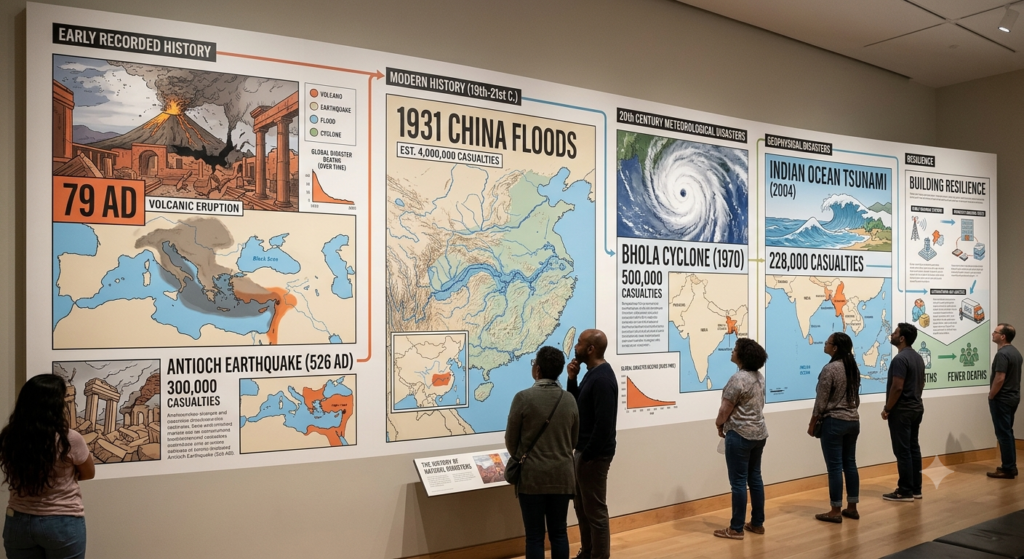
Line these nine disasters up and the common thread isn’t geography, and it isn’t the raw force of nature. It’s the same three failures, repeating across four centuries and three continents: warnings that didn’t reach people, buildings that were never built to survive what hit them, and governments that responded too slowly once the disaster was already underway. The deadliest disasters in history weren’t the strongest ones. They were the ones nobody was ready for.