I still remember the first time a typhoon knocked out power at my place for the better part of a week. No internet, no fridge, just candlelight and the sound of wind trying to peel the roof off. It’s a small, forgettable inconvenience in the grand scheme of things — nobody’s writing history books about my particular blackout — but it left me with a weird kind of respect for how much power weather and geology actually hold over us, even now, with satellites and warning systems and all our modern conveniences.
That respect is what sent me down this rabbit hole in the first place. Here’s a fun thought experiment: pick any moment in human history you find fascinating — the fall of an empire, the birth of agriculture, the reason your city has strict earthquake codes — and there’s a decent chance one of the natural disasters that changed history is lurking somewhere in the background, quietly pulling the strings.
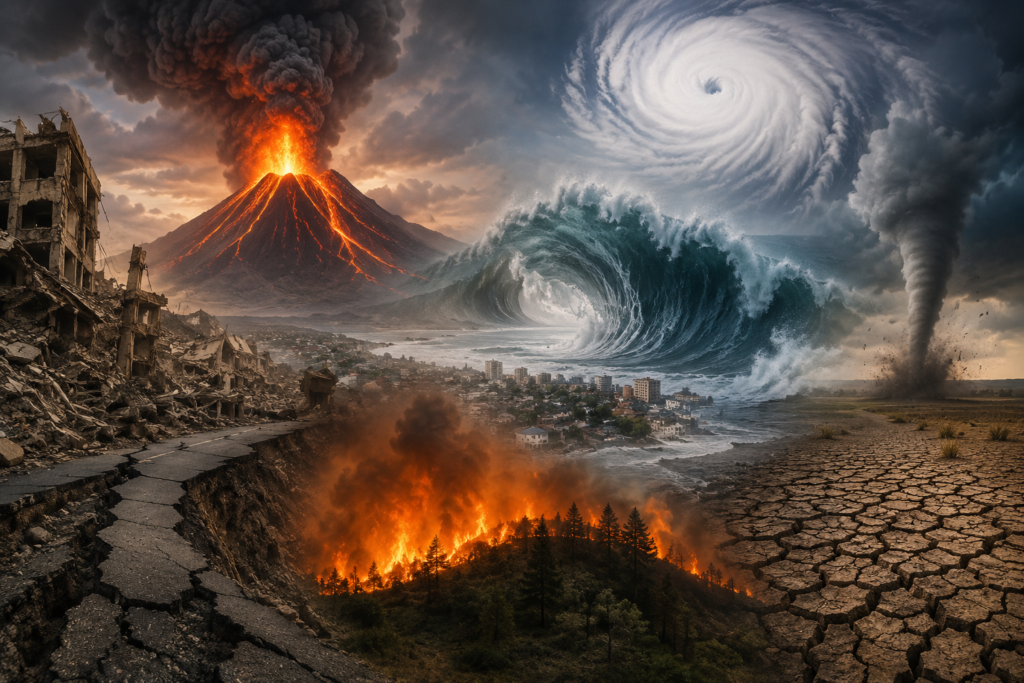
We tend to think of disasters as tragic footnotes. A flood here, an earthquake there, a few paragraphs in a textbook. But some of these events didn’t just kill people and destroy cities — they bent the entire arc of civilization in a new direction. They ended empires. They started new nations. They inspired novels. They rewired how we build our cities and how our governments respond when the ground starts shaking. In other words, these are the natural disasters that shaped the world as we actually know it today.
I went down a rabbit hole trying to rank the biggest natural disasters in history that mattered most — not necessarily the deadliest, but the ones with the longest shadow. This isn’t a perfectly objective science (how do you really compare a mass extinction event to a hurricane?), but here’s where I landed, from the single most consequential event in the story of life on Earth down to a hurricane that quietly changed how America tracks storms. Along the way, you’ll see just how much historical events caused by natural disasters continue to influence the world we live in.
1. The Chicxulub Asteroid and the Dinosaur Extinction (~66 Million Years Ago)
There’s no getting around starting here. About 66 million years ago, a chunk of rock roughly the size of a city slammed into what’s now the Yucatán Peninsula, and the dinosaurs — the undisputed rulers of Earth for well over 100 million years — were essentially wiped out within a geological blink of an eye.
Here’s the thing that makes this number one on any list: without it, mammals almost certainly stay small, marginal, and nocturnal forever. There’s no upward path to primates, no path to us. Every other event on this list — every plague, every eruption, every hurricane — only happens because this one cleared the stage first. It’s the ultimate “before and after” moment in the story of life on this planet.
2. The Black Death: How This Plague Changed History Forever (1347–1351)
Fast forward to medieval Europe, and you get a very different kind of catastrophe — one caused by a bacterium, not a rock from space, but arguably just as world-altering.
The Black Death killed somewhere between a third and half of Europe’s population in just a few years. That’s staggering on its own, but the ripple effects are what really matter. With so much of the labor force gone, surviving peasants suddenly had leverage they’d never had before. Wages rose. The rigid structure of feudalism started cracking. Some historians even argue the resulting social and economic shake-up helped set the table for the Renaissance. A horrifying tragedy, in other words, that also quietly demolished one of history’s most entrenched social systems.
3. The Younger Dryas and the Dawn of Agriculture (~12,900 Years Ago)
This one’s less famous, but I’d argue it deserves to be much better known. Around 12,900 years ago, the Earth was gradually warming out of the last Ice Age — and then, abruptly, temperatures plunged again for over a thousand years.
Why does this matter so much? Because many researchers believe this climatic whiplash is what pushed early human communities toward agriculture. Foraging and hunting became less reliable in the new climate chaos, so people started experimenting with cultivating crops instead. And once agriculture takes hold, you get permanent settlements, then surplus food, then cities, then everything else. It’s not an exaggeration to say this cold snap might be the reason civilization exists at all.
4. The Toba Supereruption and Human Evolution (~74,000 Years Ago)
Somewhere around 74,000 years ago, a volcano in what’s now Sumatra, Indonesia, erupted with a force that’s hard to even comprehend — one of the largest eruptions in the last few million years. Ash blanketed huge swaths of the planet, and global temperatures may have dropped for years afterward.
There’s a genuinely debated theory — the “Toba catastrophe theory” — that this eruption nearly wiped out early Homo sapiens, squeezing our species through a genetic bottleneck that shows up in DNA today. Not every scientist agrees with this theory, and the evidence is still contested. But if it’s true, it means one volcano may have shaped the genetic makeup of every human being alive right now.
5. The Spanish Flu (1918–1919)
The Spanish Flu pandemic killed somewhere between 50 and 100 million people worldwide — more than World War I itself, which was raging at the very same time. Soldiers packed into trenches and troop ships became the perfect delivery system for the virus, spreading it across continents in a matter of months.
The dual catastrophe of a world war and a pandemic hitting simultaneously reshaped the 20th century in ways we’re still unpacking. Public health infrastructure, quarantine practices, and international disease monitoring all trace some of their roots back to lessons learned — often too late — during this pandemic.
6. Mount Tambora and the Year Without a Summer (1815)
If you’ve ever heard of “the year without a summer,” this is the eruption responsible. Mount Tambora in Indonesia erupted so violently in 1815 that it threw enough ash and sulfur into the atmosphere to disrupt the global climate for an entire year.
Crops failed across Europe and North America. Famine and food riots followed. And in a strange twist, the gloomy, unseasonably cold weather that summer is part of why Mary Shelley — stuck indoors on a rainy vacation in Switzerland — ended up writing Frankenstein. A volcano on the other side of the world helped birth one of literature’s most enduring monsters.
7. The Plague of Justinian (541–549 CE)
Centuries before the Black Death, another plague tore through the Byzantine Empire under Emperor Justinian. Estimates vary wildly, but it may have killed tens of millions of people across the Mediterranean world.
The empire never fully recovered its former strength, and some historians argue this weakened Byzantium just enough to change the balance of power across Europe and the Middle East for centuries afterward — arguably shaping the conditions that allowed new empires and religions to rise in the region.
8. The Minoan Eruption of Thera (~1600 BCE)
On the island of Santorini, a catastrophic volcanic eruption around 1600 BCE devastated the Minoan civilization, one of the great Bronze Age cultures of the Mediterranean. Some archaeologists connect this eruption to the broader collapse of Bronze Age societies across the region — and yes, the idea of a vanished, prosperous island civilization has been linked (loosely, and not without controversy) to the myth of Atlantis.
Whether or not Plato had this eruption in mind, the eruption itself marks one of history’s great “civilization was here, and then it wasn’t” moments.
9. The Dust Bowl (1930s)
Part natural disaster, part man-made catastrophe, the Dust Bowl of the 1930s turned huge portions of America’s Great Plains into an uninhabitable dust cloud, driven by drought and decades of poor farming practices that stripped away topsoil.
Hundreds of thousands of families — the so-called “Okies” — packed up and headed west, reshaping the demographics of states like California. It also permanently changed how the U.S. approaches farming and land conservation, leading to new agricultural practices that are still standard today.
10. The 2011 Tōhoku Earthquake and the Fukushima Nuclear Policy Shift
On March 11, 2011, one of the most powerful earthquakes ever recorded struck off the coast of Japan, triggering a tsunami that devastated coastal communities and knocked out the Fukushima Daiichi nuclear plant, causing a meltdown.
The disaster killed nearly 20,000 people — but its aftershocks (pun intended) reached far beyond Japan’s coastline. Countries around the world reconsidered their nuclear energy programs almost overnight, with Germany famously announcing a full phase-out of nuclear power in the disaster’s wake.
11. The 2004 Indian Ocean Tsunami
On the day after Christmas in 2004, a massive undersea earthquake triggered a tsunami that killed over 200,000 people across more than a dozen countries, making it one of the deadliest natural disasters in recorded history.
The scale of the devastation — and the fact that so many countries had no warning system in place — led to a complete overhaul of global tsunami detection and international disaster response coordination. It’s a grim example of a disaster directly leading to the infrastructure that (hopefully) prevents the next one from being just as deadly.
12. The 1970 Bhola Cyclone and Bangladesh’s Independence
The Bhola Cyclone remains one of the deadliest tropical cyclones ever recorded, killing an estimated 300,000–500,000 people in what was then East Pakistan. What makes this disaster historically significant isn’t just its staggering death toll — it’s what happened next.
The central Pakistani government’s slow, inadequate response to the disaster fueled deep resentment in East Pakistan, and many historians point to this moment as a major catalyst for the movement that led to Bangladesh’s independence just a year later, in 1971.
13. Hurricane Katrina: A Turning Point for U.S. Disaster Policy (2005)
Katrina wasn’t just a hurricane — it became a national reckoning. The storm itself was devastating, but it was the failure of the levee system and the painfully slow, chaotic government response that turned it into one of the defining moments of early 21st-century America.
Katrina exposed deep fault lines around race, poverty, and infrastructure neglect, and it reshaped how Americans talk about disaster preparedness, climate resilience, and government accountability in ways that still surface in policy debates today.
14. The 1906 San Francisco Earthquake
The earthquake that struck San Francisco in April 1906 flattened much of the city and sparked fires that burned for days, killing an estimated 3,000 people and leaving hundreds of thousands homeless.
Beyond the immediate destruction, the earthquake became a turning point for seismic science and engineering. Building codes changed. Cities across earthquake-prone regions started taking structural safety far more seriously, and the disaster is still studied by engineers designing earthquake-resistant buildings today.
15. The Galveston Hurricane (1900)
We’ll close with the deadliest natural disaster in U.S. history: the hurricane that struck Galveston, Texas, in September 1900, killing an estimated 6,000 to 12,000 people in a city that had no real warning system and a sea wall that didn’t yet exist.
The scale of the tragedy pushed the U.S. to take storm forecasting seriously, eventually leading to major advances in meteorology and coastal engineering — including the massive seawall Galveston built afterward, which still protects the city today.
It’s easy to read a statistic like “12,000 dead” and let it stay abstract. But I think about my own week without power, multiplied by a magnitude I can’t really picture, and it starts to feel a little less like a number in a textbook and a little more like something real people actually lived through — or didn’t.
What These Disasters That Changed Civilization Have in Common
Looking at all fifteen of these side by side, a pattern starts to emerge: disasters don’t just destroy — they force change. Sometimes that change is scientific (better earthquake engineering), sometimes it’s political (a new nation born out of government failure), and sometimes it’s almost accidental (a gloomy summer producing a gothic novel). This is really the throughline connecting every entry on this list of natural disasters that changed history — destruction on one side, transformation on the other.
Ranking these was genuinely difficult, and honestly, a little subjective. Do you weigh raw death toll more heavily, or long-term civilizational impact? I leaned toward the latter — which is why an asteroid strike from 66 million years ago outranks a hurricane that killed thousands of people. But there’s no single “correct” answer here, and I’d guess most people would shuffle this list around if you asked them to build their own version.
A few disasters just missed the cut but deserve an honorable mention: the 1755 Lisbon earthquake, which shook European Enlightenment philosophy to its core; the 1931 China floods, possibly the deadliest disaster ever recorded; and the centuries-long Little Ice Age, which reshaped agriculture and conflict across the globe.
If there’s one takeaway from all of this, it’s probably this: nature doesn’t just happen to history. Again and again, it’s been one of history’s main authors.
I think back to that week without power sometimes, whenever a storm rolls in and the sky turns that particular shade of green-gray. It’s nothing compared to any of what’s on this list — but it’s a small, personal reminder that we’re all still living downstream of forces a lot bigger than us. History just happens to remember the ones big enough to leave a mark on everyone else too.
Frequently Asked Questions
What is the deadliest natural disaster in history? By death toll, the 1931 China floods are generally considered the deadliest natural disaster in history, with estimates ranging into the millions. The Black Death, while technically a pandemic rather than a single-event disaster, killed even more people worldwide over a longer stretch of time.
Which natural disaster changed the world the most? It depends on how you measure “changed.” By long-term civilizational impact, the Chicxulub asteroid impact and the Younger Dryas climate shift arguably reshaped the world more than any other event, since both were prerequisites for human civilization existing at all. By modern political impact, the Black Death and the 1970 Bhola Cyclone stand out for directly reshaping social and political systems.
How did natural disasters shape civilization? Natural disasters have repeatedly forced humans to adapt — pushing early communities toward agriculture, reshaping labor systems and government policy, driving advances in engineering and forecasting, and in some cases directly triggering the formation of new nations.
What natural disaster inspired Frankenstein? The 1815 eruption of Mount Tambora triggered the “Year Without a Summer” in 1816, and the unusually cold, gloomy weather that summer is part of why Mary Shelley, stuck indoors in Switzerland, wrote Frankenstein.