A Ponzi scheme is one of the oldest and most destructive forms of financial fraud in history. Despite decades of public warnings, government crackdowns, and countless victims losing billions of dollars worldwide, Ponzi schemes continue to evolve and trap people from all walks of life. From wealthy investors and celebrities to retirees, professionals, and ordinary workers, no sector of society is completely immune from these scams.
At its core, a Ponzi scheme is built on deception. It creates the illusion of a successful investment business when, in reality, there is little or no legitimate profit-generating activity happening behind the scenes. Instead of earning money through actual investments, operators simply use money from newer investors to pay earlier participants. This creates the appearance that the business is profitable, encouraging more people to invest. Eventually, the system collapses because it becomes mathematically impossible to sustain.
The danger of Ponzi schemes lies not only in financial loss but also in the emotional devastation they leave behind. Entire families lose savings, friendships are destroyed, communities become divided, and victims often experience depression, shame, and psychological trauma. In many cases, the fraud continues for years before authorities uncover it.
This article comprehensively explores everything there is to know about Ponzi schemes—from their history and mechanics to modern crypto scams, legal implications, warning signs, and ways to protect yourself.
What Is a Ponzi Scheme?
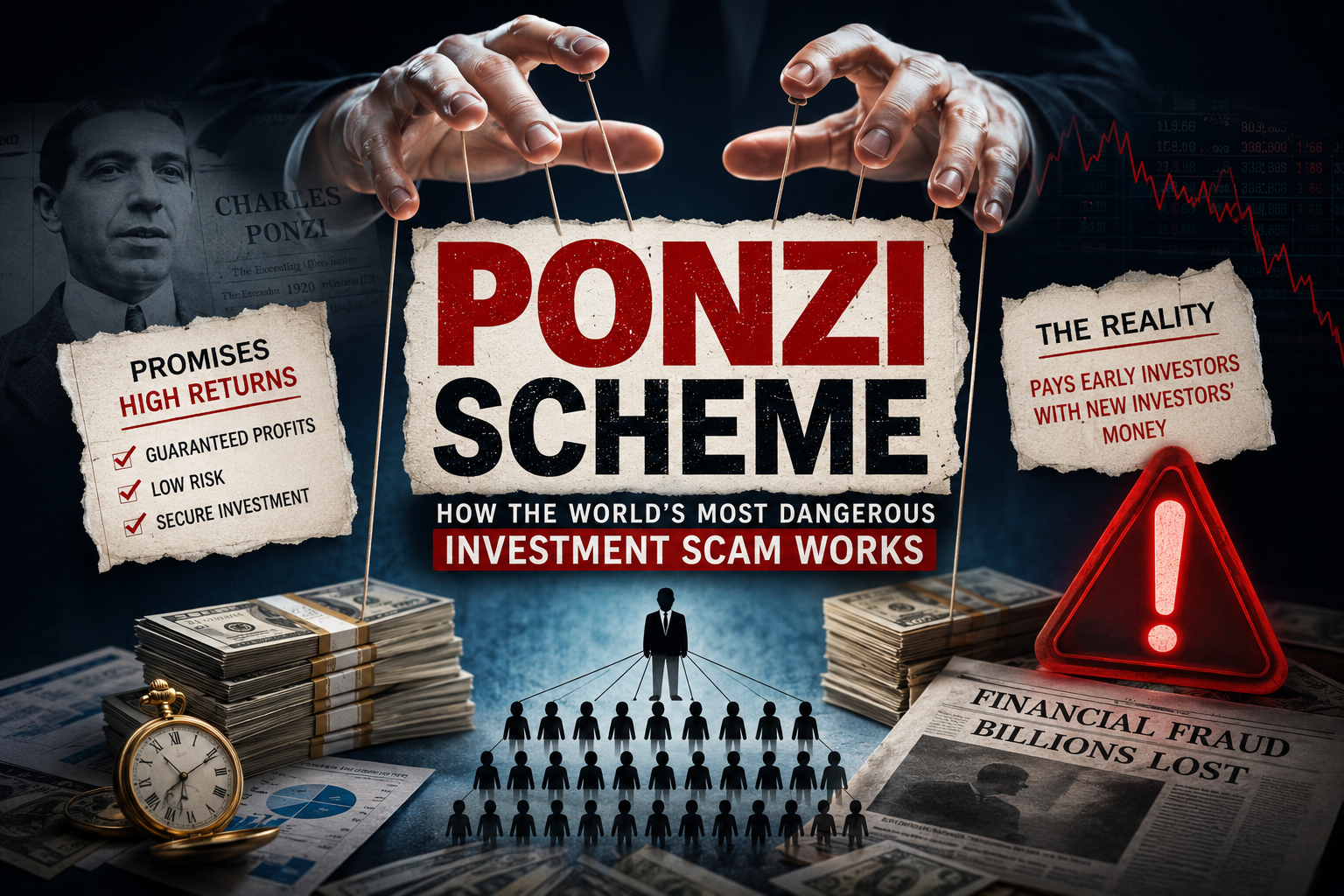
A Ponzi scheme is a fraudulent investment operation in which returns paid to earlier investors come primarily from money contributed by newer investors rather than from actual profits earned by a legitimate business or investment activity.
The scheme survives only as long as fresh money continues flowing into the system. Once recruitment slows down or too many investors attempt to withdraw funds, the operation collapses.
Government regulators such as the U.S. Securities and Exchange Commission describe Ponzi schemes as investment frauds that typically promise high returns with little or no risk. These promises are central to attracting victims because they appeal to people’s desire for quick and easy financial success.
Unlike legitimate investments, Ponzi schemes generally do not produce sustainable revenue. The operator may pretend to invest in stocks, real estate, cryptocurrency, foreign exchange trading, artificial intelligence systems, or other sophisticated financial products, but the supposed investment activity is often fabricated or greatly exaggerated.
The Origin of the Term “Ponzi Scheme”
The term “Ponzi scheme” comes from Charles Ponzi, an Italian immigrant who became infamous in the United States during the 1920s.
Ponzi claimed he had discovered a way to profit from international postal reply coupons by exploiting differences in currency exchange rates between countries. He promised investors extraordinary returns—reportedly around 50% profit within just 45 to 90 days.
At first, investors actually received the promised payouts. This caused excitement and trust to spread rapidly. Thousands of people invested their life savings because they believed Ponzi had discovered a revolutionary financial strategy.
In reality, Ponzi was not generating profits from postal coupons on the scale he claimed. Instead, he was using funds from new investors to pay earlier investors. Eventually, the flow of incoming money could no longer sustain the operation, and the scheme collapsed. Thousands of investors suffered severe losses.
Although Charles Ponzi did not invent the concept itself, his case became so famous that his name became permanently associated with this type of fraud.
How a Ponzi Scheme Works
Ponzi schemes generally follow a predictable cycle.
Stage 1: Attracting Investors
The scam usually begins with promises of exceptionally high returns and minimal risk. Fraudsters may claim to possess exclusive investment strategies, advanced technologies, secret market insights, or insider expertise.
Modern Ponzi operators frequently use:
- Social media marketing
- Fake testimonials
- Influencer endorsements
- Luxury lifestyle displays
- Religious or community connections
- Networking and referral systems
Many schemes rely heavily on trust and emotional persuasion rather than genuine financial evidence.
Stage 2: Paying Early Investors
To build credibility, operators initially pay investors exactly as promised. However, these payouts are not generated from profits. They come from money provided by newer investors entering the scheme.
This is one of the most dangerous aspects of a Ponzi scheme because early investors may genuinely believe the investment is legitimate. Some even become promoters themselves after receiving payouts.
The operator often encourages investors to:
- Reinvest their earnings
- Recruit friends and family
- Increase their investments
- Avoid withdrawing funds
This creates rapid growth and the illusion of success.
Stage 3: Expansion and Public Hype
As more people hear success stories, the scheme grows quickly. Victims unknowingly help market the fraud through word-of-mouth recommendations.
Psychological factors become extremely powerful during this stage:
- Fear of missing out (FOMO)
- Herd mentality
- Trust in social circles
- Greed and financial desperation
Some operators create fake dashboards, fabricated trading reports, or manipulated account statements to make the business appear profitable.
Stage 4: Collapse
Ponzi schemes inevitably fail because they require an endless supply of new investors.
The collapse usually occurs when:
- Recruitment slows down
- Economic conditions worsen
- Too many investors request withdrawals
- Regulators begin investigations
- Negative publicity spreads
Once the operator cannot meet withdrawal demands, panic spreads rapidly. Victims rush to recover their money, accelerating the collapse.
In many cases, operators disappear with the remaining funds before authorities intervene.

Core Characteristics of a Ponzi Scheme
Financial regulators consistently identify several warning signs associated with Ponzi schemes.
Guaranteed High Returns
Legitimate investments always involve some degree of risk. Fraudsters often promise unusually high or guaranteed profits to lure victims.
Common promises include:
- “Risk-free investments”
- “Guaranteed monthly income”
- “Double your money quickly”
- “Consistent profits regardless of the market”
These claims are major red flags.
Overly Consistent Returns
Real financial markets fluctuate constantly. Investments rise and fall depending on economic conditions.
Ponzi schemes often claim to generate profits every month without losses. Regulators warn that consistently positive returns regardless of market conditions are suspicious.
Secretive or Complex Strategies
Fraudsters may deliberately use complicated financial jargon to confuse investors.
Common examples include:
- AI-powered trading systems
- Cryptocurrency arbitrage
- Quantum investment algorithms
- Exclusive offshore trading
- Proprietary technology
When investors cannot clearly understand how profits are generated, caution is necessary.
Difficulty With Withdrawals
Many Ponzi schemes eventually begin delaying withdrawals.
Operators may invent excuses such as:
- Technical issues
- Banking delays
- Regulatory audits
- Maintenance upgrades
- Temporary liquidity problems
These delays often signal that the scheme is running out of money.
Ponzi Scheme vs Pyramid Scheme
Although often confused, Ponzi schemes and pyramid schemes are not identical.
A Ponzi scheme primarily revolves around fake investments. Investors believe their money is being invested into a profitable business.
A pyramid scheme, meanwhile, depends heavily on participant recruitment. Members earn income mainly by recruiting others into the structure.
However, both schemes rely on continuous inflows of new money and eventually collapse when recruitment slows.
Famous Ponzi Schemes in History
Bernie Madoff
One of the most infamous Ponzi schemes in modern history was operated by Bernie Madoff.
Madoff was a respected financier and former chairman of NASDAQ. For years, he claimed to generate stable and impressive returns for investors through sophisticated investment strategies.
In reality, the profits were largely fabricated. Investor funds were used to pay earlier investors while maintaining the illusion of a successful business.
The scheme collapsed during the 2008 financial crisis when many investors attempted to withdraw funds simultaneously. Losses were estimated in the tens of billions of dollars, making it one of the largest financial frauds ever recorded.
The scandal shocked the financial world because many wealthy individuals, banks, charities, and institutions trusted Madoff completely.
Ponzi Schemes and Cryptocurrency
The rise of cryptocurrency has created new opportunities for Ponzi operators.
Many crypto scams promise:
- Guaranteed staking rewards
- Automated trading profits
- Mining returns
- AI-generated earnings
- High-yield decentralized finance (DeFi) investments
Researchers have documented the increasing presence of Ponzi schemes on blockchain platforms such as Ethereum and Bitcoin.
Cryptocurrency fraud can be particularly dangerous because:
- Transactions are difficult to reverse
- Operators may remain anonymous
- Cross-border enforcement is challenging
- Victims often lack technical understanding
Regulators have repeatedly warned investors about crypto-based Ponzi schemes.

Why People Fall for Ponzi Schemes
Many assume only inexperienced or uneducated individuals become victims. This is false.
Ponzi schemes successfully target:
- Professionals
- Business owners
- Retirees
- Celebrities
- Religious communities
- Financial experts
Fraudsters exploit human psychology.
Fear of Missing Out (FOMO)
People fear losing opportunities that others appear to profit from.
Trust and Social Proof
Victims often invest because friends, relatives, or respected community leaders endorse the scheme.
Financial Desperation
Economic hardship makes people more vulnerable to promises of quick wealth.
Greed
The desire for unusually high returns can cloud judgment and reduce skepticism.
The Emotional and Social Damage
The consequences of Ponzi schemes extend beyond money.
Victims often experience:
- Depression
- Anxiety
- Shame
- Family conflict
- Social humiliation
Some victims lose retirement savings accumulated over decades.
Communities can also suffer long-term damage. When scams spread through churches, social groups, or close-knit communities, trust becomes severely damaged.
Warning Signs You Should Never Ignore
Several warning signs consistently appear in Ponzi schemes.
Major Red Flags
- Guaranteed profits
- Little or no risk
- Pressure to invest quickly
- Secretive investment methods
- Unregistered investments
- Unlicensed sellers
- Difficulty withdrawing money
- Excessive focus on recruitment
- Lack of audited financial statements
Financial authorities strongly encourage investors to verify whether investments and sellers are properly registered. (Investor)
Legal Consequences of Operating a Ponzi Scheme
Ponzi schemes are illegal in many countries because they involve fraud and securities violations.
Authorities that investigate such fraud include:
- U.S. Securities and Exchange Commission
- Federal Bureau of Investigation
- Securities and Exchange Commission
- National Bureau of Investigation
- Interpol and international financial regulators
Operators may face:
- Criminal charges
- Asset seizures
- Heavy fines
- Long prison sentences
However, recovering stolen funds is often difficult because money may already be spent, hidden, or transferred internationally.
The Role of Social Media and Technology
Modern Ponzi schemes heavily use technology.
Fraudsters now leverage:
- Facebook groups
- TikTok influencers
- Telegram channels
- YouTube promotions
- AI-generated content
- Deepfake celebrity endorsements
Social media allows scams to spread globally within days.
The combination of viral marketing and digital payment systems makes modern Ponzi schemes faster and harder to detect than traditional scams.
How to Protect Yourself
The best defense against Ponzi schemes is financial education and skepticism.
Verify Registration and Licenses
Always check whether:
- The investment is registered
- The company exists legally
- The seller is licensed
Understand the Investment
Never invest in something you do not fully understand.
If explanations are vague or overly technical, proceed carefully.
Be Skeptical of Guaranteed Returns
No legitimate investment guarantees high profits without risk.
If something sounds too good to be true, it probably is.
Avoid Emotional Decisions
Scammers frequently exploit urgency and emotion.
Take time to research independently before investing.
What To Do If You Suspect a Ponzi Scheme
If you suspect fraud:
- Stop investing immediately
- Save all communications and receipts
- Document transactions
- Warn family and friends
- Report the operation to authorities
Victims should also seek legal and financial guidance as early as possible.
The Future of Ponzi Schemes
Ponzi schemes continue evolving alongside technology.
Future scams may increasingly involve:
- Artificial intelligence
- Deepfakes
- Decentralized finance platforms
- Automated investment bots
- International crypto networks
As financial systems become more digital, fraudsters will likely develop increasingly sophisticated methods of deception.
This makes financial literacy more important than ever.
Conclusion
A Ponzi scheme is ultimately built on illusion. It creates the appearance of wealth, success, and financial opportunity while secretly depending on an endless cycle of new victims.
History has repeatedly shown that no Ponzi scheme survives forever. Every operation eventually collapses because there is no real foundation supporting it. The only question is how many people will suffer before it does.
Understanding how these schemes work is one of the most powerful tools for protecting yourself and others. Awareness, skepticism, and proper financial education remain the strongest defenses against investment fraud.
In a world where scams increasingly hide behind technology, social media, cryptocurrency, and persuasive marketing, critical thinking has become essential. Investors must remember that legitimate wealth is rarely built through guaranteed shortcuts or impossible promises. Real investments carry risks, require transparency, and are grounded in actual economic activity—not in money taken from the next victim.