Artificial Intelligence has transitioned from a speculative “future tech” to the invisible backbone of the 2026 digital economy. We are no longer just “using” AI; we are inhabiting an environment shaped by it. This guide explores the technical, practical, and ethical landscape of AI today.
I. The New Foundations: Beyond the Buzzwords
The era of rigid, “if-then” programming has ended. Modern AI is built on learned intuition, where systems identify patterns within massive datasets rather than following manual rules.
- The Paradigm Shift: Software is no longer strictly “written”—it is “grown” through training processes that mimic neural pathways.
- The Architecture of Now:
- Transformers and Attention Mechanisms: The “T” in GPT refers to the Transformer, an architecture that allows models to weigh the importance of different parts of input data (the “Attention” mechanism), enabling them to understand context over vast distances of text or code.
- Multimodality: Modern models are “natively” multimodal, meaning they process text, images, audio, and video within a single framework, allowing for more human-like reasoning across different senses.
- Diffusion Models: These use complex mathematics to “denoise” data, effectively creating high-resolution images and videos from scratch based on text descriptions.
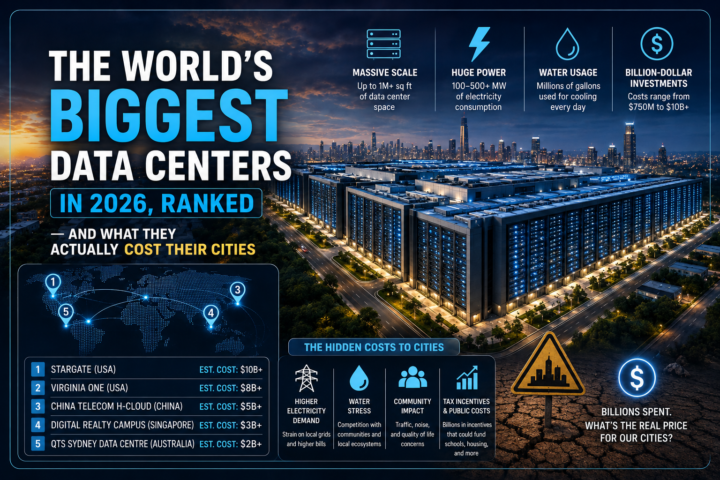
- The Compute Arms Race: Training these systems requires massive arrays of GPUs and TPUs. By 2026, the focus has shifted toward energy efficiency and “sovereign clouds” to manage the staggering electrical demands of global AI infrastructure.
II. The Generative Explosion: AI as a Creative Partner
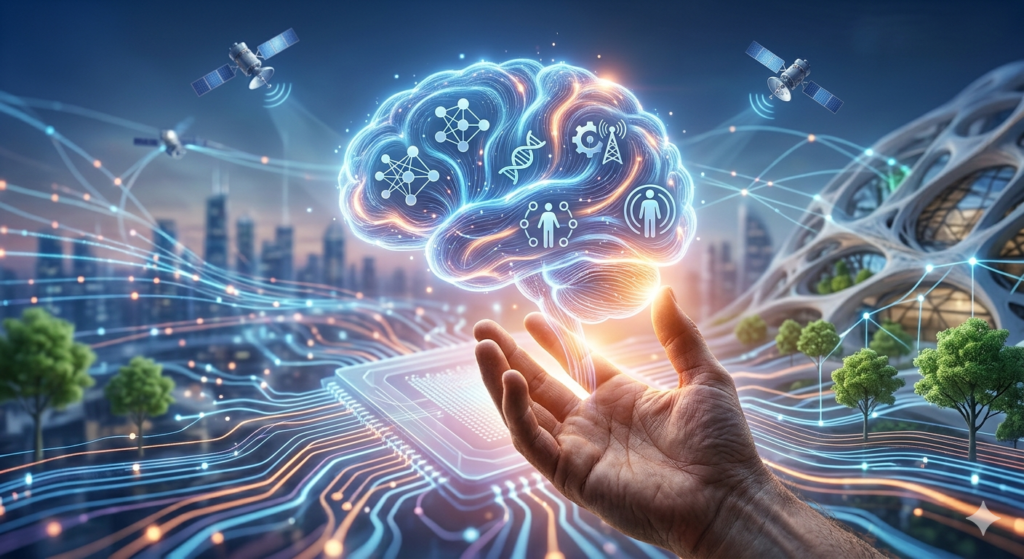
Generative AI has moved from a novelty to a fundamental productivity tool. It acts as a “force multiplier” for human creativity.
- The Democratization of Creation: Natural language is now the primary “programming language.” Whether writing a novel or building an app, users describe their intent, and the AI handles the execution.
- Synthetic Reality: High-fidelity video generation and voice cloning have reached a point of near-indistinguishability from reality, creating a new “synthetic” layer to our digital media.
- Agentic Workflows: We have moved beyond chatbots that simply answer questions. AI Agents can now plan, use external tools (like calendars and web browsers), and execute multi-step tasks autonomously, such as organizing a complete business trip or managing a project’s documentation.
III. The Invisible Integration: AI in the Background
The most impactful AI is often the kind you don’t see. It is integrated into the “plumbing” of our daily lives.
- Hyper-Personalization: Algorithms now curate everything from medical advice to education, adapting in real-time to an individual’s unique learning style or physiological data.
- Scientific Acceleration:
- Proteomics: AI-driven models like AlphaFold have revolutionized biology by predicting the shapes of nearly all known proteins, accelerating drug discovery from years to months.
- Climate Modeling: AI optimizes renewable energy grids by predicting wind and solar fluctuations with pinpoint accuracy, helping stabilize the transition to green energy.
- The Industrial Renaissance: In manufacturing, AI-powered “computer vision” monitors production lines for defects invisible to the human eye, while autonomous robotics handle high-precision assembly.
IV. The Friction Points: Ethics, Law, and Human Identity
As AI scales, so do the risks. 2026 is a year of significant regulatory and ethical reckoning.
- The Data Dilemma: The “fair use” of copyrighted data for training is being challenged in courts globally. The industry is moving toward “opt-in” data ecosystems and synthetic data training.
- The Bias Bottleneck: Because AI learns from historical data, it can inadvertently bake past societal prejudices into modern systems—affecting everything from hiring to loan approvals.
- The Hallucination Problem: Despite advancements, models can still present false information with absolute confidence. This has led to a “human-in-the-loop” requirement for high-stakes fields like law and medicine.
- The Deepfake Economy: The ease of creating “deepfakes” has necessitated new digital watermarking standards (like C2PA) to verify the provenance of digital content.
V. The Labor Evolution: AI and the Future of Work
The job market is not disappearing; it is being radically reshaped.
- Augmentation vs. Replacement: AI is largely replacing “tasks,” not “jobs.” While repetitive data entry is fading, roles requiring empathy, strategy, and complex problem-solving are more valuable than ever.
- The Rise of the “Human-in-the-Loop”: The most successful professionals are those who use AI as a “Co-pilot,” focusing their time on vetting AI outputs and providing high-level creative direction.
- Universal Basic Income & Policy: Governments are increasingly exploring social safety nets and AI literacy programs to manage the transition for workers in disrupted industries.
VI. The Frontier: What Lies Ahead?
The horizon of AI is moving toward localized, more efficient, and more logical systems.
- Towards AGI (Artificial General Intelligence): While still a subject of debate, the quest for AGI—a system that can perform any intellectual task a human can—remains the “North Star” of the industry.
- On-Device AI: The “Big AI” era is being supplemented by Small Language Models (SLMs). These are compact, private models that live on your phone or laptop, processing data locally without ever sending it to a cloud server.
- Neuro-Symbolic AI: This hybrid approach combines the “pattern matching” of deep learning with the “hard logic” of traditional programming to reduce errors and improve common-sense reasoning.
- The Alignment Problem: As systems become more powerful, the technical challenge of “alignment”—ensuring AI goals remain perfectly synced with human safety and values—is the most critical research field in the world.
VII. Conclusion: Living with the Ghost
In 2026, AI is no longer a guest in our world; it is a permanent resident. The challenge for humanity is not to resist the technology, but to maintain our sovereignty—using these powerful systems to solve our greatest challenges while preserving the messy, beautiful, and irreplaceable spark of human agency.