You’re Not Anti-Social, You Just Lack a ‘Third Place’: How to Build Community on a Budget
It’s 6:00 PM on a Tuesday. You just closed your work laptop or walked out of your last class. You’re staring at your bedroom wall or your phone screen, feeling that familiar, hollow itch to just go somewhere. You want to see people, hear background chatter, and feel like you’re part of the living world.
So, you calculate the cost of leaving your apartment.
A decent cocktail is $16. An aesthetic iced matcha at the cafe down the street is $8, and they’ve already taped over the wall outlets to discourage people from lingering anyway. A casual sit-down dinner with a friend easily clears $35 after tax and tip. Suddenly, staying home and letting a streaming app auto-play into the midnight hours feels like the only financially responsible choice.
If this routine sounds familiar, you aren’t anti-social. And you aren’t failing at your twenties. You are simply experiencing the aggressive monetization of modern life.
Sociologist Ray Oldenburg used to talk about a concept called the “Third Place.” Your first place is your home. Your second place is your job or school. Your third place is the anchors of community life—the physical spaces where you can gather, relax, and chat with regulars without the pressure of an expensive transaction.
Today, third places are disappearing, or worse, they’ve been turned into pay-to-play luxury experiences. But building a rich social life and finding your people doesn’t require a high disposable income. Reclaiming free and low-cost spaces is both a mental health necessity and a brilliant act of financial rebellion.
Anatomy of a Great Third Place
Before you go hunting for your spot, you need to know what actually makes a space work. A true third place isn’t just a physical location; it’s a psychological safety net. When evaluating your neighborhood, look for these four core traits:
- Highly Accessible & Regular: You don’t need an invite, a ticket, or a reservation. You can show up unannounced on a random Thursday and safely assume you’ll see familiar faces.
- The Social Leveler: Your job title, your background, and your bank account balance don’t matter. Inside the space, everyone is on equal footing.
- Conversation is the Main Activity: The environment naturally encourages low-stakes, casual interactions. It’s not so loud that you have to shout, and not so clinical that you’re afraid to speak.
- A Home Away from Home: The staff or regulars are welcoming, you feel safe, and there is zero pressure to “wrap it up and move along” to free up a table.
The Free & Cheap Blueprint: Where to Go Right Now
To find these spots, you have to look past the heavily marketed commercial hubs. Here is where the sub-30 community is actually gathering without breaking the bank.
1. The Modern Public Library (Reimagined)
If you think libraries are still just silent, dusty book stacks policed by frowning archivists, you are missing out on the best free infrastructure available. Modern urban libraries have aggressively adapted to target young adults.
Many now host after-hours events like free board game nights, silent book clubs (where people gather to read in comfortable companionable silence for an hour, then chat about their books over cheap tea), and maker-spaces equipped with 3D printers and sewing machines. It is one of the last truly democratic spaces left where your presence is entirely free.
2. “Run Clubs” for Non-Runners
Social run and walk clubs have quietly become the new bars for the 19-to-30 crowd. The secret? A huge percentage of the people who show up actually hate running.
Look for community-led clubs rather than elite athletic ones. These groups prioritize the slow-paced jog or casual walk, and more importantly, the post-walk hangout in a park or local parking lot. It’s an instant, recurring social calendar where the only entry fee is a pair of sneakers.
3. Community Gardens & Urban Tool Libraries
Connecting with people can be intimidating when you are staring directly at them trying to force conversation. It is much easier to connect when you are standing side-by-side working on a shared task.
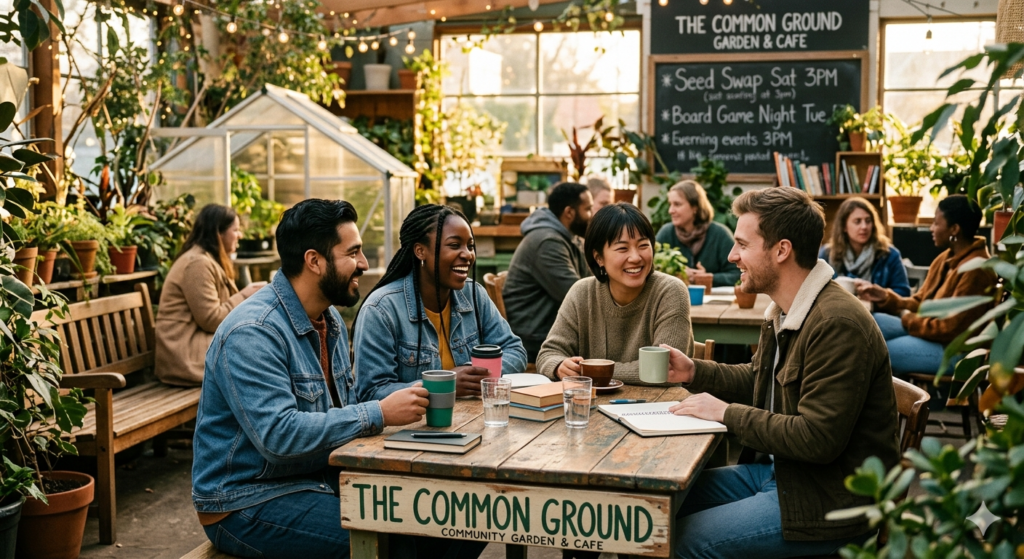
Volunteering at a local community garden or joining a neighborhood tool-share library gives you a built-in excuse to interact. You’re asking how to prune tomatoes or fix a shelf, which bypasses the awkward small talk and builds organic familiarity over time.
4. Independent Storefront Communities
Small, independent local businesses often survive by turning their retail spaces into community hubs. Local comic and board game shops host weekly open-play nights. Independent bookstores hold free poetry readings or local author spotlights. Thrifting collectives host weekend clothing swap meets. These businesses actively want you to linger because your presence creates the vibrant atmosphere that keeps them alive.
Overcoming the “Social Anxiety Tax”
Finding a space is only half the battle; the harder part is actually opening your mouth. Our generation struggles with the friction of approaching strangers, often opting to look at a phone to avoid eye contact. You can beat that social anxiety with a few tactical shifts.
First, rely on The Regular Strategy. Consistency beats charisma every single time. You don’t need to walk into a room and charm everyone. Just show up to the exact same free spot or event at the exact same time every single week. By week three or four, you become a familiar part of the landscape. Humans are hardwired to trust repetition; people will naturally start nodding hello or striking up casual conversations simply because you look familiar.
Second, use The Prop Principle. Give people an easy excuse to talk to you. If you sit at a public park picnic table scrolling your phone, you look unavailable. If you are sitting there reading a highly recognizable book, working on a sketchpad, or custom-modding a mechanical keyboard, you are handing people an open invitation to ask, “Hey, what is that?”
Finally, keep a few low-anxiety transition scripts in your back pocket. When you’ve had a good conversation with someone and want to ensure it happens again, don’t overthink it. Try these non-cringe templates:
The Group Pivot: “Hey, a few of us are walking over to grab a cheap slice of pizza down the street after this clears out. Do you want to tag along?”
The Contact Swap: “I’m trying to get out of the house and touch grass more often this summer—are you on Instagram? Let’s swap handles so I can catch you at the next meetup.”
The DIY Alternative: How to Host When You’re Broke
If your local neighborhood is a complete concrete desert lacking public spaces, you can easily manufacture your own temporary third places using what you already have.
The “Bring Your Own Ingredient” Potluck
Hosting a dinner party usually sounds exhausting and expensive. Flip the script by making it a collaborative experiment. Pick a cheap, hyper-versatile base—like a massive pot of pasta, a stack of plain corn tortillas, or a pot of white rice. Instruct every guest to bring a single ingredient that costs under $5 (a jar of sauce, a can of black beans, a block of cheese, some chopped veggies). You handle the cooking together, turning dinner into an interactive activity rather than a performance where you act as a stressed-out waiter.
De-Structured Hangouts (The “De-Compression” Night)
We need to completely redefine what it means to “host.” You do not need to entertain people, clean your apartment to a spotless shine, or provide curated playlists. Invite three or four friends over specifically to notinteract intensely.
Everyone brings whatever they were already going to do alone—their own book, a remote work laptop, a knitting project, or a video game emulator. You sit in the same room, put on some low background music, and just exist together. It offers the high comfort of a solitary night in, paired with the low-stakes warmth of human presence.
                  [ The Traditional Hangout ]
                 Expensive • Performative • Loud
                                vs.
                 [ The De-Structured Night ]
                 Free • Comfortable • Parallel
Conclusion: Friendship is an Infrastructure Project
We live in a culture that loves to internalize systemic problems. When we feel lonely, we assume it’s because we aren’t interesting enough, extroverted enough, or successful enough.
But loneliness is rarely a personal failure—it is an infrastructure failure. It is the natural result of living in cities and economies designed to keep us isolated in private spaces unless we are actively spending money.
Building a community is not about having a sparkling personality; it’s an infrastructure project. It requires finding the cracks in the commercial concrete where people are allowed to just exist for free. Pick one space, one club, or one volunteer group this week. Show up, leave your phone in your pocket for just twenty minutes, and see what happens. The best memories of your youth are almost never made in reservation-only restaurants—they happen in the weird, accidental, free spaces where real life actually takes place.