magine receiving a frantic, static-heavy phone call from your child or your company’s CFO. The voice is unmistakable—the same distinct cadence, the familiar vocal gravel, the exact pitch. They claim they are in an emergency and need a massive wire transfer or a sensitive password immediately. You comply, only to realize later that the real person was safely at their desk or asleep in bed.
This is the reality of “vishing” (voice phishing) and corporate fraud. Generative AI voice cloning tools have completely dismantled the “uncanny valley.” By analyzing only a few seconds of raw audio scraped from a public video, AI models can effortlessly synthesize human speech. Because our ears are no longer a foolproof defense, protecting ourselves from audio deepfakes requires a systematic approach. We must train our awareness to catch biological anomalies, utilize structural communication frameworks, and deploy automated forensic tools.
Mitnick Security Consulting
I. The Anatomy of an Audio Deepfake
To defeat a fake voice, you must first understand how it is constructed. Modern synthetic audio is primarily generated through two distinct methods:
- Text-to-Speech (TTS): A user types text into an interface, and a neural network—trained on hours of a specific target’s voice data—reads it aloud.
- Voice Conversion (Speech-to-Speech): A malicious actor speaks directly into a microphone, and an AI model swaps their vocal characteristics (timbre, accent, and frequency) with the target’s voice in real time.
Neural networks excel at mapping the static mathematical properties of a voice, but they struggle with the chaotic, highly dynamic physics of human biology. Traditional fraud relies on tricking your eyes; audio fraud bypasses logic by triggering an immediate emotional response to a familiar voice. This creates an exploitation vector used for high-stakes corporate wire fraud, fake political announcements, and targeted social engineering.
Passionate In Marketing
II. Level 1: The Human Ear (Acoustic Red Flags)
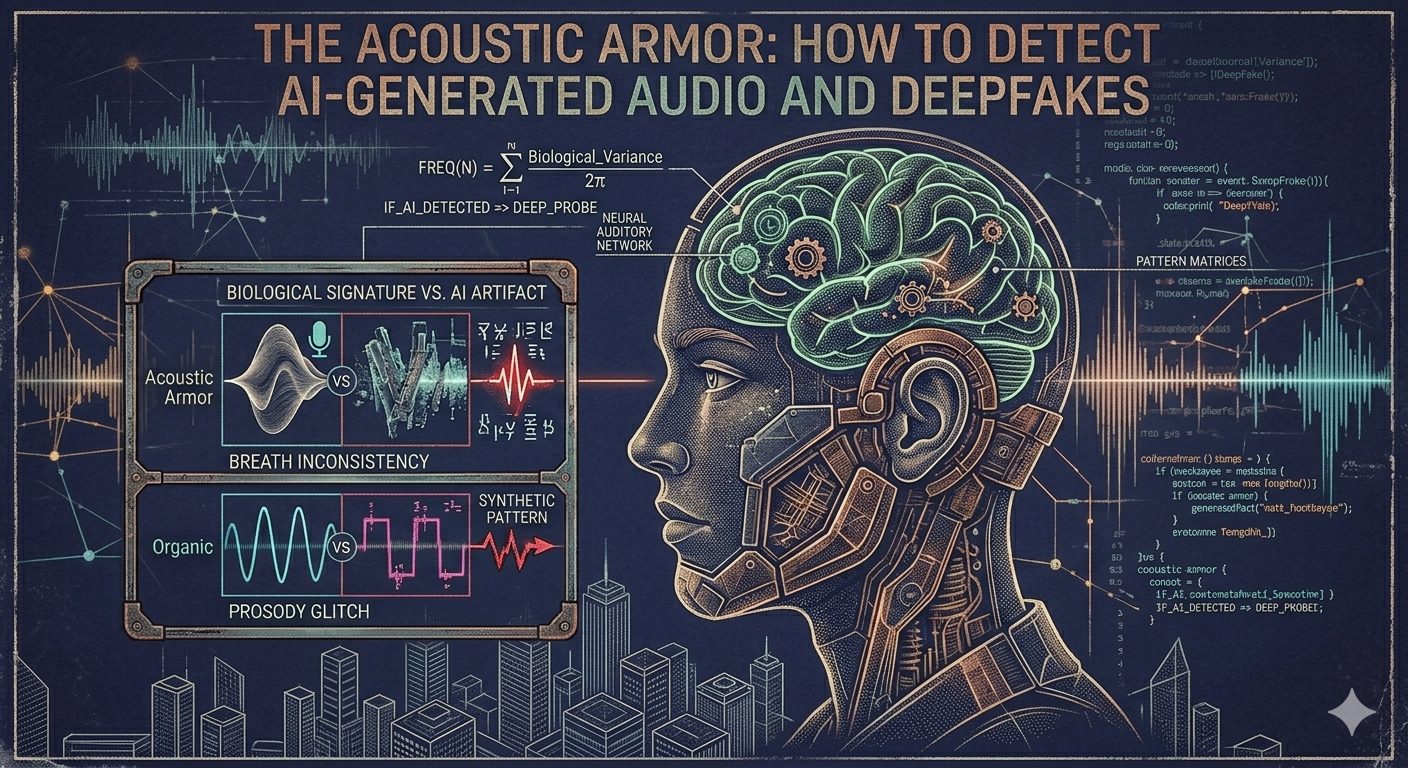
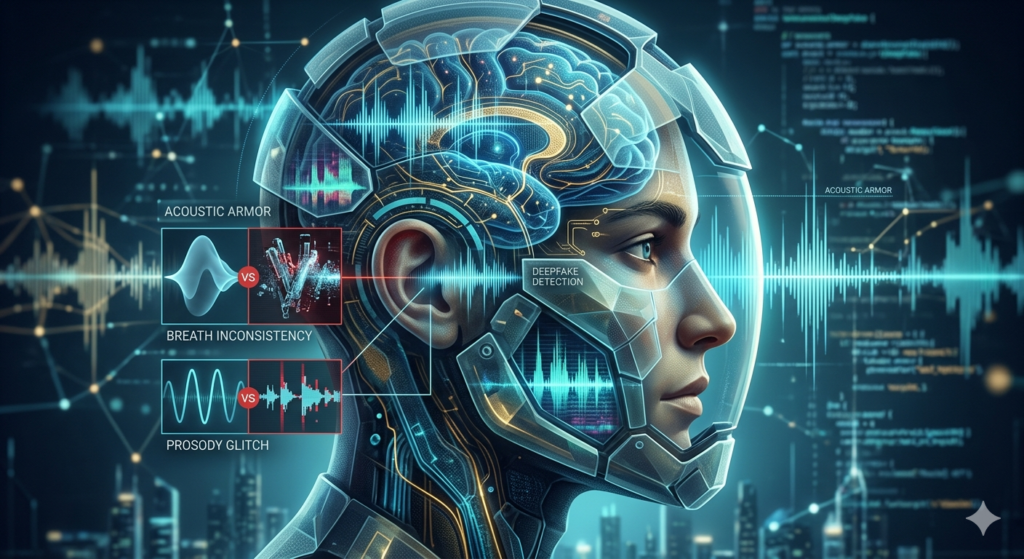
While generative models are highly sophisticated, they frequently leave microscopic digital and physical “artifacts.” If you suspect a call is fraudulent, listen closely for these four biological and physical inconsistencies:
Whisper
1. Prosody and Cadence Over-Smoothing
Prosody refers to the natural rhythm, melody, and intonation of human speech. When real people speak, their speed is chaotic. They slow down to think, elongate vowel sounds when uncertain, and naturally vary their volume to emphasize emotional points. AI audio often sounds “too perfect” or overly calculated. The cadence is uniformly spaced, lacking the micro-stumbles, filler words (“um,” “like”), and organic rhythm changes that define human conversation.
paladintech.ai
2. The “Breath Inconsistency” Tell
This is one of the most glaring flaws in synthetic speech. Humans have lungs; we must inhale and exhale to push air past our vocal cords. Pay attention to the breathing patterns:
- The Sterile Void: The audio features long, complex sentences with absolutely zero inhalation or exhalation sounds.
- The Looped Gasp: The AI generator attempts to insert artificial breath sounds, but cuts them in at unnatural grammatical moments—such as in the exact middle of a word rather than between clauses.Resemble AI
3. Acoustic Environment Mismatches
When a real person calls from a mobile device, their voice interacts with their immediate physical surroundings. If they claim to be calling from a chaotic, noisy environment like a busy street, a highway, or an airport, their voice should bounce off those surroundings. Be suspicious if the background noise sounds like a looped audio track while the speaker’s voice retains a completely sterile, studio-clean reverb profile.
4. Phoneme and Pitch Glitches
Phonemes are the distinct units of sound that form words. AI models frequently stumble over complex transitions, uncommon surnames, and technical jargon. Listen for sudden metallic clicks, brief moments of robotic stretching (asymmetry in the waveform), or sudden, unnatural pitch spikes on single syllables.
Resemble AI
III. Level 2: Behavioral and Contextual Verification
When the audio quality is too highly compressed (such as over a low-bandwidth cellular network) to hear acoustic flaws, your best defense shifts from how they sound to what they are saying.
The Psychological Trigger
Every successful audio deepfake relies on an emotional shortcut: artificial urgency. Attackers deliberately create panic—such as a legal threat, an operational crisis, or a medical emergency—to force you into a state of cognitive overload. The moment a voice actor demands that you bypass standard security protocols or corporate workflows due to a “crisis,” treat the urgency itself as a compromise indicator.
In-The-Moment Testing: The Ferrari Protocol
Named after corporate verification tactics, this protocol involves throwing off the AI generator or the live voice-conversion actor by breaking script.
- Interrupt and Pivot: Abruptly interrupt the caller with a completely random, unscripted question or a highly specific personal reference. Ask about a shared memory, an internal joke, or a non-public piece of data.
- Why it works: Interactive AI agents and live voice-swapping pipelines suffer from processing latency. Forcing the attacker to pivot on the spot will cause the system to freeze, produce severe audio lag, or give a completely nonsensical response.UncovAI
Out-of-Band (OOB) Authentication
This is the single most effective procedural control available. Never rely on the incoming connection channel to verify identity. If you receive an unusual request via an inbound call, immediately hang up. Manually initiate a new communication string through an entirely separate, pre-established channel—such as calling their personal number back directly or sending an encrypted corporate message.
Mitnick Security Consulting
IV. Level 3: Advanced Software and Forensic Detection Tools
For high-risk environments like enterprise finance, media rooms, and contact centers, human intuition must be augmented by defensive machine learning platforms.
                  ┌────────────────────────────────────────┐
                  │          Incoming Audio Feed           │
                  └───────────────────┬────────────────────┘
                                      │
            ┌─────────────────────────┴─────────────────────────┐
            ▼                                                   ▼
┌───────────────────────┐                           ┌───────────────────────┐
│  Real-Time Analysis   │                           │ Forensics & Metadata  │
│  (Live Stream/Call)   │                           │   (Post-Recording)    │
└───────────┬───────────┘                           └───────────┬───────────┘
            │                                                   │
            ├─► Latency & Packet Anomaly Check                  ├─► Spectral Spectrogram Analysis
            └─► Voice Matching (Biometrics)                     └─► Cryptographic Provenance (C2PA)
Real-Time vs. Post-Analysis Software
Modern enterprise defense splits detection architectures into two deployment layers:
- Real-Time Detection: Specialized software engines (such as Whispeak or Pindrop) integrate directly into live telephony systems and digital meeting platforms like Zoom or Microsoft Teams. They analyze the incoming stream with millisecond latency, looking for voice conversion artifacts, processing delays, and anomalies in the compressed telephony audio.UncovAI
- Post-Analysis Platforms: Enterprise deepfake defense systems (like Reality Defender or Sensity AI) perform historical forensic evaluations on media files. They convert the audio into visual spectrograms and deploy Convolutional Neural Networks (CNNs) to spot microscopic phase mismatches and mathematical imperfections hidden within the frequencies.
Understanding the Key Metric: Equal Error Rate (EER)
When auditing deepfake detection software, the primary performance benchmark is the Equal Error Rate (EER). The EER is the specific point where a system’s false acceptance rate (missing a deepfake) matches its false rejection rate(flagging a real human as a fake). The lower the EER percentage, the more accurate the tool is across diverse, real-world audio conditions.
Whispeak
The Cryptographic Shift: C2PA Provenance
The defensive landscape is steadily moving away from simply guessing what is fake and toward verifying what is authentic. Driven by the Coalition for Content Provenance and Authenticity (C2PA), modern recording devices and software platforms can now stamp audio with an immutable, cryptographic digital signature at the exact millisecond of creation. This creates an unalterable digital chain of custody, turning media verification into a pass/fail check of cryptographic metadata.
UncovAI
V. Checklist: Creating an Anti-Deepfake Protocol
To ensure your home or business is insulated against voice cloning threats, implement this structured security protocol:
| Domain | Threat Target | Actionable Protocol |
|---|---|---|
| Personal / Family | Grandparent scams, kidnapping hoaxes, urgent money requests. | The Family Passphrase: Establish a distinct, memorable phrase or word known only to your immediate family. If an emergency call is received, require the phrase before proceeding. |
| Corporate / Enterprise | Unauthorized wire transfers, payroll changes, credential harvesting. | Dual-Authorization Workflows: Mandate that no financial transfer or structural security change can be authorized solely via a voice instruction. Require secondary confirmation over an independent platform. |
| Digital Footprint | Extraction of high-quality voice samples by malicious actors. | Audio Scrape Minimization: Audit public facing videos, corporate webinars, and podcasts. Treat your public vocal footprint as a potentially compromised biometric key. |
Conclusion
The democratization of generative artificial intelligence means that anyone with an internet connection can easily duplicate a voice. However, voice cloning technology is not magical; it is a mathematical approximation of physical biology. By remaining calm during high-pressure calls, looking for acoustic glitches, enforcing strict out-of-band verification steps, and leaning on cryptographic validation protocols, you can transform your communications into an unbreachable acoustic armor.
For a deeper look into how these tools operate out in the wild, you can watch a real-world evaluation in this video demonstrating how to test an AI audio detector. It provides an excellent visual and acoustic breakdown of how software analyzes voice clones.