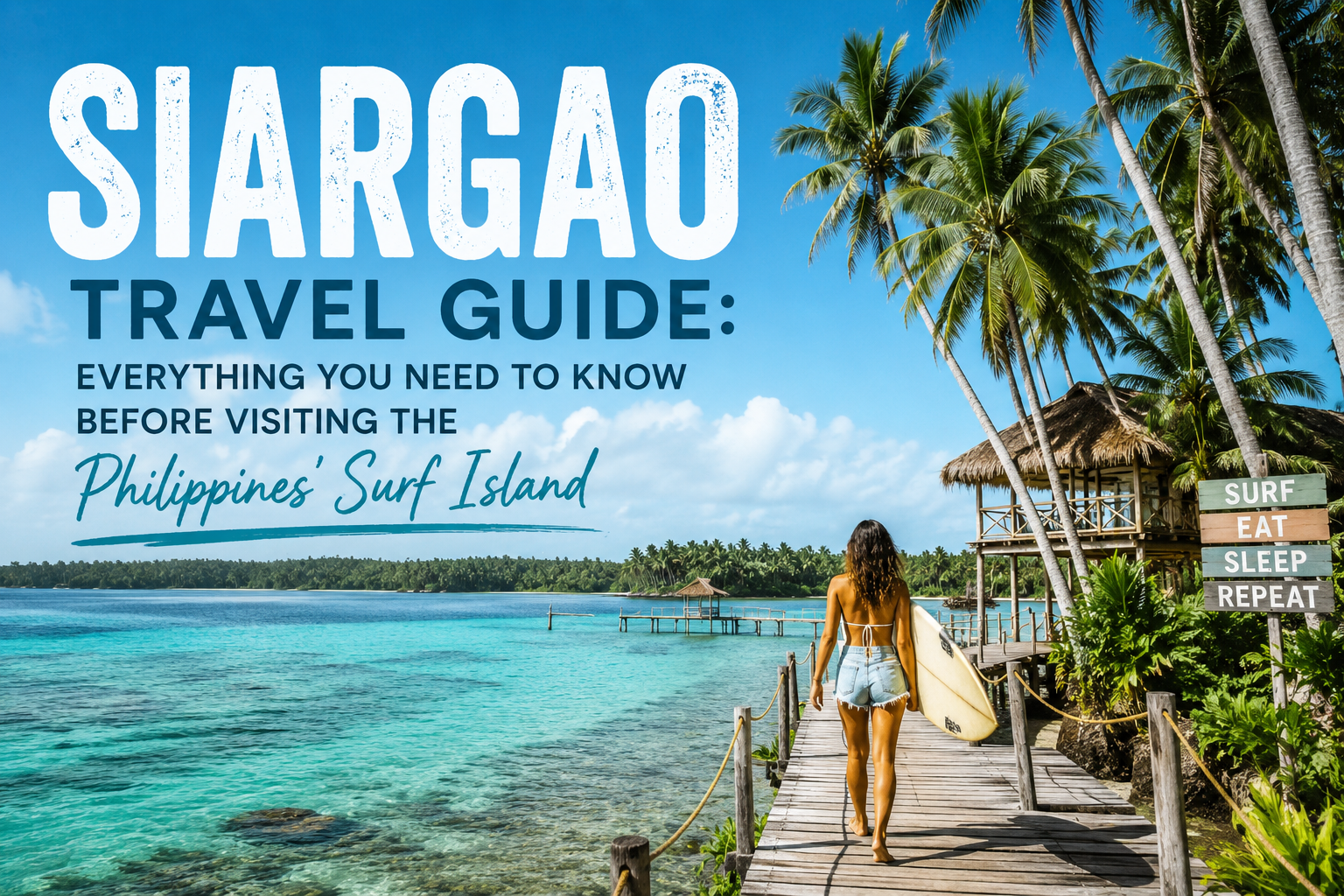
An honest, boots-on-the-ground guide to logistics, transit pivots, and local rhythms for international travelers.
There is a specific moment when you realize Siargao is different from almost any other tropical escape in Southeast Asia. It usually happens when you are riding down a narrow asphalt road flanked by hundreds of thousands of leaning coconut palms, the salty Pacific breeze cutting through the humid air, passing locals who greet you with a genuine wave rather than a practiced sales pitch. Unlike destinations that reconfigured their entire identity to serve mass commercial tourism, Siargao managed to grow around its community. It remains raw, beautifully stubborn, and deeply addictive.
Originally pulled from obscurity by intrepid surfers who stumbled upon its legendary right-hand reef breaks in the late 1980s, this tear-shaped island in the Philippine Sea has evolved. Today, it captures the hearts of digital nomads, cafe gourmands, and eco-conscious souls alike. Yet, navigating a trip here as an international traveler requires explicit, updated knowledge. Things change quickly here, and assuming it operates like Phuket or Boracay will leave you stranded without cash or missing a flight. This guide is your realistic blueprint to making the island home, even if only for a week.
1. Entry Requirements & Bureaucracy
Landing in the Philippines as an international tourist is relatively straightforward, provided your paperwork matches the strict expectations of immigration officials. Travelers from over 150 nations—including the United States, Canada, the United Kingdom, Australia, New Zealand, and most EU member states—are granted a visa-free stay of up to 30 days upon arrival.
However, the country enforces two non-negotiable rules at the border. First, your passport must have at least six months of validity remaining from your date of entry. Second, you must present proof of onward travel. This means a confirmed outbound flight ticket out of the Philippines dated within that 30-day window. Airlines will routinely deny boarding at your point of origin if you cannot produce this ticket.
The Mandatory eTravel Portal Every international traveler must register via the official Philippine government eTravel portal (etravel.gov.ph) within 72 hours before arrival. The registration generates a QR code that customs officials will scan. Crucial Warning: This system is completely free. Avoid third-party lookalike websites that attempt to charge a processing fee; ensure you are using the official .gov.ph domain.
If you find yourself captured by the island’s charm and wish to extend your stay beyond the initial 30 days, you can apply for a 29-day extension, giving you a total of 59 days. Note that there is no Bureau of Immigration office on Siargao itself. You will need to take a ferry or short flight over to Surigao City or Butuan City on the Mindanao mainland to process the extension, or work with a trusted local travel agency in General Luna that offers visa run processing for a fee.

2. When to Go: Aligning Weather with Your Travel Style
Siargao doesn’t follow the clean-cut dry and wet seasons found in western parts of the Philippines like Manila or Palawan. Instead, its proximity to the Philippine Trench gives it a more dynamic, tropical rainforest climate. Picking the right window changes your entire experience.
The Dry & Glassy Months (March to May)
Often referred to as the local summer, this period offers the most stable hot weather and clear blue skies. The sea transforms into a calm, mirror-like pool, making it absolutely perfect for island-hopping, free-diving, and swimming in the rock pools. The downside? Serious surfers will find the waves too small or entirely flat.
The Longboard & Shoulder Season (June to July)
This is arguably the sweet spot for general travelers and beginner surfers. The days are predominantly sunny with occasional tropical showers in the afternoon. The swell begins to wake up, bringing gentle, clean waves that are exceptionally forgiving for those learning to stand up on a board or longboarders who prefer relaxed lines.
Peak Surf Season (August to November)
As the southwest monsoon sets in, the island transforms into a high-energy surf haven. The Pacific Ocean begins hurling massive, consistent groundswells toward the reef. This peaks around late September and October, when the iconic Cloud 9 break produces world-class, heavy hollow barrels. This is also when the island hosts its international surfing competitions. While the atmosphere is electric, expect higher accommodation prices, crowded breaks, and an increasing frequency of evening rainstorms.
The Wet Monsoon Window (December to February)
Driven by the northeast monsoon (Amihan), these months bring heavy rains, strong winds, and rough seas. While the island is lush and uncrowded, many boat excursions are canceled for safety reasons, and power outages become more common. Unless you are an experienced surfer chasing specific winter swells, it is generally recommended to avoid this period.
3. The Master Transit Plan: Getting to the Island
Getting to Siargao requires a multi-leg journey, as Sayak Airport (IAO) on the island has a relatively short runway that only accommodates smaller, regional turboprop aircraft. There are no direct international flights to the island.
Crucial Aviation Update Older travel blogs heavily recommend booking direct flights from Manila’s primary airport (NAIA) to Siargao. However, regional airline route reorganizations have significantly reduced turboprop availability directly out of NAIA’s main terminals, making these flights rare or prone to severe weight-restriction delays. To avoid terminal confusion and lost baggage, travelers should route via alternative domestic hubs.
The Cebu Shortcut (Highly Recommended)
The most seamless way to reach Siargao is to book your international flight into Mactan-Cebu International Airport (CEB) instead of Manila. Cebu’s domestic terminal is modern, highly efficient, and offers multiple daily 55-minute shuttle flights directly to Siargao via Cebgo (Cebu Pacific’s regional arm) and Philippine Airlines. It removes the stress of transiting through Manila entirely.
Handling the Airport Transfer
Once your plane touches down at Sayak Airport, the hard work is done. Stepping out of the small terminal, you will find rows of air-conditioned passenger vans lined up. They charge a flat rate of roughly PHP 300 (around $5 to $6 USD) per person to drop you directly at the door of your accommodation in General Luna, which takes about 45 minutes.
4. Island Logistics: Money, Connectivity, & Transport
Siargao operates at its own pace, and its infrastructure, while rapidly improving, still has rustic limitations that require a bit of strategic preparation.
The Cash Dilemma
Despite the proliferation of trendy cafes and upscale boutique resorts, Siargao remains a cash-driven economy. Local eateries, market vendors, surf instructors, tricycle drivers, and boat captains do not accept plastic. ATMs in the primary tourist area of General Luna frequently run out of physical currency or lose connection during power flickers or busy holiday weekends. Do not arrive on the island empty-handed. Withdraw or exchange an ample amount of Philippine Pesos while you are transiting through the airports in Manila or Cebu.
Staying Connected
If you need reliable internet, pick up a local SIM card (Globe or Smart) or activate an eSIM prior to arrival. While 4G and 5G signals are strong along the main roads of General Luna, inland areas can be complete dead zones. Fortunately, an increasing number of workspaces, hotels, and cafes have installed Starlink satellite internet, making the island highly viable for digital nomads, though carrying a backup power bank is smart due to occasional short power brownouts.
Getting Around Safely
The absolute freedom of Siargao is best experienced on two wheels. Scooter rentals are everywhere, averaging PHP 350 to PHP 500 per day. However, local authorities have tightened regulations: you legally must possess an International Driving Permit (IDP) alongside your home driver’s license, and wearing a helmet is strictly enforced with steep fines. If you are uncomfortable riding a scooter, you can easily flag down a motorized tricycle or a habal-habal (motorcycle taxi) for short hops along Tourism Road.
5. The Ultimate Siargao Bucket List
While surfing dominates the conversation, the island’s geographical diversity ensures that non-surfers have an equally packed itinerary.
The Cloud 9 Boardwalk
Even if you have never touched a surfboard, visiting the multi-tiered wooden pier at Cloud 9 is essential. It provides a front-row seat to the local and international pros carving up fast, heavy barrels over shallow coral reef. For beginners, walk just a few hundred meters down to Jacking Horse or Secret Spot, where local coaches will patiently guide you through the whitewater for about PHP 500 an hour, board included.
The Tri-Island Expedition
This classic full-day boat tour takes you to three distinct islets visible from the shores of General Luna. Naked Island is a completely bare, blindingly white sandbar surrounded by neon-blue water. Daku Island is a massive, postcard-perfect paradise covered in leaning palms where your crew will prepare a fresh seafood feast of grilled fish, crabs, and local fruits. Finally, Guyam Island is a miniature, private-feeling oasis that you can walk across in less than two minutes, ideal for a sunset drink.
Sugba Lagoon
Located on the northwestern side of the island in Del Carmen, this sweeping lagoon is tucked inside an ancient, labyrinthine mangrove forest. The water here is a deep, surreal shade of jade-turquoise. Spend an afternoon renting stand-up paddleboards, kayaking into hidden coves, or gathering the courage to leap off the famous two-story wooden diving platform built in the center of the lagoon.
Magpupungko Rock Pools
Located in the town of Pilar, these natural limestone tidal pools are entirely dependent on the ocean’s rhythm. At high tide, they look like ordinary ocean waves crashing against cliffs. But as the tide recedes, it reveals crystalline, completely still swimming holes separated from the roaring ocean by a natural rock barrier. Always consult a local tide table before making the one-hour drive; entering during high tide is impossible and dangerous.

6. Food, Nightlife, & Eco-Cultural Etiquette
What surprises most international visitors is the sheer caliber of Siargao’s culinary scene. Driven by an influx of creative foreign expats partnering with passionate local chefs, the island serves up everything from authentic wood-fired Neapolitan pizzas and sourdough bakery treats to nutrient-dense plant-based smoothie bowls.
The nightlife holds a very specific charm. Instead of a strip of loud, competing bars, the island practices a unique community rotation. Every night of the week belongs to a specific venue—an acoustic night at a beachfront lounge on Tuesday, a loose jungle party on Thursday, or a high-energy DJ set at an open-air venue on Saturday. It keeps the community unified; everyone on the island, locals and tourists alike, naturally ends up at the exact same spot by midnight.
Finally, respect the local ecosystem. Siargao has fought hard to avoid environmental degradation. Single-use plastics are banned or heavily discouraged by local ordinance across most establishments. Pack a durable reusable water flask, opt exclusively for reef-safe sunscreens that do not bleach the delicate marine ecosystems, and remember that you are a guest in a fragile, beautifully balanced island community. Pack out what you pack in, support local businesses directly, and match the island’s slow, generous cadence.