Behind the Gates: Inside the Philippines’ Most Exclusive “Old Money” Enclaves
Drive through the right streets in Makati on a quiet Sunday morning and you’ll notice something odd. No jeepneys. No tricycles weaving through traffic. Just wide, tree-lined roads, century-old acacia trees casting shade over high concrete walls, and the occasional black SUV rolling slowly past a security booth. You won’t hear anyone honking. You won’t see a single sari-sari store.
That’s how you know you’ve wandered into a different Philippines entirely.
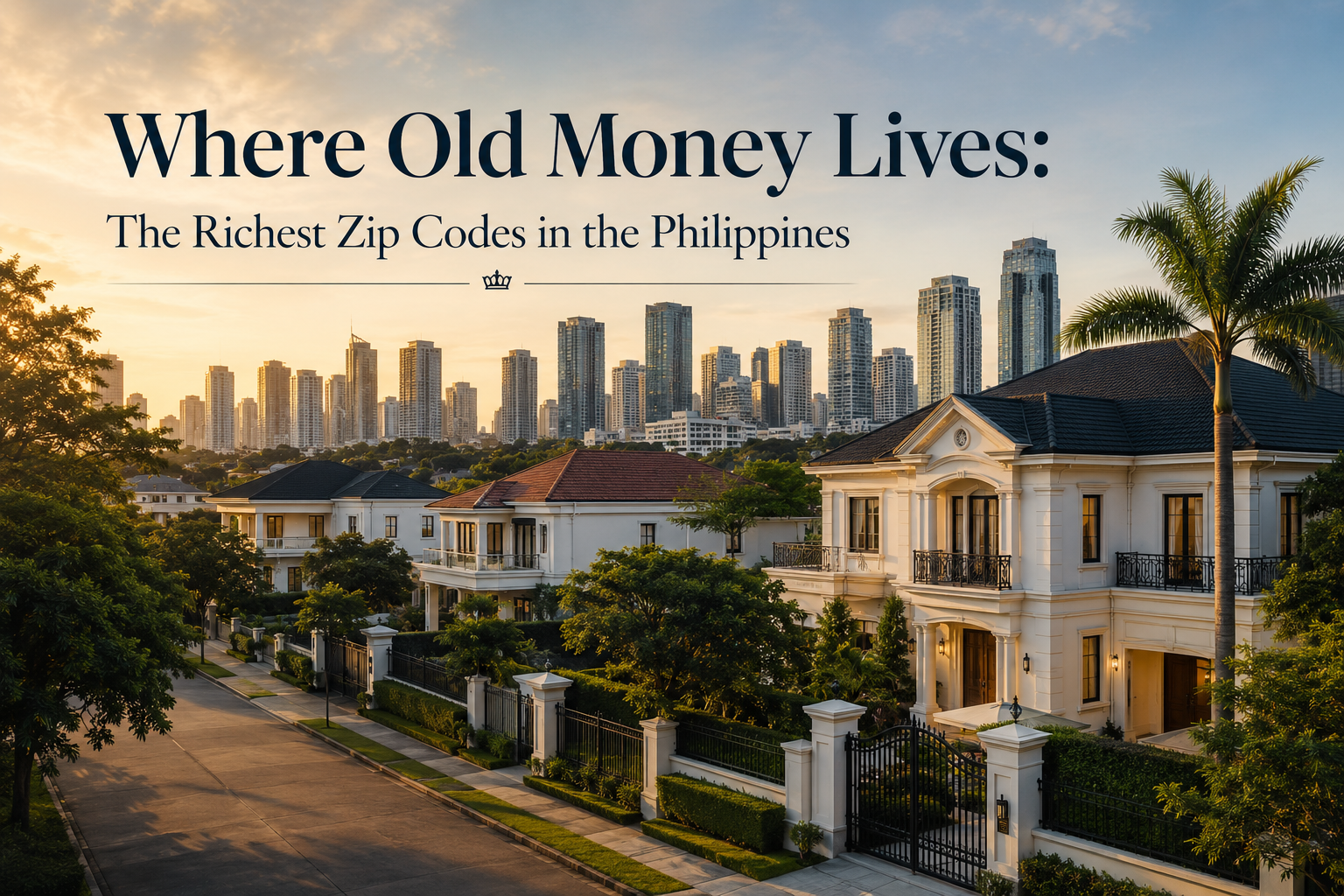
The country’s wealthiest families have always had an address. And while the rest of Metro Manila has been scrambling for space — building upward, inward, wherever — these zip codes have stayed more or less the same. Exclusive. Quiet. Stubbornly expensive. If anything, property values have just kept climbing, year after year, with barely a dip.
Here’s a look at the areas where the Philippine one percent actually live — not just where they work, not where they’re photographed, but where they go home at night.

Forbes Park, Makati — 1210
Let’s start with the obvious one.
If you’ve ever heard a Filipino casually drop the phrase “Forbes Park” in conversation, you already know what it means. It’s shorthand for a certain kind of wealth — old, established, the kind that doesn’t need to announce itself. <cite index=”4-1″>The subdivision has been called the “Beverly Hills of Manila,” and for good reason: many of the country’s wealthiest families, along with foreign diplomats and business executives, call it home.</cite>
<cite index=”4-1″>Forbes Park was established in the 1940s and named after William Cameron Forbes, the fifth American governor-general of the Philippines.</cite> It stretches across 250 hectares — divided into North and South by McKinley Road — and sits right between the Makati CBD and Bonifacio Global City. Location-wise, it doesn’t get better than that.
<cite index=”5-1″>Among the notable residents who’ve lived there: business tycoon Antonio “Tony Boy” Cojuangco, Bench founder Ben Chan, and boxing icon Manny Pacquiao.</cite> The list goes on, though most Forbes Park residents prefer their privacy, which is sort of the whole point.
<cite index=”8-1″>The streets are so quiet and secure they promise a life of privacy and comfort. Trees — some over half a century old — define the feel of the whole district.</cite> And if you live there and want to unwind without leaving your bubble, <cite index=”5-1″>the Manila Polo Club and the Manila Golf and Country Club are right inside.</cite>
As for what it costs to actually live here: <cite index=”7-1″>as of the first half of 2024, the price per square meter in Forbes Park hovers around PHP 700,000.</cite> A modest house on a decent lot? You’re looking at hundreds of millions of pesos — minimum. <cite index=”9-1″>The 2024 price range for properties runs from PHP 300 million to PHP 1.2 billion.</cite>
That’s not a typo.
Dasmariñas Village, Makati — 1221
Right next door to Forbes is Dasmariñas — or “Dasma,” as everyone calls it — and it has its own distinct personality.
<cite index=”2-1″>Developed by Ayala Corporation in the ’60s, Dasmariñas sits at the center of EDSA, McKinley Road, Forbes Park, and Ecology Village.</cite> The location is almost comically convenient: close to embassies, international schools, the airport, and both Makati and BGC’s business districts.
<cite index=”7-1″>Within the village are two scenic parks — Campanilla Park and Mahogany Park — along with sports and recreation amenities including a gym, basketball, badminton, and tennis courts.</cite> It’s also a popular address for foreign diplomats and expats, partly because of how close it is to the various embassy compounds in the area.
Property prices here are only slightly more approachable than Forbes — and by “slightly,” we mean the difference between a lottery win and a very big lottery win. <cite index=”7-1″>By the first half of 2024, the price per square meter in Dasmariñas Village had reached an average of PHP 600,000.</cite>
Urdaneta Village, Makati — 1229
Urdaneta doesn’t get as much attention as Forbes or Dasma, but people who know Makati real estate will tell you it’s one of the most sought-after addresses in the country.
<cite index=”7-1″>It’s one of the smallest yet most exclusive villages near Makati’s CBD, offering elegant homes along with amenities like a clubhouse and basketball courts.</cite> What makes it particularly interesting is the policy that defines daily life there: <cite index=”5-1″>the village strictly prohibits the operation of commercial institutions within its neighborhoods.</cite> No restaurants opening up next door. No offices. No noise from retail foot traffic. Just homes, and the kind of peace that comes from living in a place that’s been deliberately kept that way.
<cite index=”7-1″>Located just across Ayala Triangle Park, it’s close to premier hotels like Discovery Primea and the Peninsula Manila, plus shopping destinations like Glorietta, Greenbelt, and Shangri-La Makati.</cite>
<cite index=”9-1″>The 2024 price range for Urdaneta Village properties runs from PHP 35 million to PHP 756 million</cite> — a wide spread that reflects everything from smaller lots to full-on mansion territory.
Bel-Air Village, Makati — 1209
Bel-Air has a story behind it that most people don’t know. <cite index=”5-1″>It was originally developed for the Philippine Airlines Pilots Union, built on the site of the former Neilson Airport — the country’s only airport during the American period. They wanted the word “Air” in their enclave’s name, and the name stuck.</cite>
Today, Bel-Air is one of the most consistently well-maintained villages in Makati. <cite index=”5-1″>Barangay Bel-Air has been awarded the cleanest and greenest barangay in Makati for eight consecutive years and was inducted into the Makati Clean and Green Hall of Fame in 2005.</cite> That’s not an accident — it reflects a community that actually takes upkeep seriously.
<cite index=”2-1″>It’s described as Makati’s hip and laid-back side, with a cozy community feel. From brunch spots to speakeasy lounges, nearby areas like Legazpi Village have plenty of hangouts popular with young professionals</cite> — and Bel-Air residents benefit from that same energy without being in the middle of it.
<cite index=”7-1″>The average price per square meter in Bel-Air Village as of the first half of 2024 is PHP 480,000.</cite>
San Lorenzo Village, Makati — 1223
San Lorenzo — or “SanLo” if you’re from around there — sits in one of the wealthiest barangays in the country and has a slightly different character from its neighbors.
<cite index=”7-1″>Primarily commercial in land use, this vibrant village hosts over 8,000 business establishments, ranging from small enterprises to the headquarters of major corporations.</cite> It’s less of a purely residential enclave and more of a hybrid — which makes it a draw for business owners who want to live close to where they work, literally.
The area around San Lorenzo bleeds into some of the most expensive commercial real estate in Metro Manila, which naturally keeps residential values high. It’s one of those zip codes that doesn’t need much explaining — the address does the talking.
Bonifacio Global City (BGC), Taguig — 1634
BGC is the newest kind of wealth on this list — not old-money quiet, but loud, shiny, and unapologetically modern. And it has moved very, very fast.
<cite index=”2-1″>Bonifacio Global City started development in 1995. Today, the district has grown to become a financial and lifestyle hub home to several residential condominiums such as 8 Forbes Town Road, Bellagio, Essensa, Serendra, Pacific Plaza Towers, One McKinley Place, and The Luxe Residences.</cite>
What BGC offers that the old Makati villages don’t is scale and lifestyle infrastructure built from scratch — wide pedestrian lanes, bike paths, art installations, rooftop bars, international schools, and a density of high-end restaurants that rivals anything in Southeast Asia. The streets are planned. The greenery is intentional. Even the traffic, while still Manila-level painful, is better managed than most of the metro.
<cite index=”6-1″>Houses in the McKinley Hill area within Taguig — close to BGC — range from PHP 40 million to PHP 150 million.</cite> Condominiums in BGC proper vary widely depending on the building, but high-floor units in prestige towers regularly trade in the hundreds of millions.
Wack-Wack Greenhills, Mandaluyong — 1550
The name catches people off guard every time. Wack-Wack. It comes from the Filipino word uwak, meaning crow — <cite index=”2-1″>the area gets its name from the crows that used to populate the area.</cite> The crows are long gone, replaced by some of the most expensive real estate on the eastern side of Metro Manila.
<cite index=”2-1″>The neighborhood of Wack-Wack Greenhills sits between Addition Hills and Ortigas Avenue</cite> — well-positioned between Makati and Ortigas, which makes it convenient without being in the thick of either. The Wack-Wack Golf and Country Club anchors the neighborhood, and the whole area has that old-Mandaluyong-money feel that doesn’t get enough credit.
McKinley Hill, Taguig — 1634
McKinley Hill is BGC’s quieter, more residential neighbor — and for people who want the Taguig lifestyle without the full density of BGC’s commercial bustle, it’s become a genuinely compelling option.
<cite index=”2-1″>The town of McKinley Hill overlooks Makati and Bonifacio Global City. With only about 1,458 residents, McKinley Hill is one of the most sparsely populated neighborhoods on the list</cite> — which, in Metro Manila terms, is almost surreal. Space is the ultimate luxury in this city, and McKinley Hill has it.
<cite index=”9-1″>Modern and smart homes within a well-planned, secure subdivision define the McKinley Hill lifestyle. The 2024 price range runs from PHP 7.5 million to PHP 120 million</cite> — which, relative to the other neighborhoods on this list, makes it one of the more “accessible” entry points into this tier of Philippine real estate. (Accessible is relative. We’re still talking millions of pesos.)
Valle Verde, Pasig — 1605
Valle Verde is the only address on this list that sits entirely in Pasig — and it holds its own against the Makati names without any trouble.
<cite index=”5-1″>The only subdivision in Pasig that can be considered truly upscale and exclusive, Valle Verde comprises six mini-villages, all of which sit very close to Ortigas Center, Capitol Commons, and Eastwood City.</cite> It’s popular with a certain kind of Pasig-Ortigas professional class — people who work east of the Makati CBD and don’t want the commute that comes with living in the southwest.
<cite index=”9-1″>Exclusive access to the Valle Verde Country Club — with high-end restaurants, event venues, and recreational courts — is one of the major lifestyle draws.</cite> The community is tight-knit in the way that older subdivisions tend to be: multigenerational families, long-term residents, and a general sense that people here aren’t going anywhere anytime soon.
Ayala Alabang, Muntinlupa — 1780
And then there’s Ayala Alabang — the outlier that makes every other subdivision on this list look small.
<cite index=”5-1″>At approximately 700 hectares, Ayala Alabang Village is larger than all of Makati’s primary subdivisions combined.</cite> Seven districts. Thirteen parks. Sports facilities including swimming pools, basketball courts, tennis courts, and football fields. The Alabang Country Club. And Alabang Town Center — one of the more pleasant malls in Metro Manila — sitting right inside its boundaries.
<cite index=”7-1″>The average price per square meter in Ayala Alabang as of 2024 is PHP 350,000</cite> — lower per square meter than Forbes or Dasma, but the lots here are enormous. The total price tag on a proper Ayala Alabang home can still run into the hundreds of millions.
There’s also a particular kind of family that gravitates toward Ayala Alabang: usually with kids, usually choosing schools in the south, often with a preference for space over urban convenience. The trade-off is the SLEX commute, which is its own particular form of suffering — but residents seem to have accepted that as the cost of living somewhere that actually feels like you have room to breathe.
A Few Things Worth Saying Out Loud
What ties all of these places together isn’t just price — it’s proximity to money. Every zip code on this list sits near a CBD, a lifestyle hub, or a major road artery. The Philippine wealthy, it turns out, don’t retreat into the mountains. They stay close to the action, wrapped in gates and greenery, with a security guard at every entrance.
What’s also notable is how stable these addresses are. <cite index=”2-1″>Since Makati’s development in the ’50s, real estate values have just risen and risen.</cite> The families that bought into Forbes Park or Dasma decades ago made what turned out to be some of the best real estate investments in the country’s history. Land in these areas doesn’t depreciate. It barely even slows down.
For everyone else — the vast majority of Filipinos who will never live behind those gates — these zip codes function as a kind of economic landmark. A measure of where the ceiling is. A reminder of how concentrated wealth really is in this country, and how neatly it maps onto a handful of streets in one corner of Metro Manila.
The gates are tall for a reason.
Sources: eCompareMo/ZipMatch Real Estate Data; Santos Knight Frank Metro Manila Property Market Report 1H 2024; Lamudi Philippines; Hoppler Philippines; Wikipedia.
Property prices referenced are based on available 2024 market data and are subject to change. This article is for informational purposes only.