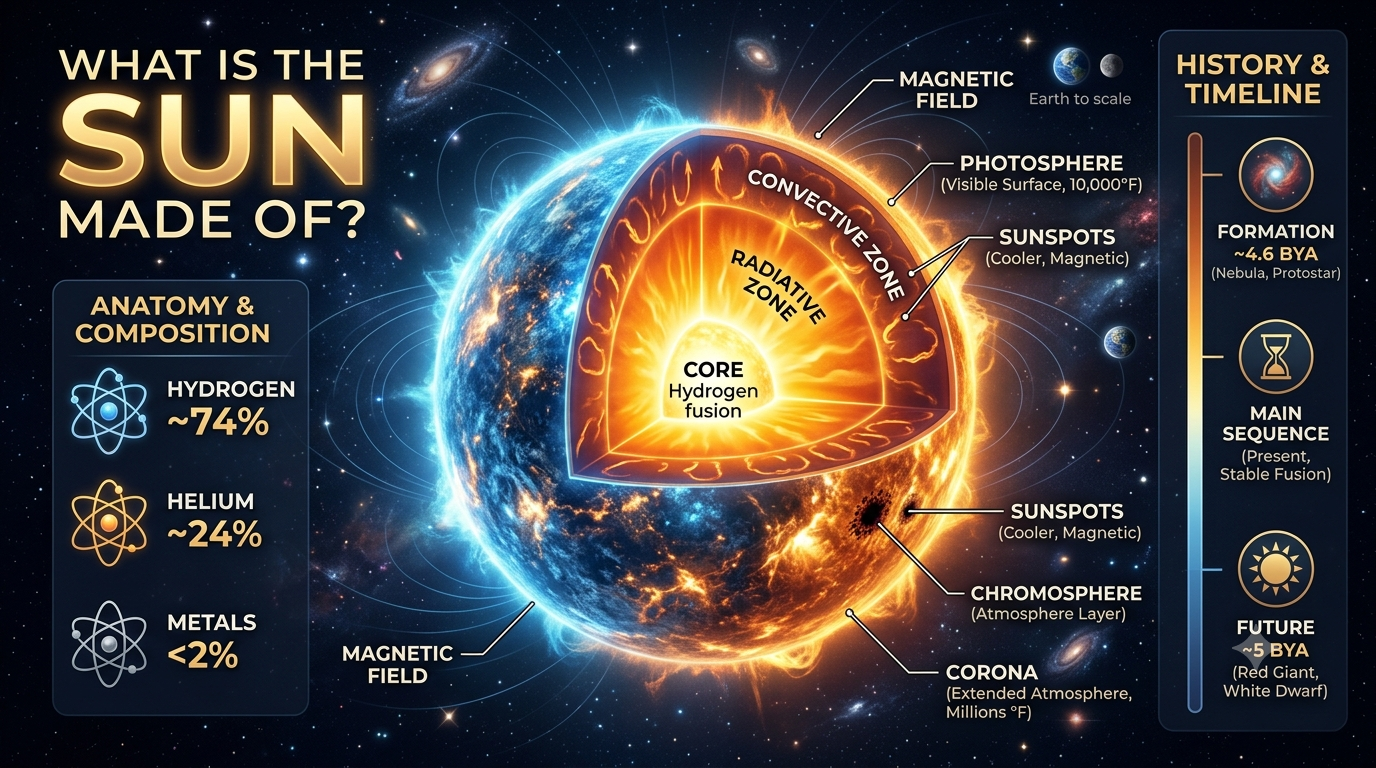
Complete Biography and Explainer of Our Nearest Star
We tend to treat the Sun like a permanent, static fixture of the sky—a reliable cosmic lightbulb that clicks on in the morning and off at night. But if you could zoom in close enough to feel its true scale, you wouldn’t see a calm, glowing orb. You would see a churning, violent, magnetic engine.
I remember stepping outside during the solar eclipse a few years back; even when the moon blocked out almost the entire disc, the remaining sliver of light was bright enough to sting your eyes. It was a visceral reminder that the Sun is a dynamic ball of plasma actively shaping every square inch of our solar system. Understanding it isn’t just an exercise for astronomers; it is the story of our own climate, our technology, and the very boundary between life and a frozen, silent rock.
Here is the complete biography of the star that makes everything we know possible.
1. Quick Reality Check: The Sun by the Numbers
Instead of a dry spreadsheet, it helps to look at the raw, mind-boggling scale of this thing to realize just how tiny we are:
- Its Age: It’s hovering around 4.6 billion years old. Basically, our star is comfortably coasting through its middle-age years.
- The Blueprint: Astronomers officially classify it as a G-type main-sequence star—or a Yellow Dwarf. Don’t let the “dwarf” label fool you, though.
- An Absolute Heavyweight: The Sun is a massive cosmic hog, commanding roughly 99.8% of all the actual matter in the entire solar system. If you wanted to scoop out its insides, you could comfortably pack about 1.3 million Earths into the empty shell.
- The Long Commute: It sits roughly 93 million miles away from us. To put that in perspective: when a packet of light escapes the Sun’s surface, it flies through the vacuum of space at a blinding 186,000 miles per second and stilltakes about 8 minutes and 20 seconds to hit your face.
2. Anatomy of a Star: What’s Inside the Sun?
Think of the Sun less like a solid rock and more like a hyper-pressurized onion made entirely of hot, electrified gas (plasma). It’s split into distinct layers that behave in some truly bizarre ways.
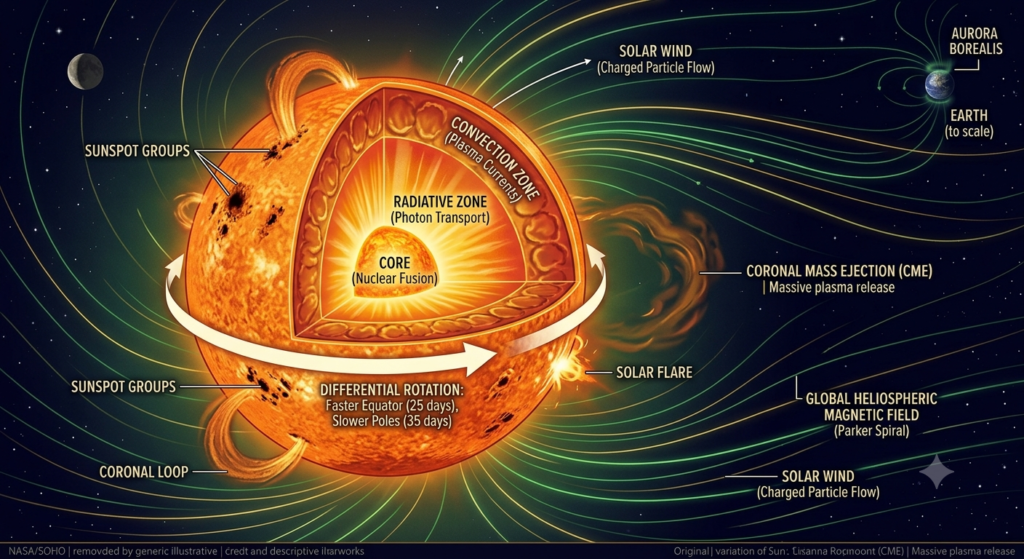
A. The Interior Layers
- The Core: This is the engine room. At the absolute center, the pressure is so crushing and the temperature so extreme—reaching 27 million°F (15 million°C)—that hydrogen atoms are physically forced to smash together. This process, known as nuclear fusion, creates helium and releases an unfathomable amount of energy. It is the purest form of nuclear power in the universe.
- The Radiative Zone: Surrounding the core is a layer so incredibly dense that energy cannot flow through it easily. Instead, light particles (photons) bounce around like balls in a chaotic, hyper-speed pinball machine. A single photon can take 100,000 years just to wander its way out of this layer.
- The Convective Zone: Here, the density drops, and the energy changes how it moves. It behaves like a cosmic lava lamp. Huge currents of boiling plasma rise to the surface, cool down, and sink back toward the interior to be heated again.
B. The Atmosphere and Surface
- The Photosphere: This is what we see as the “surface” of the Sun. It is a turbulent crust of boiling plasma bubbles. Ironically, it is the coolest part of the Sun, sitting at a relatively mild 10,000°F (5,500°C).
- The Chromosphere: A thin, reddish layer just above the surface that shoots out massive spikes and loops of superheated gas.
- The Corona: The Sun’s outermost atmosphere, which stretches millions of miles into space. The corona presents a famous paradox: even though it is farther from the core than the surface, its temperature suddenly spikes back up to millions of degrees. Scientists are still actively researching exactly why the corona gets so fiercely hot.
3. History: The Biography of Our Star
Stars aren’t permanent fixtures; they are born, they live under a strict set of physical laws, and eventually, they run out of fuel.
A. The Birth (4.6 Billion Years Ago)
Long before the planets existed, there was only a massive, cold, dark cloud of interstellar gas and dust. A nearby cosmic event—perhaps the shockwave of a dying supernova—caused this cloud to destabilize and collapse under its own gravity. As the matter packed tighter and tighter into the center, it spun faster, grew hotter, and formed a protostar. Eventually, the core became so hot and pressurized that the “spark” of nuclear fusion ignited. The Sun was born.
B. The Present Day: A Perfect Balance
Right now, the Sun is in its prime, a phase astronomers call the main sequence. It stays a perfectly round, stable shape because of a concept called hydrostatic equilibrium.
Think of it as a permanent cosmic tug-of-war:
- Nuclear fusion in the core is constantly exploding outward, trying to blow the star apart.
- Gravity from the massive weight of the star is constantly crushing inward, trying to collapse it into a point.
Because these two forces are perfectly matched, the Sun remains stable, providing a steady stream of heat and light that allowed life on Earth to evolve over billions of years.
C. The Timeline of the Future
The Sun is slowly using up its hydrogen fuel. While it won’t happen tomorrow, its timeline has a definitive end:
- In 1 Billion Years: The Sun will gradually brighten by about 10%. This small change will trigger a runaway greenhouse effect on Earth, boiling our oceans and ending life as we know it.
- In 5 Billion Years: The core will completely run out of hydrogen. Gravity will win the tug-of-war, crushing the core down. This sudden collapse will heat the outer layers so intensely that they will balloon outward. The Sun will become a Red Giant, expanding so far into space that it will swallow Mercury, Venus, and likely Earth.
- The End: Eventually, the outer layers will puff away into space, creating a beautiful ring of glowing gas called a planetary nebula. All that will be left at the center is a tiny, dense, cooling ember about the size of Earth, known as a White Dwarf. It will slowly fade into the darkness over trillions of years.
4. The Active Sun: Space Weather and Magnetism
The Sun isn’t just a glowing lightbulb; it is a magnetic monster. Because the Sun is made of fluid plasma rather than solid rock, its equator rotates faster (about 25 days) than its poles (about 35 days). This uneven spinning twists and tangles the Sun’s massive magnetic field like a ball of yarn.
Every 11 years, this magnetic tension builds to a peak—a cycle that flips the Sun’s north and south magnetic poles. This cycle creates distinct solar features:
- Sunspots: Dark, relatively cool patches on the surface where intense magnetic fields break through, temporarily blocking the upward flow of heat.
- Solar Flares: Sudden, blinding flashes of energy caused by the snapping of tangled magnetic lines.
- Coronal Mass Ejections (CMEs): Giant bubbles of magnetized plasma blasted into space at millions of miles per hour.
[Solar Flare/CME] ---> Travels through space ---> Hits Earth's Magnetic Field ---> Aurora / Grid Stress
When a CME hits Earth, our planet’s magnetic shield deflects most of it, funneling the particles toward the poles. Personally, I remember watching the news during the massive solar storms of May 2024 when people were catching vibrant pink and green auroras as far south as Florida and southern Europe. It’s wild to realize that a magnetic “burp” from 93 million miles away can literally repaint our night sky.
However, there’s a dark side to this beauty: a severe enough solar storm can induce massive electrical currents right on the ground, threatening to blow out power grids, fry satellite electronics, and completely disrupt global GPS systems.
5. How We Study It: Humanity’s Eyes on the Sun
For most of human history, looking directly at our star was impossible or dangerous. Early civilizations worshipped it, and astronomers like Galileo risked their eyesight drawing sunspots through early telescopes.
Today, we study the Sun using a fleet of advanced space probes. Two groundbreaking missions are rewriting the textbooks right now:
- NASA’s Parker Solar Probe: Launched to do the unthinkable, this heavily shielded spacecraft flies directly through the outer corona, surviving extreme radiation to gather data on solar winds.
- ESA’s Solar Orbiter: This spacecraft takes high-resolution images of the Sun’s elusive polar regions, helping us map out the magnetic engine in real-time.
The Big Sun Takeaway
It is easy to think of the Sun as an ordinary, middle-aged star—and in the grand scheme of a universe filled with trillions of galaxies, it is. But its ordinariness is exactly why we are here. Its steady size, predictable fuel consumption, and stable distance provided a perfect billions-of-years cushion for life to take root.
Every breath of air we take, every calorie of food we consume, and every breeze that moves across the earth is just a different, recycled version of sunlight. We don’t just live near the Sun; we live because of it.