The Complete History, Technology, and Future of the Mobile Phone
If you fell into a coma in 1996 and woke up today, the electric cars and streaming services wouldn’t even be the weirdest part of your morning. The real shocker? Seeing groups of people walking down the sidewalk, completely hypnotized by glowing rectangles in their palms.
We use them to summon rides, manage our life savings, broadcast our lives, and find dates. Oh, and occasionally, we use them to make a phone call. Let’s be honest: the smartphone has completely rewired human civilization. In just a few decades, it went from a heavy, multi-thousand-dollar corporate status symbol to an absolute utility used by over 5 billion people.
To understand how we ended up in this hyper-connected reality, we have to look back at how a clunky military experiment evolved into a pocket-sized supercomputer.
1. The Dawn of Mobile Communication (Pre-1970s)
Long before anyone envisioned an “app,” mobile communication was a messy, heavy affair. It was restricted to military ships, police cruisers, and incredibly wealthy executives. The earliest ancestors were the tactical two-way radios used during World War II.
By the late 1940s, AT&T and Southwestern Bell rolled out the Mobile Telephone Service (MTS). These early “car phones” were absolute monsters. The transceiver took up most of a vehicle’s trunk, drew massive amounts of power from the car battery, and required a manual operator just to route the call.
Worse yet, the network system was an absolute bottleneck. A single city network only had a handful of radio channels available. Think about it: if three or four people in Manhattan were using their car phones at the same time, everyone else in the city got a busy signal.
The real breakthrough came in 1947 when a Bell Labs engineer named DH Ring conceptualized a “cellular” network. Instead of using one massive radio tower to cover an entire city, he figured the grid could be broken down into small, interlocking sectors—or “cells”—each with its own low-power transmitter. Because the signals didn’t travel forever, different cells could reuse the same radio frequencies at the exact same time without interfering with each other. The theory was brilliant, but the computing power required to seamlessly “hand off” a call from one cell to another while driving didn’t exist yet. The idea sat on a shelf for decades.
2. The Brick Era and the First Generation (1G): 1973–1989
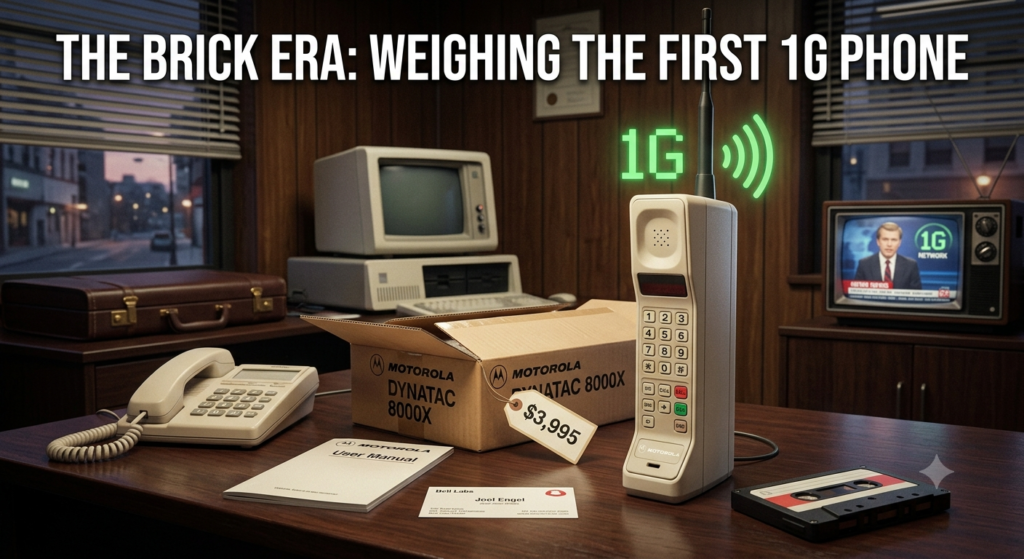
On April 3, 1973, a Motorola engineer named Martin Cooper walked down Sixth Avenue in New York City holding a gadget that looked like a cream-colored household brick with a rubber antenna. He pulled out the prototype, dialed the number of Joel Engel—his chief rival at Bell Labs—and said: “Joel, I’m calling you from a real cellular phone. A portable, handheld cellular phone.”
It took another decade of regulatory battles, network building, and hardware refinement before that prototype became a commercial reality. In 1983, the Motorola DynaTAC 8000X hit the consumer market.
Affectionately dubbed “The Brick,” the DynaTAC cost a staggering $3,995. That’s nearly $12,000 today when adjusted for inflation. It weighed over two pounds, required ten hours to charge, and offered a grand total of 30 minutes of talk time. Yet, executives and high society fell over themselves to buy it.
This era marked the birth of 1G (First Generation) wireless networks. 1G was completely analog. It was built purely for voice data, suffered from terrible audio quality, and had zero security. If you had an old-school radio scanner, you could easily tune into your neighbor’s frequencies and listen to their entire conversation.
3. The Digital Shift & Texting (2G): 1990s

The 1990s brought the digital revolution, changing how data moved through the air. The transition to 2G (Second Generation) networks relied on digital standards like GSM and CDMA. Digital signals meant clearer voice calls, tighter security encryption to prevent cloning, and drastically better battery efficiency.
Because internal components were shrinking, phones finally became pocket-sized. This decade birthed legendary industrial designs. Motorola dropped the StarTAC in 1996, introducing the world to the “flip phone” form factor. Meanwhile, Finland’s Nokia began its absolute domination of the global market.
Devices like the Nokia 3310 became cultural icons. If you ask anyone who grew up in that era, they’ll tell you the real obsession wasn’t just the indestructible plastic shell or the weeks-long battery life—it was trying to beat your high score in Snake.
       +-----------------------+
       |   THE 2G REVOLUTION   |
       +-----------------------+
                   |
     +-------------+-------------+
     |                           |
[Digital Signal]          [SMS Data Track]
     |                           |
Clearer audio              "Merry Christmas"
No eavesdropping            (First Text, 1992)
The real kicker of the 2G era was a secondary data channel originally meant for network notifications: Short Message Service (SMS). In December 1992, an engineer named Neil Papworth used his computer to send the message “Merry Christmas” to a colleague’s mobile phone in the UK.
No one predicted that texting would explode into a dominant form of human interaction. By forcing messages into a tight 160-character limit, SMS single-handedly invented a new era of linguistic shorthand (like “BRB” and “LOL”) and altered the social fabric of teenage life globally.
4. The Internet on the Go (3G): 2000s
By the turn of the millennium, voice and text were no longer enough. Consumers wanted the desktop web in their pockets. This demand ushered in 3G (Third Generation) networks, which used packet-switching technology to transmit internet data alongside traditional voice signals.
The early 2000s saw a sharp divide in the mobile landscape:
- The Business Elite: Research In Motion (RIM) captured the corporate world with the BlackBerry. Featuring a full physical QWERTY keyboard and secure push email, it became so addictive that users nicknamed it the “CrackBerry.”
- The Feature Phone Consumer: Everyday users rocked sleek, stylish devices focused on multimedia. Phones like the razor-thin Motorola Razr V3 became ultimate fashion statements, while Sony Ericsson Walkman phones turned your device into an MP3 player.
While 3G opened the door to the mobile web, the initial experience was painful. Browsing the internet meant looking at stripped-down, text-heavy “WAP” pages that resembled an old digital directory rather than the actual web. The world was waiting for hardware that could handle the true power of the internet.
5. The Modern Smartphone Explosion (4G): 2007–2019
On January 9, 2007, Steve Jobs took a stage in San Francisco and announced three revolutionary products: a widescreen iPod with touch controls, a revolutionary mobile phone, and a breakthrough internet communications device. He famously revealed, “These are not three separate devices. This is one device. And we are calling it iPhone.”
     STEVE JOBS' 2007 TRIFECTA
+---------------------------------+
|  [Touch iPod]  +  [Cell Phone]  |
|               +                 |
|  [Internet Communicator]        |
+---------------------------------+
                ||
                \/
       THE ORIGINAL IPHONE
The iPhone changed everything. No plastic keys, no cheap styluses—just a giant sheet of glass responsive to multi-touch gestures like pinching to zoom. While tech purists pointed out that it lacked 3G speeds and couldn’t even copy-and-paste text, the user experience shifted the industry overnight.
A year later, Google launched Android OS as an open-source platform. This allowed any hardware manufacturer—Samsung, HTC, LG, and Motorola—to build their own touch-screen smartphones. The intense competition completely crushed giants of the previous era; Symbian, BlackBerry, and Windows Phone slowly faded into obscurity.
Around 2010, 4G LTE networks rolled out. Providing true broadband speeds on the move, 4G transformed smartphones from mere communication tools into the bedrock of entirely new industries. High-speed mobile data gave rise to the App Economy, creating mega-platforms like Instagram, Uber, Snapchat, and Spotify. The phone was now your map, your bank, your camera, and your television.
6. Where We Are Now (5G and Foldables)
Today, the smartphone market has hit a plateau. The basic glass rectangle can only improve so much, forcing manufacturers to push boundaries using advanced network architecture and radical hardware designs.
The 5G Ecosystem
Modern flagship devices are powered by 5G networks. Moving beyond the simple video-streaming focus of 4G, 5G delivers ultra-low latency and enormous bandwidth. This network layer functions less like a cellular pipeline and more like an invisible cloud infrastructure, connecting billions of Internet of Things (IoT) devices, autonomous vehicles, and real-time cloud gaming engines instantly.
The Foldable Revolution
To break the monotony of the glass slab, display technology has taken a literal turn. Using flexible OLED screens and highly engineered liquid-metal hinges, devices can now fold open or shut.
| Form Factor | Primary Focus | Notable Examples |
| Book-Style Foldables | Multitasking, productivity, and massive screens that mimic small tablets. | Samsung Galaxy Z Fold, Google Pixel Fold, Vivo X Fold |
| Clamshell Flips | Ultra-portability, vintage nostalgia, and shrinking a modern screen into a pocket-friendly square. | Motorola Razr, Samsung Galaxy Z Flip |
The Silicon & AI Revolution
Inside modern devices, the real battle happens within the silicon. Current smartphones rely on sophisticated On-Device Artificial Intelligence. Mobile processors feature dedicated Neural Processing Units (NPUs) that execute generative AI models locally on the device.
Instead of relying on traditional optical lenses alone, modern mobile photography uses computational photography—where AI instantly fuses multiple exposures, cleans up low-light noise, and sharpens images to rival professional cameras.
7. The Anatomy: How a Cellphone Actually Works
To appreciate the modern smartphone, it helps to look beneath its glass and aluminum shell. A massive amount of engineering takes place every single second.
+-------------------------------------------------------------+
|                  INSIDE A MODERN SMARTPHONE                 |
+-------------------------------------------------------------+
| [System on a Chip (SoC)] ---> Brain: CPU / GPU / NPU         |
| [Cellular Modem]        ---> RF Translation to Digital Data |
| [Lithium-Ion Battery]   ---> Dense Chemical Power Storage   |
| [Sensor Suite]          ---> Gyroscope / Accelerometer      |
+-------------------------------------------------------------+
When you place a call or stream a video while riding in a car, your phone transmits data via radio waves to the nearest cell tower. As you speed down the highway, the network performs a precise technical dance known as a handoff. Before your current cell tower loses your signal, it coordinates with the next tower along your path to seamlessly transfer your connection without dropping a single packet of data.
Inside the device itself, several key components work in tandem:
- The System on a Chip (SoC): Unlike old desktop PCs that had separate components scattered across a motherboard, a smartphone packs its CPU, graphics card, RAM, and AI cores onto a single tiny square of silicon.
- The RF Modem: The device’s translator. It intercepts high-frequency radio waves from the air and converts them into 1s and 0s that your phone’s processor can read.
- The Lithium-Ion Battery: To keep devices incredibly thin, manufacturers use custom-shaped lithium-ion cells. These store massive amounts of energy under high pressure, managed by complex thermal chips to prevent overheating.
- The Sensor Suite: Tiny Micro-Electro-Mechanical Systems (MEMS) like gyroscopes and accelerometers track your phone’s position in 3D space, shifting screen orientation instantly and keeping your GPS maps pointed in the right direction.
8. The Global and Societal Impact
The proliferation of the mobile phone has changed the baseline of human behavior. It has fundamentally altered our attention spans, sleep hygiene, and social structures. Psychologists regularly study phenomena like nomophobia (the acute anxiety caused by being without your mobile device) and the dopamine-driven feedback loops built into social apps.
Yet, its economic and democratic impacts tell an incredibly positive story.
Skipping the Grid: In many developing nations across Africa and Asia, the mobile phone allowed communities to leapfrog traditional computing architecture entirely. Because installing copper landlines and distributing desktop PCs across rural areas was too expensive, the wireless smartphone became the primary gateway to the modern economy.
This leapfrog effect sparked massive economic empowerment. Platforms like Kenya’s M-Pesa popularized mobile money long before Apple Wallet or Google Pay were mainstream in the West. Suddenly, millions of unbanked citizens could transfer funds, run businesses, and secure lanes using basic cellular networks.
To top it off, smartphones transformed global politics through citizen journalism. With a high-definition video camera in every citizen’s pocket, institutional overreach, human rights violations, and breaking news events are broadcasted to the world in real time, bypassing centralized state media control entirely.
9. Environmental and Ethical Challenges
The immense scale of the smartphone industry comes with serious costs. Our global appetite for upgrades creates a troubling trail of ethical and environmental issues.
- The Supply Chain Nightmare: Modern electronics depend on rare earth minerals. The mining of cobalt and lithium—essential for long-lasting phone batteries—is frequently linked to severe human rights violations, child labor, and dangerous working conditions in places like the Democratic Republic of Congo.
- The E-Waste Mountain: Because consumers upgrade their phones every few years, humanity discards millions of tons of electronics annually. Toxic components like lead, mercury, and cadmium often wind up in landfills across developing nations, contaminating local water supplies and ecosystems.
- The Fight to Repair: For years, tech manufacturers built devices with glued-in batteries, proprietary screws, and software locks designed to block independent repair shops. This sparked the consumer-led Right to Repair movement, resulting in new legislation forcing companies to provide parts, tools, and manuals to everyday consumers to extend their devices’ lifespans.
The Future: What Comes After the Smartphone?

The smartphone will eventually fade away, replaced by technology that integrates even more naturally into our daily lives.
       THE ROAD AHEAD
+--------------------------+
|  Handheld Glass Slabs    |  (Present Day)
+--------------------------+
            ||
            \/
+--------------------------+
| Augmented Reality (AR)   |  (Smart Glasses / Contact Lenses)
+--------------------------+
            ||
            \/
+--------------------------+
| Brain-Computer Interface |  (Direct Thought Communication)
+--------------------------+
The most immediate successor is Augmented Reality (AR). As smart glasses become sleeker, lighter, and more socially acceptable, they will likely project our screens, directions, and messages directly onto our field of vision. When your glasses can display a transparent 80-inch television onto any empty wall, carrying a glass brick in your pocket will seem archaic.
Further out on the horizon lie true Brain-Computer Interfaces (BCIs). Early devices from pioneers like Neuralink show a future where neural implants could allow humans to browse data, send messages, or control virtual interfaces using thought alone.
No matter what form it takes next, the device in your pocket has already done its work. It permanently bridged the gap between human thought and the vast expanse of digital information, changing our species forever.