A History of How Food Shaped Humanity
Food is not just fuel; it is the ultimate architect of human civilization, biology, and culture. A few years ago, I found myself standing in a dimly lit cave in the Basque Country of Spain, staring at the charred remains of an ancient hearth buried beneath layers of sediment. It was a profoundly grounding moment.
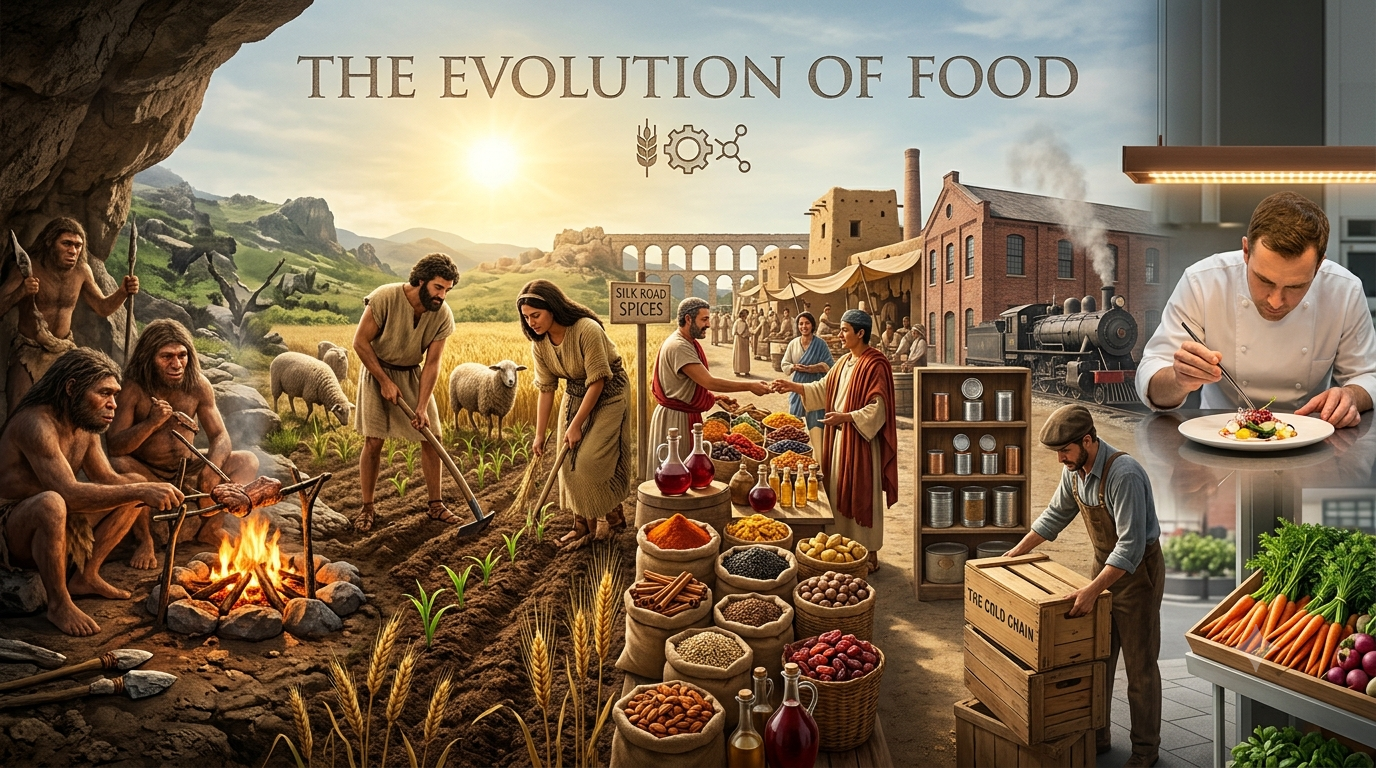
Long before food became a multi-billion dollar industry, an art form, or a daily choice we scroll through on a delivery app, it was the singular force dictating where we lived, how we evolved, and whether we survived. From that accidental spark of the first cooking fire to the sterile laboratories of modern cellular agriculture, our relationship with what we eat has undergone a series of radical revolutions.
Every bite we take today contains the echoes of these turning points—shifts that transformed humans from passive foragers into masters of the global ecosystem.
The Dawn of Flavor – Foraging and Fire (Prehistory–10,000 BCE)
To understand how food shaped us, we have to dismantle a modern myth: the idealized, uniform “Paleo diet.” The prehistoric human plate was not a standardized menu of lean wild game and pristine berries. Instead, our ancestors were opportunistic survivalists. Depending on the climate and the season, the hunter-gatherer diet varied wildly. In the coastal regions of South Africa, it meant harvesting nutrient-dense shellfish; in the Eurasian steppes, it meant tracking megafauna; and in tropical zones, it meant a heavy reliance on fibrous tubers, wild grains, and insects.
Then came the spark that changed our biology forever: fire.
+------------------------------------------------------------+
|                  THE COOKING HYPOTHESIS                    |
|                                                            |
|  Raw Diet                                    Cooked Diet   |
|  (Massive chewing,                           (Soft, dense  |
|  low energy yield)                           energy yield) |
|         |                                          |       |
|         v                                          v       |
|  Large jaws/gut                             Large brains   |
|  Small brains                               Small jaws/gut |
+------------------------------------------------------------+
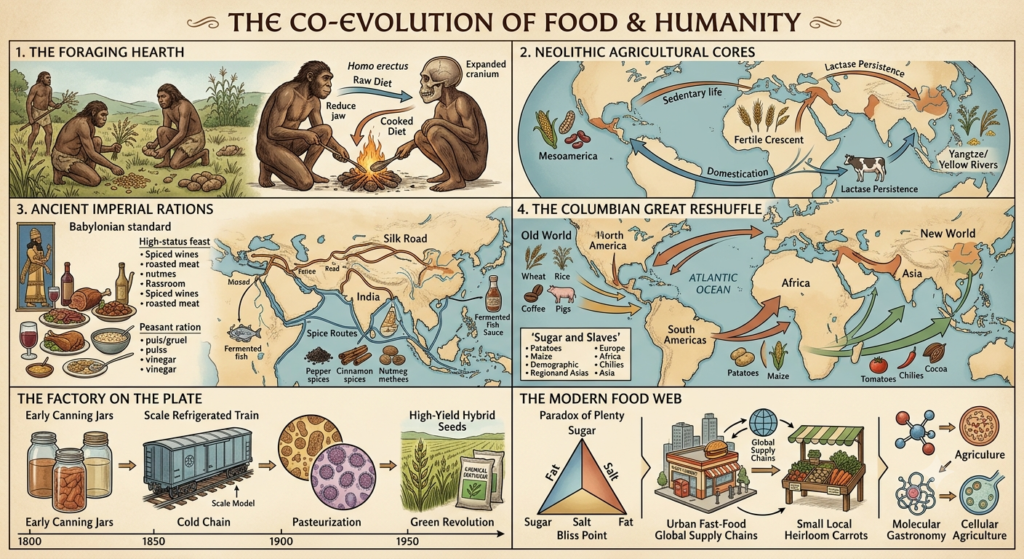
When Homo erectus harnessed fire roughly 1.9 million years ago, they did something no other species had ever done: they outsourced digestion. Cooking breaks down tough collagen fibers in meat, gelatinizes starches in root vegetables, and neutralizes deadly plant toxins. Because cooked food yields far more calories for far less physical effort, humans no longer needed massive, energy-hogging digestive tracts or heavy, bone-crushing jaws. Over millennia, our guts shrank, and that saved metabolic energy was redirected straight to the brain. We didn’t just cook food; cooked food literally built the modern human brain.
Beyond biology, fire created society. A raw diet required hours of solitary, rhythmic chewing. Fire required a hearth, and a hearth required waiting, gathering, and sharing. The campfires of our ancestors became the world’s first social networks—places where language, storytelling, and culture were born while waiting for dinner to cook. At the same time, the earliest roots of food preservation were taking hold. When a hunt was too successful to consume at once, humans noticed that strips of meat left near the smoke of the hearth didn’t spoil as quickly, or that meat buried in the subarctic tundra stayed fresh for weeks.
The First Revolution – The Birth of Agriculture (10,000 BCE–3,000 BCE)
Around 12,000 years ago, as the last Ice Age receded, humanity made a profound gamble. We stopped chasing our food and forced it to stay in one place. This transition, known as the Neolithic Revolution, occurred independently in several global hotspots: the Fertile Crescent of the Middle East, the Yangtze and Yellow River valleys in China, and Mesoamerica.
Nomadic freedom was traded for a sedentary existence tied to the cycles of three holy staples: wheat, rice, and maize.
               [ NEOLITHIC AGRICULTURAL CORES ]

      Mesoamerica             Fertile Crescent          Yangtze/Yellow Rivers
    (Maize, Beans)            (Wheat, Barley)               (Rice, Millet)
          |                          |                            |
          +--------------------------+----------------------------+
                                     |
                                     v
                        Sedentary Civilizations
                        & Animal Domestication
As humans settled, we also began rewriting the genetics of the animal kingdom. We shifted from hunting animals to herding them, domesticating sheep, goats, cattle, and pigs. This brought about a radical biological shift on our plates: dairy. Prior to agriculture, humans lost the ability to digest lactose (the sugar in milk) after weaning. But in populations that domesticated cattle—particularly in Northern Europe and parts of Africa—a genetic mutation flared up and stuck. Lactase persistence allowed adults to drink fresh milk, unlocking a continuous, life-saving source of protein and liquid fat that didn’t require killing the livestock.
However, the shift to farming was a double-edged sword. Historian Yuval Noah Harari famously argued that humans didn’t domesticate wheat; wheat domesticated us. The early farmers actually worked harder, had worse diets, and died younger than their hunter-gatherer ancestors. Instead of a vibrant, diverse diet of hundreds of wild plants and animals, humans suddenly relied on just a few crops. If the wheat crop failed due to drought or blight, an entire village starved. Furthermore, crowding people together next to animal pens created a playground for zoonotic diseases—like smallpox, measles, and influenza—which jumped from livestock to humans.
Our teeth tell the story: the skeletal remains of early farmers show a massive spike in dental decay and nutritional deficiencies (like anemia) compared to the robust bones of foragers. Yet, agriculture had one advantage that foraging never could: it produced a surplus of calories. And surplus calories meant population explosions.
The Empire of Spice and Grain – Antiquity to the Middle Ages (3,000 BCE–1450 CE)
With agricultural surpluses came the rise of the first great cities and empires. Food quickly evolved from a matter of personal survival into a tool of state control, bureaucracy, and intense social stratification.
In Ancient Egypt and Mesopotamia, food was currency. The state operated via massive royal granaries. Laborers who built the pyramids were not paid in gold; they were paid in daily rations of bread and beer. Food also became the ultimate divider of social class. While a Roman peasant subsisted on puls (a thick wheat gruel) and a splash of sour vinegar-wine, the elite indulged in legendary banquets featuring roasted dormice stuffed with minced pork, exotic flamingo tongues, and wines sweetened with honey and cooled with mountain snow.
+--------------------------------------------------------------+
|                     ANCIENT FOOD CLASS MATRIX                |
|                                                              |
|  ELITE:   Flamingo Tongues • Spiced Wines • Honey Concations  |
|  PEASANT: Wheat Gruel (Puls) • Salted Fish • Sour Vinegar    |
+--------------------------------------------------------------+
As empires grew, their appetites stretched across continents. The Silk Road and maritime spice routes weren’t built on a quest for gold, but on an obsession with flavor. Spices like black pepper, cinnamon, cloves, and nutmeg were worth their weight in gold. They were status symbols, medicines, and essential tools to mask the monotonous or slightly turned flavors of winter meats.
Because getting fresh food across empires was impossible, this era became the golden age of preservation science. Fermentation took off globally, not just as a way to get buzzed, but as a biological shield. The alcohol in wine and beer killed pathogens, making them safer to drink than raw city water. In Asia, Aspergillus molds were used to ferment soybeans into soy sauce and miso, preserving protein for months. In Europe, milk was transformed into aged cheeses, and cabbage was salted into sauerkraut to stave off scurvy during bitter winters. Salting, pickling, and air-drying became the technologies that kept armies marching and sailors alive.
The Great Reshuffle – The Columbian Exchange (1450–1800)
In 1492, Christopher Columbus’s landfall triggered what is arguably the most eco-shaking event in human history: the Columbian Exchange. For millions of years, the flora and fauna of the Old and New Worlds had been completely isolated. In a matter of decades, they collided and shuffled.
         [ THE COLUMBIAN EXCHANGE ]

     OLD WORLD                       NEW WORLD
  (Europe, Asia, Africa)          (The Americas)
         |                              |
         | --- Wheat, Rice, Coffee ---> |
         | --- Cattle, Pigs, Horses --> |
         |                              |
         | <--- Potatoes, Maize ------- |
         | <--- Tomatoes, Chilies ----- |
         v                              v
  Population Boom                 Ecological Shift
  & Culinary Rebirth              & Plantation Economy
Consider what global cuisines looked like before this moment: Italy had no tomatoes; Ireland had no potatoes; India and Thailand had no chili peppers; Switzerland had no chocolate; and the Americas had no coffee, wheat, or farm hogs.
I remember talking about this with my grandmother while watching her make her signature, intensely spicy Goan fish curry. Goa, on the western coast of India, is famous for its fiery food—yet every single chili pepper used in her kitchen traced its lineage back to Portuguese traders who brought them from South America in the 1500s. Before that, Indian cuisine relied on black pepper for heat. It blows my mind that the very identity of a culture’s food can be rewritten by a single maritime trade route.
The introduction of the humble American potato to Europe completely altered world history in a similar way. Potatoes grow underground, hidden from marching armies intent on burning grain fields, and they produce roughly three times the calories per acre compared to rye or wheat. When paired with milk, a diet of potatoes can sustain a human indefinitely. This sudden, massive influx of reliable calories put an end to the systemic famines that had plagued Europe for centuries, triggering a population boom that fueled the workforce of the upcoming Industrial Revolution. Meanwhile, in Asia, American sweet potatoes and maize allowed farmers to cultivate hilly terrains where rice couldn’t grow, sparking a parallel demographic surge in China.
But the Exchange had a deeply dark, extractive side. The European obsession with sugar, coffee, and tobacco—luxuries that required tropical climates—gave rise to the plantation system. Millions of enslaved Africans were violently trafficked across the Atlantic to clear forests and harvest sugarcane in the Caribbean and Brazil under brutal conditions. The global appetite for sweetness and stimulants was bought with human lives, permanently reshaping the demographics, politics, and ecology of the Americas.
The Factory on the Plate – Industrialization and Science (1800–1950)
By the 19th century, humanity was moving en masse into smoking, crowded industrial cities. People were no longer living next to the fields that fed them. For the first time in history, the distance between the farm and the fork spanned hundreds, sometimes thousands, of miles. Science had to step in to defeat the natural clock of decay.
The first major breakthrough came from a desperate military need. In 1795, Napoleon Bonaparte offered a hefty prize to anyone who could invent a way to preserve food for his far-flung armies. A confectioner named Nicolas Appert won it by discovering that sealing food in glass jars and boiling them kept the food from spoiling. A few years later, Peter Durand patented the use of tin cans. Though neither man fully understood why it worked, they had invented canning. It wasn’t until Louis Pasteur discovered microbes in the 1860s that humanity finally understood the invisible enemy: bacteria. Pasteurization soon followed, turning milk from a frequent vector for tuberculosis and typhoid into a safe, shelf-stable staple.
       [ TIMELINE OF THE INDUSTRIAL COLD REVOLUTION ]

  1810s ─────────────────── 1870s ─────────────────── 1940s
  Canning Patented         Mechanical             Green Revolution
  (Appert & Durand)        Refrigeration          Chemical Fertilizers
                           (The Cold Chain)       & Hybrid Seeds
The next leap was the creation of the artificial “cold chain.” In the late 19th century, mechanical refrigeration units were installed in ships, trains, and massive warehouses. Suddenly, cattle raised on the vast pampas of Argentina or the plains of Texas could be slaughtered, chilled, and shipped across the Atlantic to dinner plates in London without spoiling. Seasonality began to dissolve.
Then came the mid-20th century, and with it, the Green Revolution. Led by scientists like Norman Borlaug, agriculture turned into a high-tech branch of chemistry. The development of synthetic nitrogen fertilizers (via the Haber-Bosch process) along with high-yielding, disease-resistant hybrid seeds allowed global crop yields to skyrocket. We learned to produce massive gluts of grain. Agriculture became an industry of heavy machinery, monoculture, and chemical inputs, effectively decoupling the human population capacity from the natural constraints of the soil.
The Modern Diet – Convenience, Chemistry, and Critique (1950–Present)
Today, we live in the world that the industrial food complex built. The post-WWII era heralded the rise of ultra-processed food. Food scientists cracked the code of the “bliss point”—the exact mathematical combination of sugar, salt, and fat that overrides human satiety signals and keeps us eating. High-fructose corn syrup, born out of massive domestic corn surpluses, found its way into everything from soda to bread.
           THE "BLISS POINT" EMULSION

                 / \     / \
                /   \___/   \
               |   SUGAR     |
               |  (Energy)   |
                \     ___   /
                 \   /   \ /
                  \ / FAT \
                   | (Density)
                  / \     / \
                 /   \___/   \
                |    SALT     |
                | (Electrolyte|
                 \           /
                  \_________/
Convenience became the ultimate metric. TV dinners, fast-food drive-thrus, and powdered mixes promised to liberate the modern worker from the kitchen. The modern supermarket emerged—a surreal temple of abundance where strawberries are available in dead winter, and thousands of products line the aisles, neatly stripped of any visual connection to the dirt, sweat, or animals they came from.
I used to think this hyper-efficiency was an unmitigated triumph, until I spent a week working on a small organic permaculture farm in Vermont. Pulling heirloom carrots out of the damp, freezing October earth, washing off the grit, and eating them raw gave me a completely different understanding of flavor. They tasted complex—woody, intensely sweet, and slightly bitter. It made me realize that the uniform, perfectly clean carrots wrapped in plastic at my local grocery store had been systematically bred for shelf-life and transport, not for soul.
This hyper-industrialization has sparked a deep cultural and health crisis. For the first time in human history, global diseases of nutritional excess—like type 2 diabetes, obesity, and cardiovascular disease—outpace illnesses caused by caloric scarcity.
In response, a powerful counter-culture has bloomed. Over the last few decades, the farm-to-table movement, the demand for organic labeling, a resurgence of localism, and a fascination with ancestral fermentations (from sourdough to kombucha) have swept through the culinary world. People are actively trying to reconnect with the ancestral rhythms of eating. Concurrently, food has reached its peak as a medium for artistic abstraction. Chefs utilizing molecular gastronomy have turned dining into sensory illusions—using gelling agents, liquid nitrogen, and centrifuges to transform a familiar flavor like “bacon and eggs” into a delicate warm foam or a frozen sphere.
Where Do We Eat From Here?
When we step back and trace this lineage, a stark paradox emerges. We are currently living in an era of unprecedented culinary abundance, yet our food system is facing a fragile crossroads. Agriculture is one of the leading drivers of deforestation, biodiversity loss, and greenhouse gas emissions.
As we look toward the future, the next food revolution is already brewing. We are seeing the rise of vertical indoor farming that uses 95% less water, the commercialization of cellular agriculture producing real meat grown from animal cells without the slaughterhouse, and personalized nutrition plans based on our unique gut microbiomes.
Ultimately, history shows us that whenever we change what we eat, we change who we are. From the first Australopithecus pulling a charred tuber from the embers of a wildfire to a modern scientist sequencing the genome of a perennial grain, our plates have always been a mirror of our technology, our values, and our survival. What we choose to put on that plate next will determine not just our health, but the fate of the planet itself.